

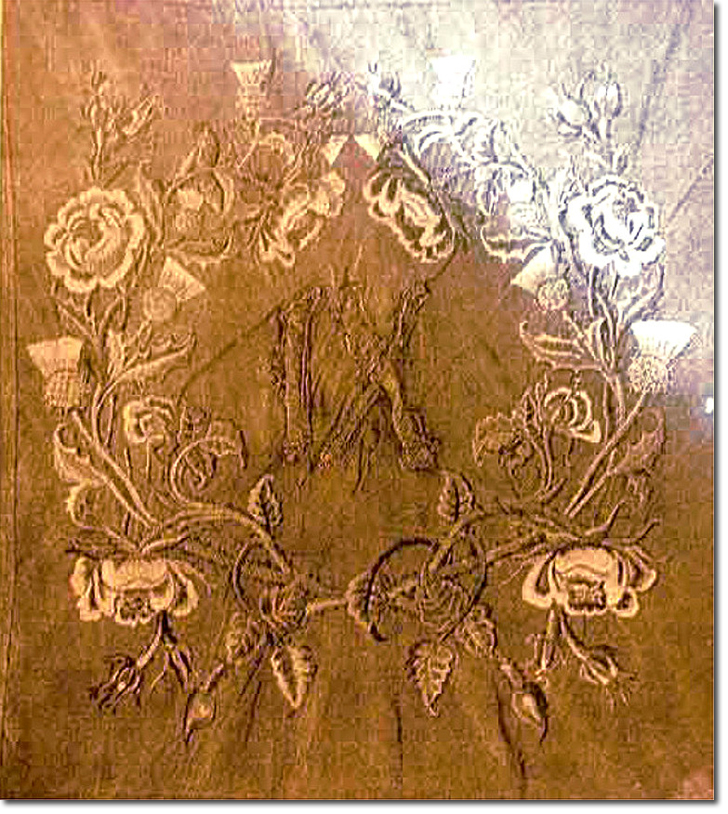
This central Union wreath of roses and thistles surrounds the Roman numerals IX. The photo is in monochrome so does not tell us the colour of the silk flag but by 1757 it would have been yellow. The regiment’s facings were green up until 1733 and light orange until 1747 when they were described as yellow. The flag itself would have been 6 foot 6 inches flying by 6 foot 2 inches on the pike. The pike was 9 foot 10 inches tall.
The Act of Union in 1707 combined the two crosses of St Andrew and St George to make the first Union Flag which was used by lieutenant-colonels and majors throughout the whole Colour. During the reign of William III (1689 - 1702) the number of Colours per battalion was reduced to three; the colonel, lieutenant-colonel and major. Captains no longer carried Colours except in the Guards regiments. The Colonel’s Colour had a small Union flag in the top corner and their personal device in the centre of the Colour. But in 1747 new regulations authorised only two Colours per regiment or battalion, the First being the King’s Colour, a Union Flag, and the Second Colour, later called the Regimental Colour, being made, in the 9th Foot, of yellow silk with the small Union flag in the corner. The personal devices of Colonels were no longer permitted, so a regimental badge, or in most cases, a Roman numeral was displayed. The regiment did not have the Britannia badge until the 1780s (officially 1799).
This centerpiece may have been transferred to the New Colours received in 1772. The image is courtesy of ‘British Infantry Colours 1747-1800’ at https://www.62ndregiment.org/colours.htm

