

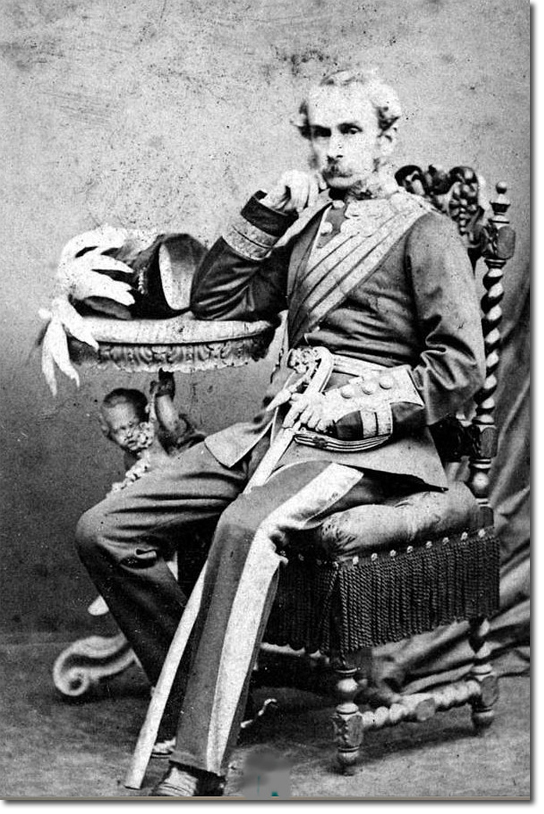
Henry Bates was born in 1813, the son of an officer in the Royal Marines. He was educated at Charterhouse and joined the army as an ensign in the 38th (or 1st Staffordshire) Regiment on 9 July 1829. In 1836 he exchanged to the 82nd (Prince of Wales’s Volunteers) and spent 3 years in the West Indies on the staff of Lt-General Samuel Ford Whittigham. In 1853 he exchanged to the 98th (The Prince of Wales’s) Regiment and spent 21 years in India as a staff officer. He was ADC to Sir Robert Henry Dick who was killed at Sobraon in 1846. He was also ADC to Sir Hugh Gough, Commander-in-Chief in India. He served in the Punjab Campaign 1848-49 and was present at Ramnuggur, the Passage of the Chenab, Chillianwallah and Goojerat.
Colonel Bates was Military Secretary to Lord Elphinstone, Governor of Bombay during the Indian Mutiny. In 1863 he was promoted to major-general and commanded a brigade at Aldershot. He was then appointed GOC Cork District during the Fenian Rising in 1866, and received the thanks of the Irish Government for his services. The following list of General Bates’s progress in the military contains an anomaly; he was promoted to colonel in 1854 and lieutenant-colonel in 1857. The usual progression is lieutenant-colonel then colonel. This oddity is repeated in every army list that I have checked between 1861 and 1889.
1829 Ensign 38th Foot 9 July
1833 Lieutenant 28 Nov
1836 transferred to the 82nd Regiment
1845 Captain 8 Aug
1846 Brevet Major 19 Jun
1849 Brevet Lieutenant-Colonel 7 Jun
1853 exchanged to the 98th Regiment, Major 11 Oct
1854 Colonel 28 Nov
1857 Lieutenant-Colonel 18 Sep
1863 Major-General 9 Oct
1871 Colonel of 9th East Norfolks 31 Dec
1872 Lieutenant-General 8 Mar
1873 Appointed Companion of the Order of the Bath (CB)
1877 General 1 Oct
1881 Retired from the army.
1889 Colonel of the Prince of Wales’s Volunteers (South Lancs)
1893 Died in London 2 March.

