

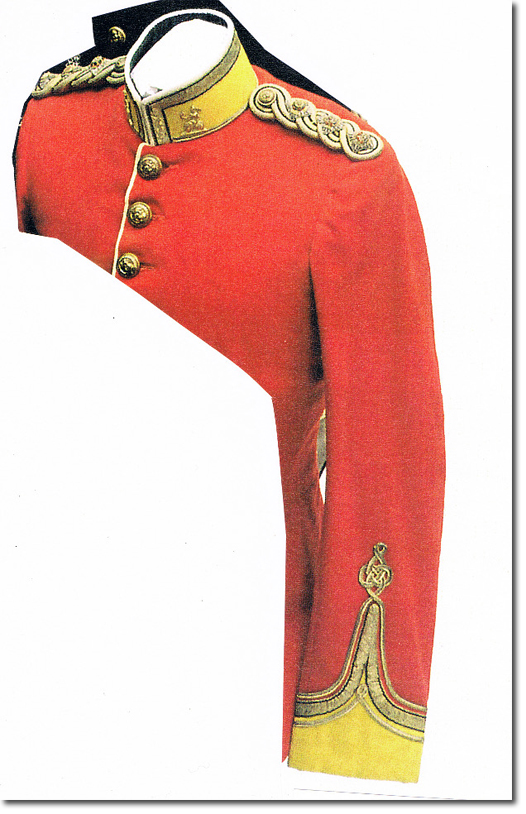
This cutting from an auction catalogue shows the salient points of the dress tunic worn by officers of the Norfolk Regiment after 1902, incorporating the yellow facings which were revived for the regiment in 1905.
The gold lace on the collar and sleeve have black edges. Black lines can also be seen in the twisted gold shoulder cords. This was a distinction gained by the 1st Battalion in 1881 to commemorate their involvement in the Peninsula War in 1809. The 9th Foot formed the extreme rearguard covering the embarkation of British troops at Corunna, following the disastrous retreat from Spain in the winter of 1808-09. Sir John Moore was in command of the army in this retreat, and the battle of Corunna on 16 Jan 1809. He was mortally wounded and died that evening. When he was buried the next day. His grave was dug by a fatigue party of the 9th Foot and the regiment attended his laying to rest. The History of the Regiment says this:
'Eight regiments (Norfolk, Somerset LI, East Yorks, Leicestershire, East Surrey, Loyal North Lancs, York and Lancaster, and the Connaught Rangers) were authorised to wear two black lines on the margins of the officers’ gold lace…. The Leicestershire Regiment claim theirs as being a sign of mourning for Wolfe. In the case of the Norfolk Regiment these two black lines date back to the regulation of 1768. The drummers of the Norfolk Regiment had, at any rate, from 1859 to 1871, worn also a central black line in their lace which, it is claimed, was in memory of the presence of part of the regiment at the funeral of Sir John Moore in 1809…the following letter sanctions the black line for officers’ gold lace:
“Horse Guards
“8th July, 1881
“Her Majesty has been graciously pleased to approve of the officers of the Norfolk Regiment wearing a black line in their lace, in consideration of the part taken by the late 9th Foot at the burial of Sir John Moore.”
The tunic has three stars (pips) on the shoulder cords which, after 1902, denoted the rank of captain. The 1902 Dress Regulations also simplified the lace and braid on the tunic so that all officer ranks had the same pattern on the collars and cuffs. Prior to 1902 the cuffs of a captain would have had two rows of gold lace.
This tunic was the property of Captain George Barons Northcote (1884 - 1915). He was educated at Marlborough and King’s College, London. He joined the 2nd Battalion on 16 Aug 1905 and gained the rank of captain on 9 April 1913. He was severely wounded in Mesopotamia and died on 4 December 1915

