

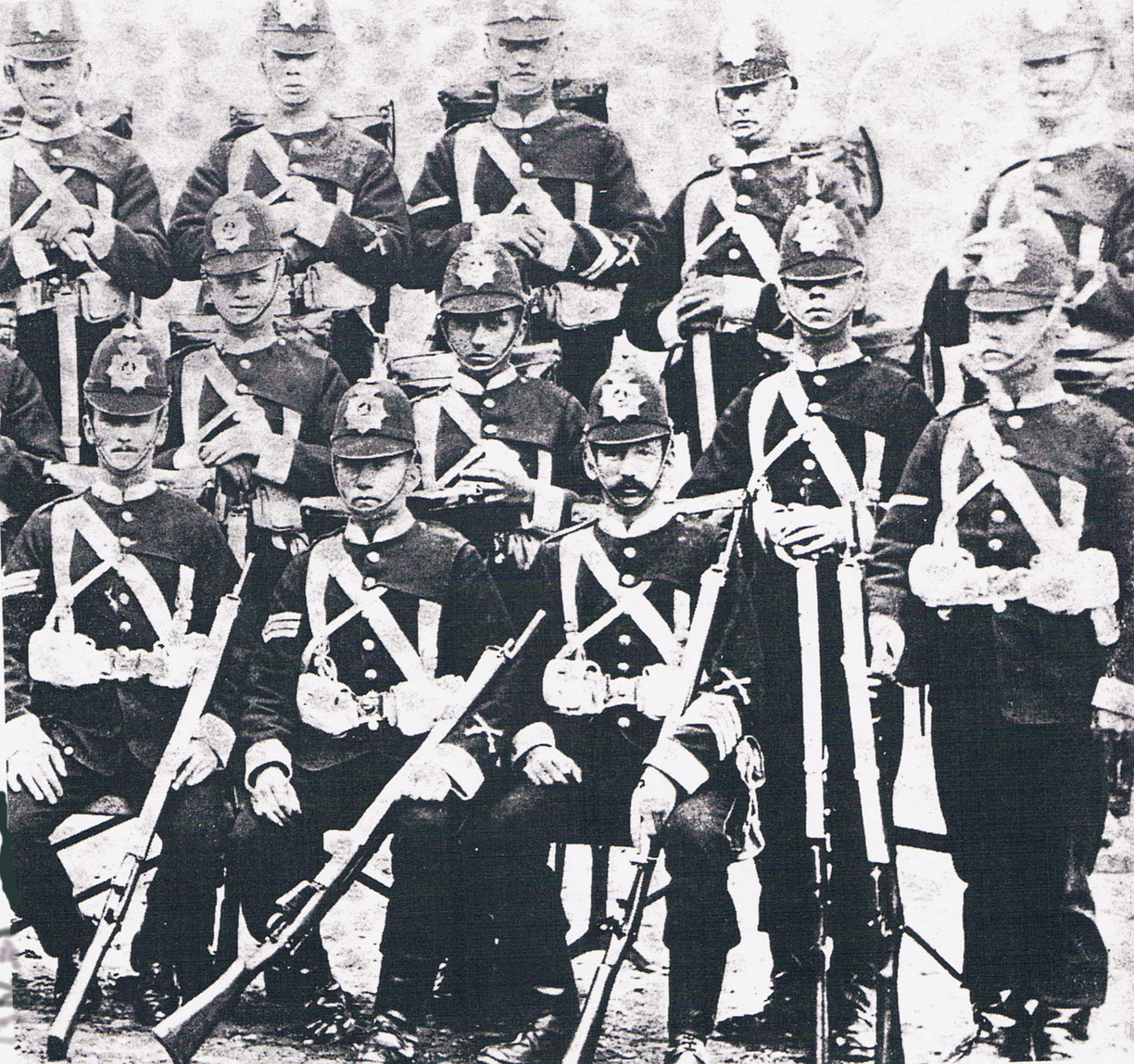
This group are dressed in scarlet serge frock tunics that look very similar to dress tunics but do not have white piping down the front edge. They are fastened with seven buttons whereas similar frocks worn in hot climates had five buttons.They also have a patch of scarlet cloth on the left shoulder which covers the white straps of their equipment to prevent the rifle from rubbing against the straps while being carried at the slope. The rifles are Lee Metfords, issued between 1888 and 1895. They are recognisable as they have magazines and the rifle sling is attached just above the magazine.
The frock tunic had a white collar and white round cuffs, and collar badges are just about visible in some cases. The three seated at the front have chevron stripes; two are sergeants with three gold stripes on their upper right arm, while the third has four white good conduct stripes on his left forearm. These denote that he had served at least 18 years and probably more than 20. He would have earned a fifth stripe after 23 years. A lance-corporal at the back has two good conduct stripes for at least 6 years service. He and some of the others have white musketry proficiency badges of crossed rifles on their left forearm.
The equipment they carry shows that they are in marching order. They have Slade Wallace equipment which was introduced in 1888. This had fewer straps than the previous 1882 equipment, and the valise was worn higher on the shoulders so that the top was visible when viewed from the front. A rolled greatcoat was carried at waist level. The straps crossing on their chest are, a slim strap for the circular water bottle, and a canvas strap for the haversack, which, judging from the man standing on the right, was neatly folded in this case.
The blue home service helmet has a rounded front peak and the Britannia badge can be seen in the centre of the star plate on the front. Their trousers are tucked into black gaiters. Boots and gaiters are clean and shiny, suggesting that these men are preparing to march rather than having just arrived. In the 1890s the second battalion of the Norfolk Regiment was serving in England while the 1st Battalion was in India, so this photo is most likely to show men of the 2nd Battalion.
Regimental Details | Uniforms

