

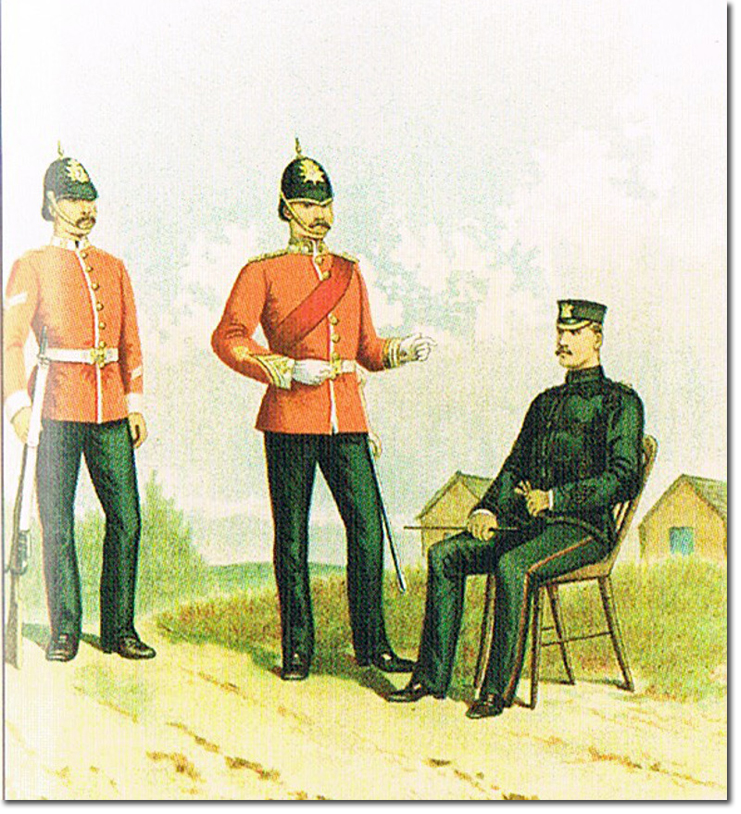
The Cardwell Reforms obliged infantry regiments to conform to a change of facings colour which was intended to be more economical but which removed regimental distinction. So the traditional yellow facings were changed in 1881 from yellow to white, the colour adopted by all non-royal English regiments. Most regiments managed to revert back to their former coloured facings before dress uniform was put aside in 1914, and the Norfolk Regiment (as it was called from 1881) reverted back to yellow facings in April 1905.
The corporal on the left, wears the dress tunic with plain round white cuffs and white collar. The shoulder straps were scarlet and had NORFOLK embroidered in white, in a curve. The tunic fastened with seven buttons and had white piping down the front and on the back skirts. There was no piping on the collar, cuffs, or shoulder straps. He has two white rank stripes on his right arm and two good conduct stripes on his left forearm. These good conduct badges were moved from the right to the left forearm in 1881. An Army Circular of May 1885 authorised this list:
2 years good conduct — one stripe
6 years good conduct — 2 stripes
12 years good conduct — 3 stripes
18 years good conduct — 4 stripes
23 years good conduct — 5 stripes
28 years good conduct — 6 stripes
The central figure is a lieutenant in dress uniform, also with white facings. His cuffs are pointed and edged with gold lace and braid in the same manner as the 1868 pattern tunic. His collar is edged with white piping and has gold lace along the top and front edge. An embroidered Britannia badge is sewn on each side. Rank badges for officers were worn on the gold cord plaited shoulder straps as from 1881. From that year the system of rank changed so that lieutenants had one star (no badge for second-lieutenants). The lieutenant and the corporal wear the home service blue cloth-covered helmet adopted in 1878, but they were different in quality, notably the front peak, which for the corporal is more rounded and not edged with gilt metal.
The seated officer wears undress uniform which consists of a blue patrol jacket that has four rows of black silk cord across the front, described in the 1891 Dress Regulations as quarter inch flat plait with double drop loops. The jacket is edged with flat black mohair, one inch wide. It was fastened with hooks and eyes, but there were also black silk netted olivets to link the flat plait cording. The cuffs were decorated with Austrian knots of flat plait. The flat plait was also on the back seams of the jacket with crow’s feet loops top and bottom and two double loops at equal distance along its length. The shoulder straps were edged with flat black braid and had gilt rank badges. He has an undress forage cap and dress trousers.
This reproduction is from Richard Simkin’s series of chromolithograph Military Types published in the Army and Navy Gazette. This is no.49 out of 112, published on 2 Jan 1892.

