

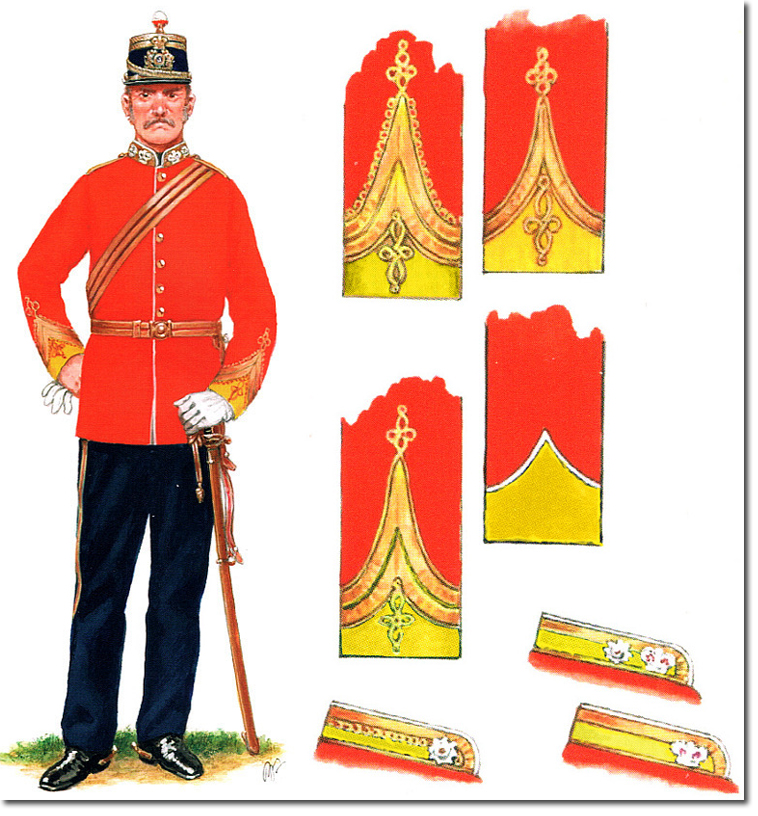
The officer shown here has the rank of colonel and wears the 1868 pattern tunic which has pointed cuffs instead of the slash flap style of the previous pattern. His rank is denoted on each side of the collar; embroidered crown and star. The gold lace and braid on the cuffs are a further indication of his rank (also that of lieutenant-colonels); two rows of lace edged with Russia braid formed in small circles, finished off with figuring above and below. The sleeves shown on the right demonstrate the way that four other officer ranks were displayed. Top left is a major’s cuff which has the circular braid on the top edge only. Below left is a captain’s cuff with no circular braid. Top right is a lieutenant’s cuff with only one row of gold lace.
The lower right cuff is that of a sub-lieutenant. That rank replaced the rank of ensign in 1871, and the 1868 dress regulations stated that there should be no gold lace or braid on their dress tunic. However, the rank was shown on the plain unlaced collar; an embroidered star on each side. The collars of three other officer ranks are shown below the cuffs; on the left is a major’s collar, with gold lace along the top and front, and circular braid below the lace. This was the style for all field officers. On the right is a captain’s collar with no circular braid, but having crown and star embroidered badges. Below that is a lieutenant’s collar with a crown only.
The figure of the colonel shows him in full dress. The gold and crimson sash on his left shoulder was worn on State occasions and balls. On other occasions a plain crimson silk sash was worn on duty. The waist-belt is also for full dress occasions only. Normally a white leather belt was worn. The brass sword scabbard was for field officers only. Captains and below had steel scabbards. The shako is the 1869-78 final pattern. The two rows of gold lace around the top were worn by colonels and lieutenant-colonels. The colonel wears spurs as he was one of the few regimental officers to be mounted on parade and on the march. Around 1871 trousers for mounted officers were replaced by breeches and knee boots.
The illustrations are adapted from Bryan Fosten’s bookletThe British Infantry Tunic 1855-1914 (Military Historical Society 2023)

