

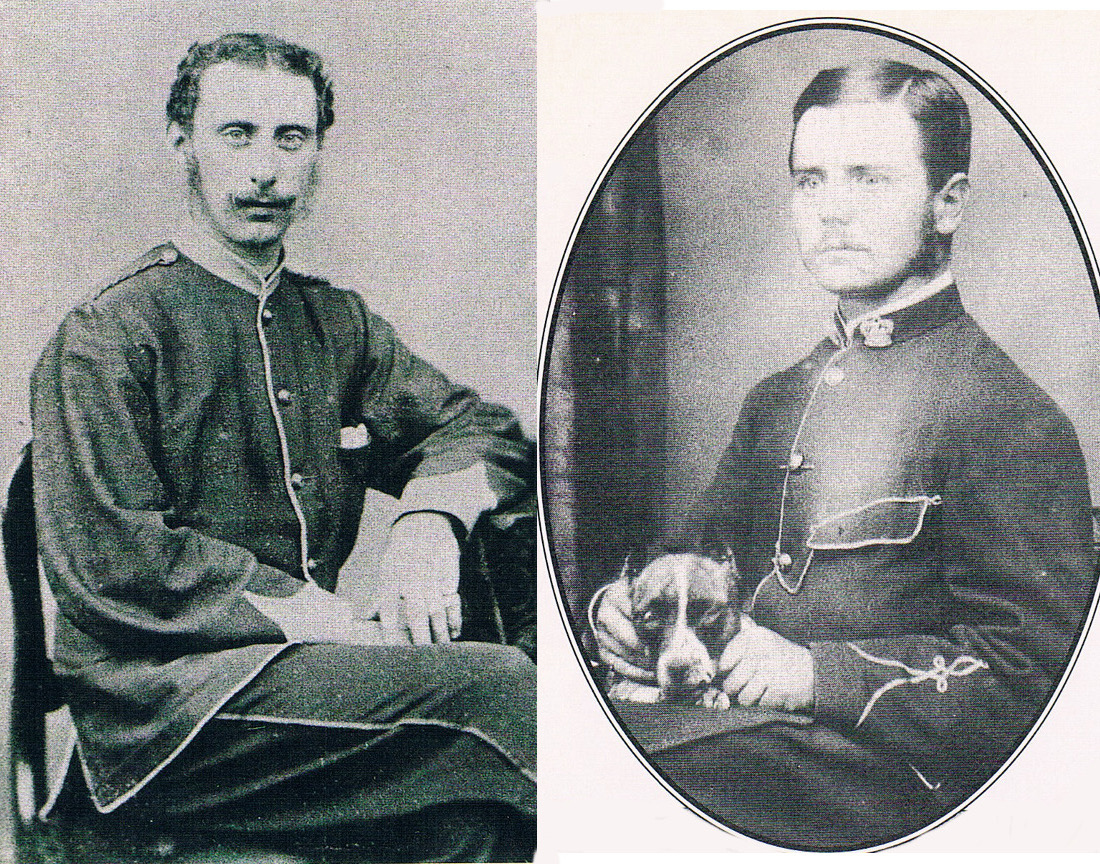
These two photos were taken at some time in the 1860s, showing different patterns of the hot climate frock. Although these garments are described as India frocks, the 9th did not serve in India in the 1860s. The 1st Battalion was sent from England to the Ionian Islands (including Corfu and Kefalonia) in 1860. In 1864 they moved to Gibraltar, then the next year went to Cape Colony. In 1870 they were in Ireland. The 2nd Battalion was raised in 1857 and also went to Corfu, in 1858, and in 1864 sailed to China and then on to Japan in 1866. They returned to the UK in 1868.
The left-hand photo of an unknown officer is taken from Military Modelling magazine (2002). The photographic process in this case shows up the yellow collar and pointed cuffs against the scarlet of the frock. It is edged with white piping and fastens down the front with five gilt buttons. One breast pocket can just be seen on his left side, and the shoulders have twisted red cords on both sides. This garment is one of the earliest India frocks c1861. At least one photo taken around this time shows an officer wearing a loose-fitting white frock.
The right-hand photo is from Regiment magazine Feb/Mar 1997 and shows Lieutenant Thomas Farley who was an ensign in the 1st Battalion from Oct 1861, promoted to lieutenant on 22 Sep 1865. The crown on his collar shows his rank as lieutenant so the photo is post-1865. The film emulsion shows the collar and cuffs as dark, indistinguishable from the scarlet frock. The figuring on his cuff is gold braid and this braid also edges the front and the collar. The breast pocket has a flap also edged in gold.
Regimental Details | Uniforms

