

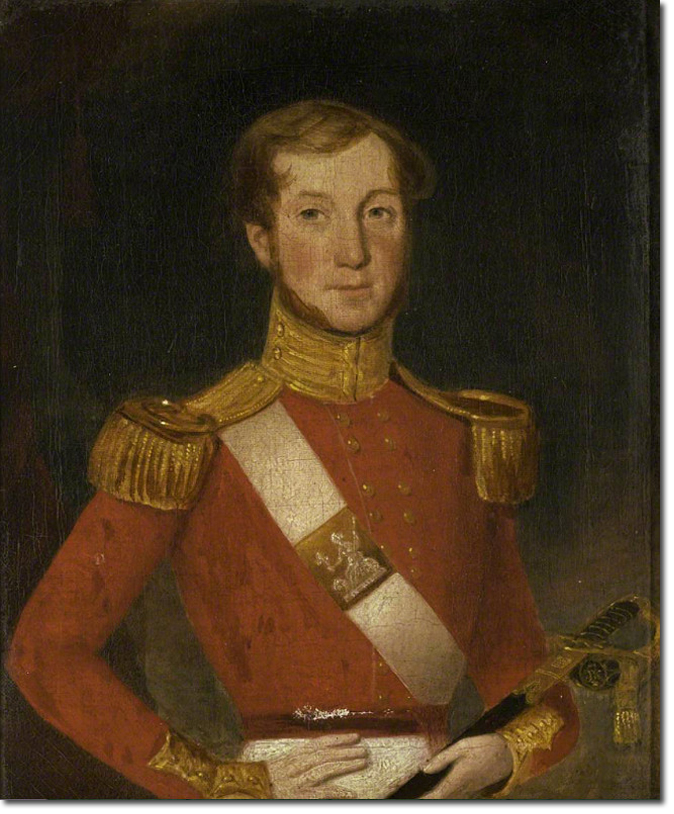
In 1830 the uniform of infantry officers of the regular army was ordered to have only gold lace. This meant that officers of the 9th (East Norfolk) Regiment were obliged to change their silver buttons and epaulettes for gilt buttons and gold bullion epaulettes. The fringed epaulettes worn by this lieutenant indicate that he was a battalion company officer. From 1828 epaulettes were worn on both shoulders by officers of all ranks. The collar and cuffs have rich coverings of gold lace so that the yellow facings could only be seen on the round cuff and the back of the collar. The cuff had a scarlet slash flap covered in gold lace and four gilt buttons. There were also two buttons on each side of the collar.
The change to gold also meant that the shoulder-belt plate was burnished gilt, but the figure of Britannia remained as silver. The lower part of the portrait shows that the officer is wearing white trousers which were worn in the summer months (1 May - 14 October). The crimson silk sash of office is tied around his waist leaving the fringed ends on the left side. He holds his sword which is in a scabbard bound in black leather with gilt mountings. The sword knot wrapped around the half-basket hilt is gold and crimson with a gold bullion fringe.
The portrait comes from the National Army Museum Online Collection. The officer is named as Lieutenant John Spring who joined the regiment as an ensign on 19 Feb 1829, promoted to lieutenant on 12 Sep 1834. It is thought that he died of cholera in India in 1837.

