

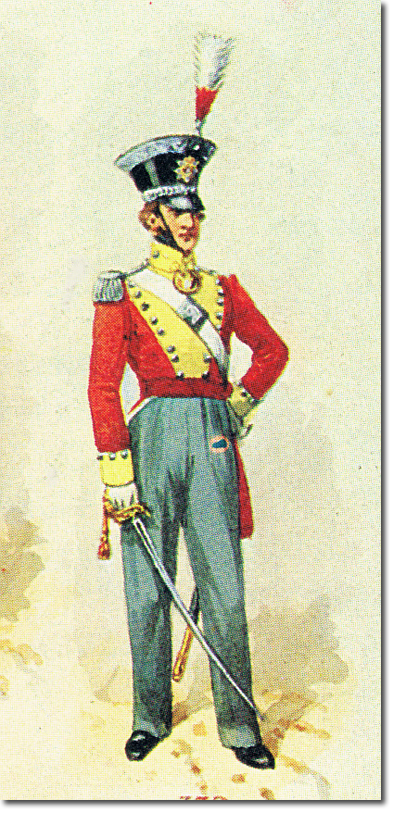
The officer in this Simkin illustration wears dress uniform. However, there was probably little opportunity to wear this during the early 1820s as the 9th East Norfolks were posted to the West Indies from 1819 to December 1826. The following year they were stationed in Plymouth and in October 1827 went to the north of England. The coatee was scarlet with yellow facings and silver buttons and epaulette. Silver was also to be found on the shako which by this time had reached a height of 8 inches. The 1822 Dress Regulations were the first detailed instructions for officers:
‘Coatee — scarlet; the colour of lappels, cuff. and collar according to established uniform of each regiment; Prussian collar full three inches deep, with a loop and small button at each end; straight lappels, buttoned back to ten large regimental buttons, with loops, occupying two thirds of space from outward edge to front seam of armhole, tapering to two inches and a half at bottom, closing in front with hooks and eyes; cuffs three inches and a half deep, with four loops and buttons on each; four short loops on the back; coatee skirts with cross flaps, four loops and buttons on each; white kerseymere turn-backs;— regimental skirt ornaments.
‘Regiments authorized to wear lace, are to be laced on the turn-backs, and backskirts, as well as the above loops; regiments not authorized to wear lace, have the loops of twist. The distinction peculiar to regiments of having their loops either by pairs or regular to be preserved.
‘Epaulette—gold, or silver, lace strap two inches and a half wide, with a broad, and two narrow, beadings round the edges; embroidered crescent; two rows bright bullions three inches long. Field officers wear a pair of epaulettes, rank distinguished according to the Regulations contained in page 102 [ rank badges star for a major & crown for a lieut-colonel]: the Adjutant wears, in addition to epaulette, a strap, similar to that of epaulette, on the left shoulder. Officers of flank companies wear wings according to the established regimental pattern.’

