

The word ‘ensign’ is a heraldic term for the armorial design carried by a body of troops, but in the infantry this was known as a Colour. The officer assigned to the task of carrying the Colour was chosen from the lowest ranking officers who held the rank of ensign. This rank was discontinued c1870 and re-named sub-lieutenant.
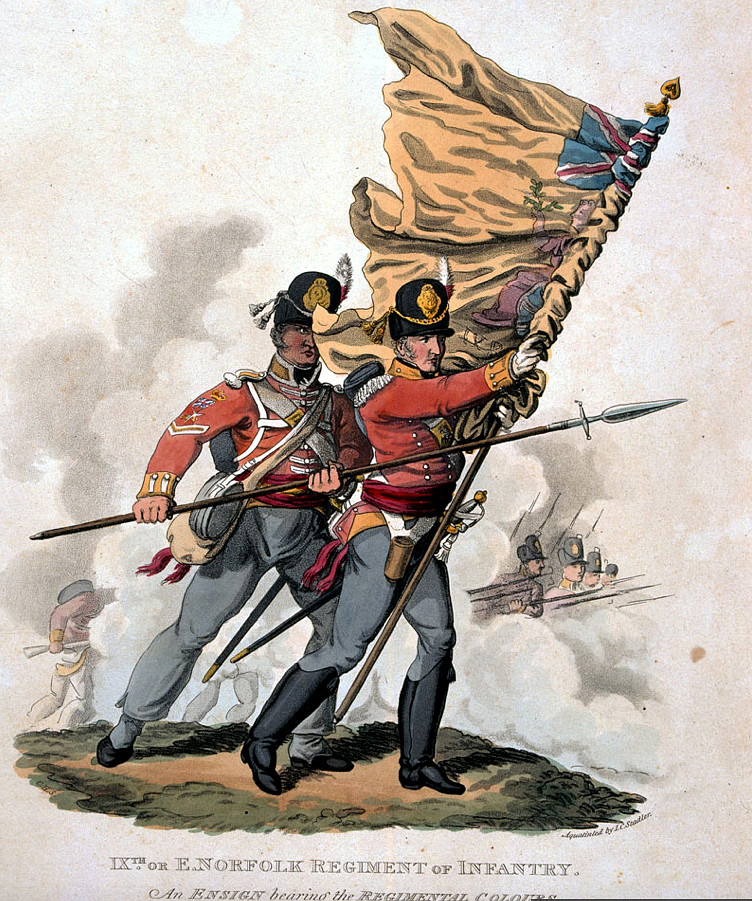
This print was drawn by Charles Hamilton Smith and aquatinted by I C Stadler, dated 1 Dec 1813. It was 33rd in a series of 60 prints depicting ‘Costume of the Army of the British Empire according to the Last Regulations 1812’. The ensign’s jacket has yellow facings and silver buttons and epaulette. The tails are short and have turn-backs (should be white) and false pocket flaps. The crimson sash of office round his waist secures the Colour-belt as well as his sword-belt. He has grey breeches and knee boots although in a battle situation he would wear grey overalls. The Regimental Colour that he holds is yellow with the figure of Britannia in the centre and a small Union flag in the top corner.
He is closely protected by the Colour Sergeant who is armed with a pike. His jacket is decorated with white lace, distinguishing senior NCOs from the rank-and-file who had regimental patterned lace, which consisted of two thin black lines along its length. The rank badge on his right arm is carefully drawn because it was new to the British infantry, introduced in 1813. The single stripe is superscribed with a single Union flag that has crossed swords on the staff and a crown above. This arm badge lasted until c1870 when it was changed to three stripes and two crossed flags. The Colour Sergeant also has a sword carried in a scabbard attached to his shoulder-belt. He has a valise on his back and a haversack and water-bottle slung on his left shoulder. The sash of office around his waist is crimson with a yellow stripe along its length, although this is partly obscured by the pike.
Both officer and NCO wear the 1812 pattern shako with battalion-company white-over-red plumes on the left side. The badges on the front are universal brass plates, but other sources show that the 9th (East Norfolk) Regiment was distinguished by having a silver or white metal figure of Britannia on the front of the shako.
Regimental Details | Uniforms

