

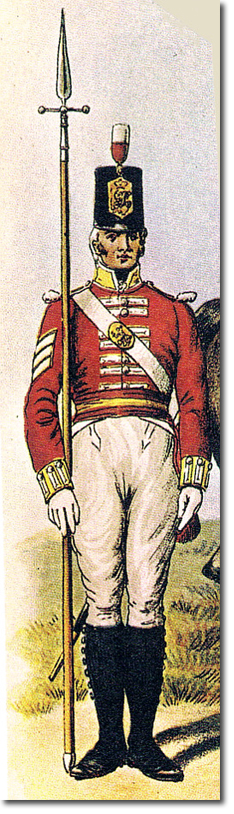
The infantry jacket of the early 19th century had become fully closed down the front so that waistcoats were unnecessary. For other ranks the lapels were not exposed as they were for officers. The yellow facings were confined to the high stand collar and the cuffs. The buttonhole lace decorated the front of the jacket and the cuffs. There was also lace on the false pocket flaps on the rear of the jacket. Sergeants had plain white lace while the rank-and-file had regimental pattern lace which was still two thin black lines as introduced in 1768. Sergeants were distinguished by chevrons on the right arm and a crimson sash tied round the waist. This has a central stripe of the facing colour, which for the 9th was yellow.
The bicorne hat was replaced at the turn of the century by a stove-pipe shako that had a white over red plume on the front. The shako plate was die-struck brass. For most regiments it was of universal pattern but those regiments that had a special badge were permitted to display them inside the central garter strap. It is not clear if the 9th had the Britannia badge in the centre.
This sergeant has only one shoulder belt, to support his sword. The rank-and-file had a belt on each shoulder; the one on the left shoulder supported a black ammunition pouch. Sergeants were armed with a pike and so did not need the ammunition pouch. His sword-belt has a brass belt-plate with the figure of Britannia. The nether-wear had not changed from 1792; white breeches and black knee-length gaiters. These were confined to parades; overalls were worn on campaign.

