

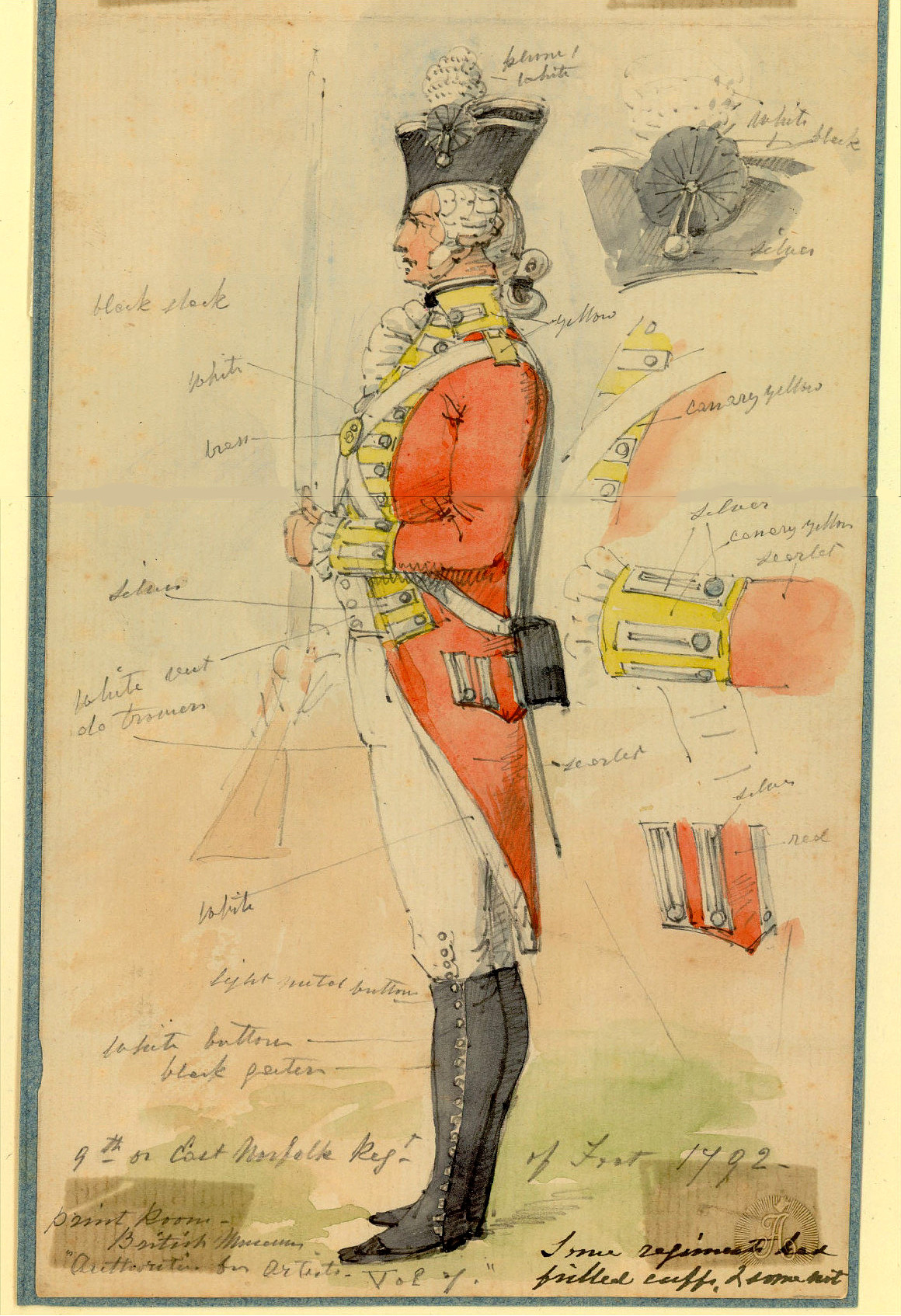
This drawing is almost identical to the print of a private by Edward Dayes and is also dated 1792 so it would be reasonable to assume that they are by the same artist. But this drawing is by Edmund Scott who is best known for a series of 10 prints, dated 1797, of soldiers demonstrating ‘manual exercises’. This soldier of the 9th Regiment is not included in the 10 prints which are either guardsmen, militiamen or artillery. The drawing is taken from the Brown Digital Repository which has provision for enlargement.
The drawing is labelled by the artist which suggests that he made a quick sketch from life and made notes so that he could colour it in later. The most astonishing aspect of the sketch is that the soldier has silver lace, confirmed by the notes repeated three times. It was the custom at this time that the rank-and-file had regimentally patterned lace and the sergeants had plain white lace, while only officers and sergeant-majors had silver (or gold) lace. Normally sergeant-majors were armed with a sword and did not carry a musket, nor wear a belt supporting an ammunition pouch.
The only explanation is that this drawing was made at the regimental depot at Norwich while the battalion was serving in the West Indies. If the artist was focused on recording ‘manual exercises’ perhaps the depot sergeant-major obliged, wearing rank-and-file equipment and posing for the ‘present arms’ position. In his book British Infantry Uniforms Since 1660, Michael Barthorp, in the chapter on uniforms worn 1768-1799, says:
‘Sergeant’s hats had silver lace and their coats followed the men’s style but with plain white lace. Crimson worsted sashes with a stripe in the facing colour were worn around the waist by sergeants; if the facings were red the stripe was white. Halberts were replaced by 9ft pikes in 1792 for all sergeants, including grenadiers and fusiliers, who formerly had been armed like their officers [i.e. with muskets]. Only Light Infantry sergeants retained the fusil. In 1768 corporals’ coats received a white silk epaulette on the right shoulder instead of their shoulder knots.’
Regimental Details | Uniforms

