

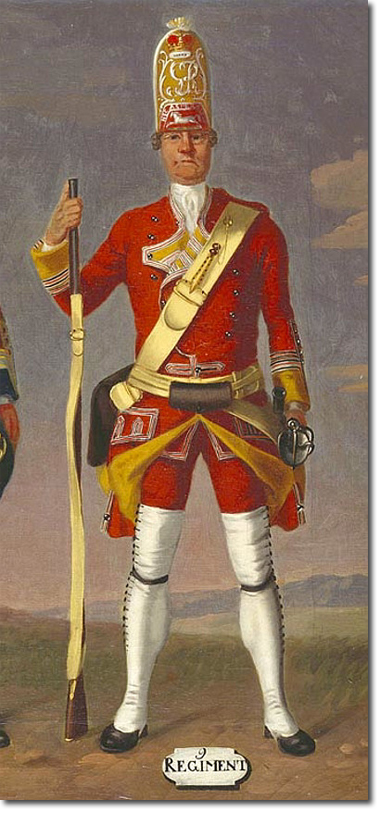
David Morier, the Swiss artist, came to England in 1743 and was commissioned by the Duke of Cumberland to paint the uniforms of the British Army in 1751. The infantry regiments were represented by the grenadiers, presumably because the tall embroidered mitre cap deserved being recorded for posterity. It seems that Morier relished the task of painting the fine detail of the caps, and the lace on the coat. The grenadier shown here is the right-hand figure of three, the others being the 7th Royal Fusiliers and the 8th King’s. The coat is shown closed with the waist-belt worn outside the coat. The Fusilier is dressed similarly but the 8th grenadier has his coat open, lapels folded back, with the belt worn under the coat. All the regiments had the option of wearing the coat either way, mostly closed in marching order.
The uniform differs from the one shown in the Cloathing Book of 1741 in that the lace is a different pattern. In 1741 it was white with a red zig-zag, but here, ten years later, it was white with blue lines near the edges and a red line in the centre. The mitre cap is yellow, the facing colour, also seen on the lapels and cuffs. The devices on the front are the White Horse of Hanover, worn by all the regiments, and a universal GR cypher. The regiments numbered 1 to 8 have special regimental badges instead of the cypher, but the 9th was the first of the line regiments, at this date, not to have a badge. This undermines the claim, by some sources, that the regiment was granted the badge of Britannia after their brave actions at the battle of Almanza in 1707.
The waist-belt has a leather frog that supports a sword, or hanger, as well as a socket bayonet. The black cartouche on the front was for cartridge ammunition and the black bag on his right hip was for grenades. He has a brass match case attached to his shoulder belt, a feature added in 1745, to contain a lighted fuse to ignite grenades before throwing.

