

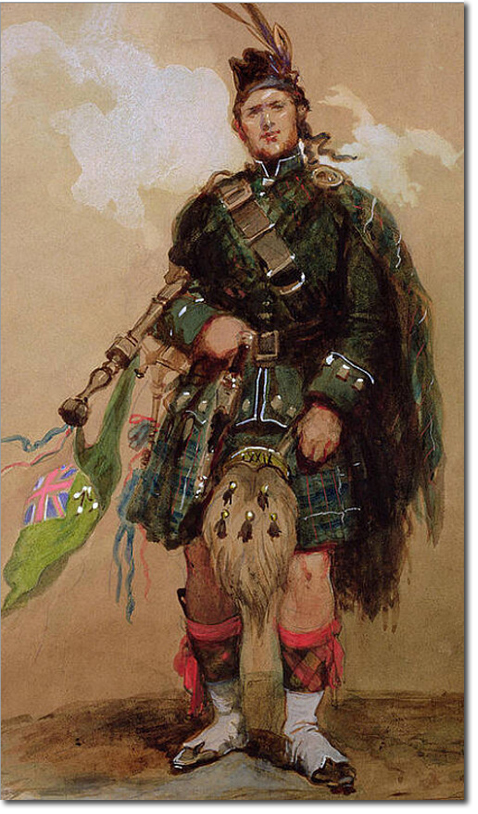
It is interesting to compare the uniform of this piper of 1853 with that of a piper of 1999 (and even up to now, 2024 at the time of writing). There are many similarities between the uniforms that are 150 years apart, the glengarry cap with eagle feathers, the green doublet, black shoulder belt, kilt, plaid, sporran, hose and spats. The piper is recognisable as belonging to the 79th, having LXXIX on the cantle of his sporran and a green pipe-banner with Union flag in the corner. The green colour of the banner is surprisingly pale, but is repeated in another painting by the same artist, of a piper playing to two officers at Chobham Camp. The officers in that painting have facings on their jackets of mid-green, and the Regimental Colour in a painting of 1840 looks dark green.
The doublet, with gauntlet-style cuffs and Inverness skirt flaps, was adopted by pipers of the 79th at some time after 1847 when the artist Raffet depicted pipers in waist-length jackets with short tails. The pipers’ doublet pre-dated the scarlet doublet worn by the rest of the regiment after 1855.
The cap has two long feathers and one short one. At some time after 1853 the regimental pipers wore only one eagle feather, although a caption under a photo of the Pipe Major in 1999 states that the Pipe-Major wears two feathers only when the Commanding Officer or Royalty are present.
The French artist Eugene Lami (1800 - 1890) painted this watercolour at Chobham Camp in 1853, on the eve of the Crimean War. He painted several studies of officers and men of the 79th Cameron Highlanders. The regiment had returned from Canada in 1851 and moved from Edinburgh to London in 1852 for the Funeral of the Duke of Wellington, then took part in the 1853 Camp of Exercise at Chobham, the first peacetime manoeuvres held by the Army in Great Britain.

