

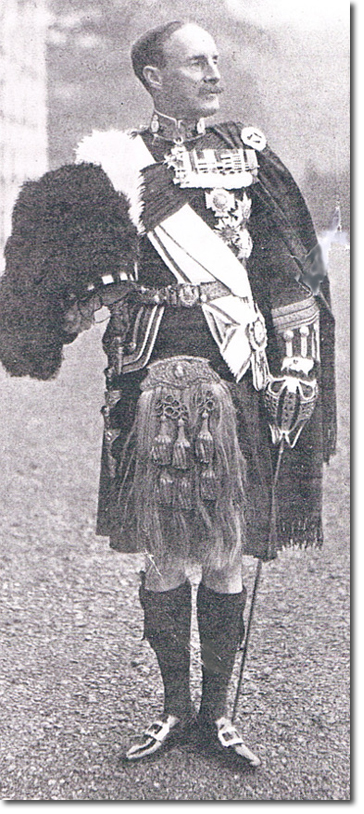
Ian Standish Monteith Hamilton was born in Hafton, Argyll on 16 jan 1853, the son of Colonel Christian Monteith Hamilton who commanded the 92nd Gordon Highlanders from 1865 to 1869. Ian’s mother was Corinna, daughter of the 3rd Viscount Gort. But she died in 1856 giving birth to Ian’s brother, the artist Vereker Monteith Hamilton, famous for his paintings of military battles.
Ian was educated at Wellington College and entered Sandhurst. He was commissioned into the 92nd Gordon Highlanders on 24 April 1872, and had his first experience of military operations in Afghanistan. The regiment then went to South Africa where Hamilton was wounded at the Battle of Majuba. His left hand never recovered from the injury. Further service took him to the Sudan on the Nile Expedition, then Burma and India. He was awarded the DSO for service in Bengal, by which time he was a Colonel. In the Chitral Expedition of 1895 he was military secretary to Sir George White, also a Gordon Highlander. From 1895 to 1898 he was Deputy QMG in India and he commanded a brigade in the Tirah Campaign.
In the Boer War he was Assistant Adjutant General to Sir George White and commanded the infantry at the battle of Elandslaagte. He was then with White when the Boers besieged Ladysmith. After the Relief of Ladysmith he commanded the Mounted Infantry. He famously led the March from Bloemfontein to Pretoria which Winston Churchill wrote about in Ian Hamilton s March (Longmans Green 1900). This march included 10 battles and Hamilton being recommended twice for the VC.
There was further service in the Boer War with Kitchener and command of columns in Western Transvaal. He was rewarded with promotion to lieutenant general and the post of Military Secretary. He was appointed Knight Grand Cross of the Order of the Bath (GCB in 1910). He went to the Far East in 1904 as military attaché serving with the Japanese Army in Manchuria where he observed trench warfare with machine guns. Shortly before WW1 he was in command in the Mediterranean but when war broke out he was initially in command of defending the south coast of England.
His involvement in the Gallipoli campaign of 1915 was the low point of his extensive military career, but he was not to blame for its failure despite the fact that he commanded the land forces that were defeated by the Turks. This was the end of his active military career. After the war he had close ties with Germany which prompted him to make the inadvisable comment that he was “an admirer of the great Adolph Hitler”. But his diplomacy proved useful when he managed to retrieve the drums of the Gordon Highlanders that had been captured by the Germans in WW1. He was presented with the drums in a ceremony in Berlin where he spoke about there being “no more war between the old allies of Waterloo”.
General Hamilton was appointed Colonel of the Queen’s Own Cameron Highlanders on 7 Dec 1904. The photo shows him in the dress uniform of the regiment. On 26 Oct 1914 he transferred to be Colonel of his old regiment, the Gordon Highlanders, a position he retained until June 1939. He was married in 1887 to Jean Muir, and had no children but later adopted two children. He was a prolific writer and poet and he and his wife had their portraits painted by John Singer Sergeant. He died at his Hyde park home on 12 October 1947 at the age of 94. He was buried in Kilmadock Cemetery in Doune, Stirlingshire.

