

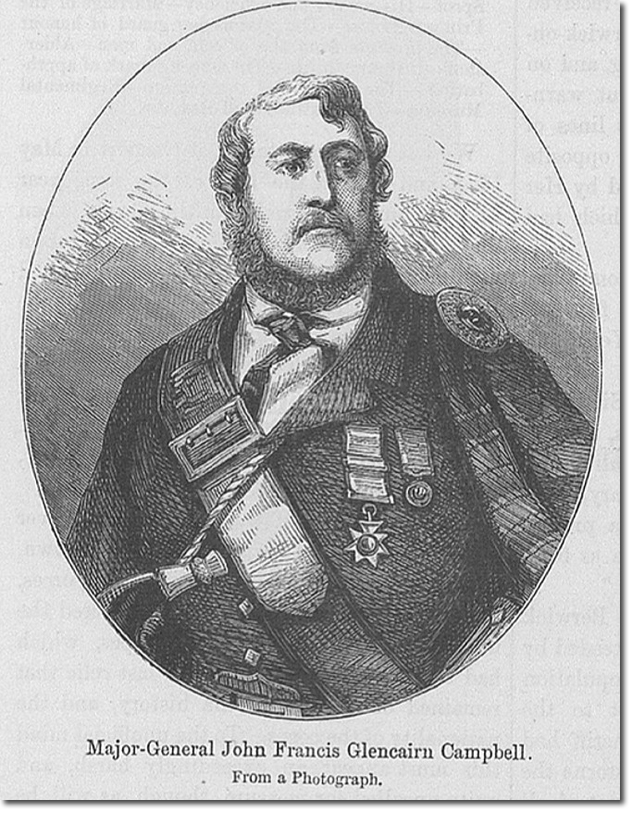
John Francis Glencairn Campbell was born c1810 and commissioned as an ensign into the 91st Argyllshire Regiment on 25 Oct 1827. He was with the regiment as it served in the Mediterranean, reaching the rank of lieutenant-colonel on 14 April 1846, commanding the regiment from 1848 to 1860. In 1845 the 91st was in Cape Colony where Campbell commanded the infantry fighting the Boers beyond the Orange River. When the Kaffir War broke out in 1846 he was in command of the 91st Reserve battalion and took 200 men of his regiment together with 180 local troops to force the pass in the Amatola Mountains on 16 April 1846. During this battle Colonel Campbell tried to help a wounded man onto his horse but the horse was shot. He was mentioned in despatches for this. The next day he was sent to the assistance of Major Gibson of the 7th Dragoon Guards who was in danger of losing ammunition wagons. The wagons were rescued due to Campbell’s timely intervention, but the rest of the Division’s baggage was lost. He was also mentioned in Despatches for this action.
The day after that, on 18 April, his men were deployed to cut off the retreat of the enemy to Block Drift. The 91st were facing an overwhelming force but held them off at the Drift for two hours. Another battle took place at Block Drift on 12 May when 2,000 of the enemy attacked the advance post but were beaten off, losing many casualties. Colonel Campbell was given command of Fort Beaufort and tasked with taking one of three columns to attack Chief Sandilla. This was a successful operation which ended the war. Colonel Campbell was highly praised for his service and awarded the CB.
During the Crimean War the 91st was stationed at Athens for the protection of British interests. Campbell was promoted to full colonel on 20 June 1854 and commanded the British contingent in Greece from April 1855 until the end of the war. He relinquished command of the 91st Argyllshire Highlanders in 1860 when he was promoted to major general, and on 12 July 1868 was appointed Colonel of the Cameron Highlanders. He was promoted to lieutenant general shortly before his death in August 1870.

