

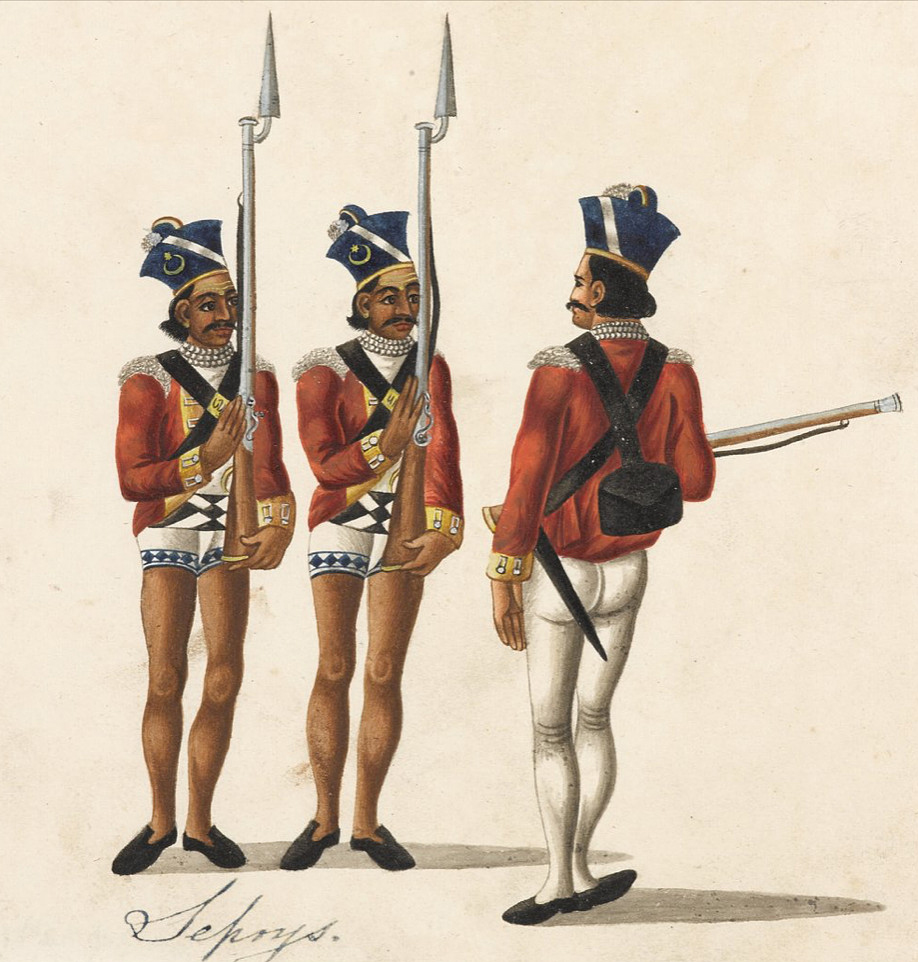
From 1809 the facing colour of the 1st Regiment Bengal Native Infantry was yellow.This lasted until 1819 when the colour was changed to white. The figure on the right is an Indian officer, probably a Jemedar. He has white leggings and black shoes. Apart from that there is little difference in his uniform with the sepoys. By 1815 jacket tails were considerably shorter but the European style of buttoning the jacket from neck to waist was probably reserved for campaigns. A print by Hamilton Smith shows the jacket buttoned up. The lapels are turned back to reveal yellow facings, and the button-holes are of white lace. The white shorts retained the blue decoration that had been the pattern for several decades. And the blue kummerbund still has the white saltire cross.
The blue hat at this stage was more practical than the sundial hat, although it must have been hard to stop it falling off when running. The pattern is unlike anything worn by British soldiers, who had a peaked shako at this time. In the 1840s sepoys were allowed to wear forage caps on campaign. The black belts are often seen in Indian prints of sepoys, but white or buff was more usually worn by the battalion companies. This print may show men of the light company which traditionally had black belts.
Regimental Details | Uniforms

