|
Raising of the Regiment
|
|
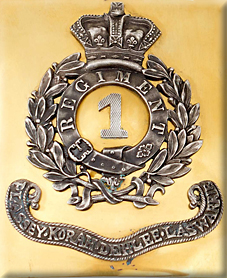
The 1st Regiment is descended from the ‘oldest corps in Bengal’. It was raised in Calcutta in January 1757, the first unit to be regularly clothed in red tunics in 1765 giving the unit its name ‘Laul-Paltan’ the Red Battalion. It came under the army of Lord Clive, first fighting in the attack on Chandernagore and then the Battle of Plassey on 23 June 1757. Being a newly raised and untried battalion they ‘acquitted [themselves] as well as could be expected for so young a corps’ The battalion was granted the battle honour PLASSEY retrospectively on 23 Feb 1829.
In 1758 the battalion saw action in the Northern Sircars under Colonel Ford. They distinguished themselves in that action. They fought against the Dutch in 1759-60 when the enemy was defeated and many prisoners were taken. They also served under Colonel Cailland in the dethroning of the Nawab Mir Jafar from the Musnud. They took part in the defeat of Shah Zadah in 1761, and in 1763 war broke out with Cossim Ally, during which they ‘served with distinguished bravery’
|
|
Mutiny at Manjie 1764
|
|
Captain Primrose Galliez took over command in November 1763 and while in command the battalion was known as 'Gillis-ki-Paltan'. They were at Sant in Feb 1764 where another unit had mutinied. They showed symptoms of insubordination but were prevented from mutiny by the officers. They were then sent to Patna to fight against Sujah Dowlah on 3 May 1764. They fought well and then patrolled the Choprah district with Marines and European Grenadiers. They halted at Manjie and a month later the Marines were sent away. Left to themselves the discontent they showed at Sant developed into open mutiny.
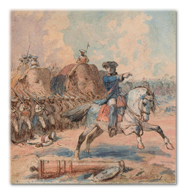
At first they imprisoned their officers, but released them the next day. The Marines were brought back and the mutineers rounded up. They were sent to Choprah where Major Munro was in command. Munro dealt with the mutiny harshly, picking out 28 of the worst offenders. Eight guns were brought out and eight mutineers tied to the muzzles. Three grenadiers asked to be placed on the right, their place of honour in battle. The Marines witnessed the horror and were badly affected by the spectacle, especially as two of them had been in the execution squad that had shot Admiral Byng in 1757. The other 20 men were ordered to different stations of the army to be executed in a similar cruel manner, to discourage any sepoys from thinking about mutiny.
The rest of the battalion were sent to Patna and brought up to strength. They were re-numbered 9th Battalion, being the rank of Captain Galliez. In 1765 it was posted to the Third Brigade.
|
|
Battle of Korah 1776
|
|
The battalion was renumbered again in 1775 to become the 16th. It took part in the action at Korah alongside the 15th Battalion (later the 10th Regiment). Colonel Parker commanded the detachment. In June 1776 the battalion was posted on the left of the line, commanded by Captain William Jones. They came under heavy fire from 4 battalions of Neejeebs. The battalion showed great bravery when they were ordered to fix bayonets and charge with determination. Although very much outnumbered they dispersed the Neejeebs. One of their officers, Lieutenant Erskine was killed in the action.
|
|
Reorganisation 1796
|
|
In 1796 the authorities decided to organise the Bengal Infantry into 12 regiments composed of two battalions, each consisting of 2 grenadier and 8 battalion companies. Each regiment had an establishment:
British
1 Colonel Commandant
2 Lieutenant-Colonels
2 Majors
7 Captains
1 Captain-Lieutenant
22 Lieutenants
10 Ensigns
2 Sergeants
Indian
20 Subadars
20 Jemadars
100 Havildars
100 Naiks
40 Drummers and fifers
1,600 Sepoys
Staff
1 Quartermaster
2 Adjutants
1 Paymaster
1 Sergeant Major
1 Quartermaster Sergeant
1 Drum Major
1 Fife Major
2 Drill Havildars
2 Drill Naiks
1 Surgeon
1 Surgeon’s Mate
2 Native Doctors |
|
The Mud War 1802
|
|
When the zemindar, Rajah Bhagwani Singh, refused to pay his tax, a force was sent out to attack and reduce his two mud forts at Sasni and Bijaigarh in the Jumna Doab. On 12 Dec the force set out under Lt-Colonel Blair, consisting 4 Troops of the 3rd native Cavalry and 4 battalions of NI, 1/2nd, 1/8th, 2/12th and 1/15th, and some artillery. (The regiment was the 2nd Battalion 12th Regiment from 1796 to 1824).
The siege of Sasni proved to be very problematic. After 3 weeks of siege operations an assault was made on 14 Jan 1803. But the ditch was too deep and the ladders too short, so the storming party had to withdraw with the loss of 10 killed, including Captain Morrison of the 2/12th, and 29 wounded. Reinforcements subsequently arrived, including British troops and Major-General the Hon. Frederick St John, followed by the Commander-in-Chief, Lt Gen Lake himself. The fort finally fell on 11 February. The other fort, at Bijaigarh, was captured on 27 Feb.
|
|
Second Maratha War 1803-05
|
|
Both battalions of the 12th Regiment accompanied the Commander-in-Chief, Lt General Lake, to the rendezvous at Sikandra in Aug 1803. The fort of Aligarh was assaulted on 4 Sept with the loss of 59 killed and 212 wounded. The Marathas lost 2,000 killed. The Native Infantry battalions consisted of 1 &2/4th and 4 companies of 2/17th.
|
|
Delhi 11 Sep 1803
|
|
In September, Lake marched towards Delhi with 4,500 men. This included the 2n Bn 12th Regiment. He met the Maratha army drawn up ready for battle at the village of Patparganj, 8 miles from Delhi. The enemy was commanded by French officers under Louis Bourquien and had a strength of 19,000 men and 100 guns. Lake advanced with his cavalry and then pretended to retreat to draw the enemy away from their entrenchments. The Marathas fell into Lake’s trap and when confronted by the NI battalions, opened fire with a tremendous volley. But the NI stood firm, fired back and then charged. The enemy broke and fled, pursued by the cavalry back to the River Jumna. The British loss was 109 killed including Lieut Hill of the 2/12th, and 368 wounded, 9 missing. The enemy lost 3,000, and 68 of their guns were captured. The battalion (after de-designation as the 1st Regiment in 1824) was awarded the honour DELHI. The result of this victory was the end of French power in Northern India.
|
|
Laswari 1 Nov 1803
|
|
Lake’s next success was the capture of Agra in October 1803. A forced march was made by Lake’s army to prevent the Marathas, under Sindhia, re-taking Delhi. The enemy were a disciplined force styled the Deccan Invicibles, 14,000 men and 72 guns. Lake caught up with them at Laswari on 1 Nov. He had to leave his infantry several hours behind so could only attack with his cavalry. This gave the Marathas time to deploy their army in two lines around the village of Mahalpur with their artillery in front and cavalry on the right. Lake attacked their right with the British 76th Foot under Maj-Gen Ware. But they came under heavy fire so the 2/12th and 6 companies of 2/16th were sent to support them. The 76th and the NI advanced under very heavy fire of canister shot. The enemy cavalry attacked but were discouraged by a sharp volley and a counter charge by the 29th Light Dragoons. Both lines of the enemy were now penetrated and the Marathas were on the back foot. The British cavalry charged and this broke the enemy’s resolve and they retreated. The rout of the Marathas caused them the loss of 7,000 killed and 2,000 taken prisoner. The loss to Lake’s army was 172 killed. The 2/12th and 2/16th were especially thanked by Lake. The award of LASWARREE was granted on 23 Feb 1829.
|
|
Actions in 1807-08
|
|
In 1807 it was found necessary to send detachments against various zemindars in Oudh. The 2/12th Regiment, under Major O’Donnell stormed Akbarpore in March, and after a ‘smart resistance’ took the fort of Pathar-serai in October 1808. In the same year, the Commander-in-Chief directed each battalion to convert one of its companies to light infantry so that the 2/12th now had two grenadier companies, one light company and 7 battalion companies.
|
|
Mauritius 1810
|
|
In August 1810 two volunteer battalions of Bengal sepoys were sent with an expedition to capture Mauritius (Ile de France). The 2/12th provided men for this expedition. They arrived near Port Louis on 29 Nov 1810 but met feeble resistance. The French gentry of the militia were appalled that ‘black follows of India’ had been sent against them and refused to fight. The two volunteer battalions lost one native officer and 32 men missing. Medals were given to those who took part, gold for the officers and silver for the men.
|
|
Nepalese War 1814
|
|
A force was assembled to march into Nepal in May 1814. There were 4 Divisions. The 3rd Division, commanded by Major General John Sullivan Wood, included two companies of the 2/12th Regiment NI. Each Division marched separately to attack different areas of Nepal. The 3rd was ordered to march from Gorukhpur through Bhutwal and Sheoraj to Palpa. In his book, Sketch of the Services of the Bengal Native Army, F G Cardew says.
‘The history of the first campaign of this war includes a greater number of disastrous failures and of ill-arranged and worse-carried-out enterprises, due generally to an entire want of appreciation of the necessities of hill warfare than had ever before, or have ever since befallen the arms of the British in India.’
Major General Wood proved to be a completely incompetent commander. His progress was delayed by lack of transport and supplies so it was not until Jan 1815 that he attacked the Gurkha post of Jitpur. The operation was mismanaged but his men were successful despite a lack of reconnaissance. But Wood declared the position untenable and ordered a retreat. The loss was 24 men killed and 109 wounded, 5 of which were officers. A further demonstration was made against Bhutwal but it achieved nothing so the Division withdrew to cantonments in Gorakhpur.
|
|
Third Maratha War 1817
|
|
The British directed their military activity to Central India where the Maratha princes and the Pindaris were causing trouble. The Marquis of Hastings prepared for war with a Grand Army of 88,000 men, against an enemy that could muster 217,000. Again the army was split into four divisions. The Right Division was made up of the 8th Light Dragoons, 1st Native Cavalry, Gardner’s Horse and some native contingents. The infantry was made up of the 14th Foot and the Bengal NI battalions, 1/25th, 1/27th and 2/12th. The artillery component was 18 guns. The Division was commanded by Maj-Gen R S Donkin.
In this year, 1817, the ranks of Subedar-Major and Colour Havildar were added to the establishment of each battalion. In Nov 1817 the Right and Centre Divisions were at Gwalior when the army was struck by an epidemic of Cholera which, within a week rendered 764 men dead or incapacitated as well as 8,000 camp followers.
In October 1840 three battalions of Light Infantry were formed at Meerut and Cawnpore from the light companies of different regiments. During the First Afghan War the 1st and 2nd of these battalions were moved to Ferozepore and Ludhiana. The 3rd Light Infantry Battalion contained light companies of the 1st, 11th, 12th, 24th, 50th, 58th, and 67th Bengal NI, with the rifle company of the 9th Bengal NI. No mention is made in Cardew’s History of the movements of the 3rd LI Battalion. But if the first two LI battalions remained in place they would have been well situated for the 1st Sikh War of 1846. The 1st Regiment did not take part in either of the Sikh Wars.
|
|
Indian Mutiny 1857
|
|
In 1857 the 1st Regiment Bengal NI was stationed at Cawnpore (Kanpur). The other Indian Infantry regiments were the 53rd and 56th BNI. There was also the 2nd Bengal Cavalry. All these regiments were considered to be loyal and unlikely to mutiny. The commander at Cawnpore, Sir Hugh Massy Wheeler, was so sure of their loyalty that he sent two British companies, one each from the 32nd and 84th Regiments to help the garrison at Lucknow against a siege. Wheeler prepared an entrenched position in the south of the city which he chose instead of a much better citadel in the magazine which was well stocked with ammunition and stores. The sepoys were unsettled by the preparations being made to fight and defend the British families. A drunken British officer named Cox fired his pistol at his Indian guard but missed. He was acquitted the next day, 3 June 1857, and this sparked the Mutiny which broke out on the 5th. The 2nd Bengal Cavalry were the first to rebel and a general muddle caused the sepoys to follow suit. The 1st NI rebelled and left the next day, 6 June 1857, and headed towards Delhi. They took the regimental treasure with them and as much ammunition as they could carry. Some sepoys remained loyal to Wheeler, 150 men, but it is not clear to which regiments they belonged.
Cawnpore was the scene of the worst massacre of women and children at the hands of Nana Sahib’s army. They came to Cawnpore under the pretence that they were helping the British but Nana entered the magazine which was lightly defended and it became clear that he was not there to help. He caught up with mutineers who were leaving Cawnpore to head towards Delhi and persuaded them to join him in capturing the city for the rebel cause.
|
|
|