

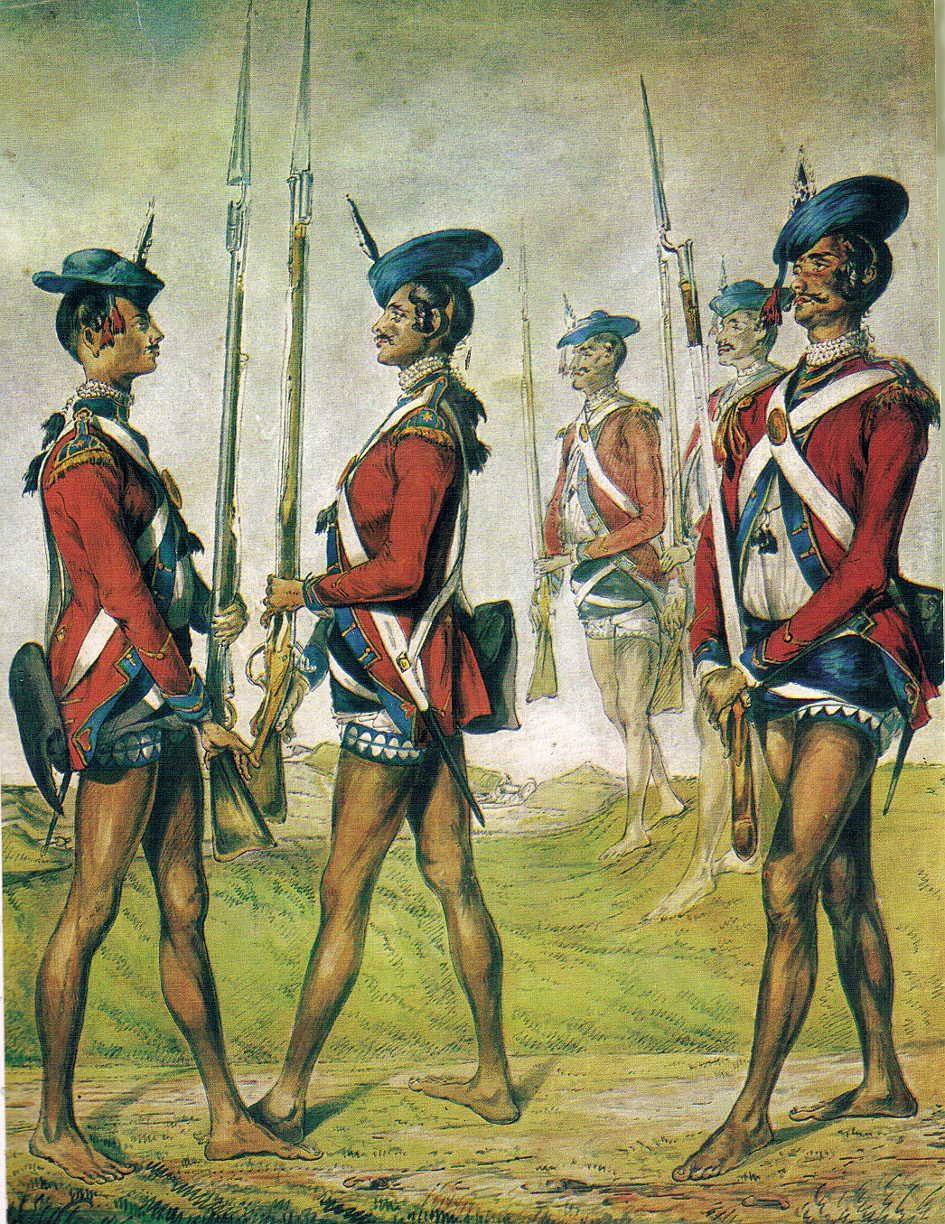
The uniforms worn by the Indian Army at this time are well shown in this watercolour by the artist who signed his work ‘Green’. He may have been a British officer, but was a very skilled draughtsman. The red jackets worn by the soldiers are based on the European pattern, close-fitting, fastened only near the top with hooks and eyes, with blue lapels to the waist, short tails with blue turn-backs, and collars, which are unclear in this painting. The blue shoulder wings are fringed with gold or yellow worsted. The figure on the right has gold or yellow cords hanging from his right shoulder indicating that he is an NCO, probably a naik. There are button-holes which show as yellow lines, on the lapels and wings, and as chevrons on the sleeves and cuffs.
White shirts are worn under the jacket, and two black tassels can be seen just below where the jacket fastens. These are probably brushes for the priming pan on the musket. Netherwear consists of shorts that have a blue decoration round the hem. A blue cummerbund is worn over the shorts which has a white saltire on the front. A white beaded necklace is worn by all native ranks. The most distinctive feature is the hat. This was known as the ‘sundial’ headdress. The two passing sentries show both sides of the hat. The brim tilts up on the left side, but the right side has a flatter brim showing the crown of the hat. At the front is a stiff pointed item that shows better on the naik. It is decorated around the edge and has a device in the middle. Red tassels hang from the right side.
The white belts on each shoulder support a black leather pouch on the right hip and a bayonet scabbard on the left. A brass shoulder-belt plate is attached to the bayonet belt. Curiously they are barefoot. The uniforms look like dress, for parade and ceremonial. The men are part of the Quarter-Guard stationed at a fort.
The artist has not indicated which regiment these men belong to but we know that the 1st Bengal Native Infantry had uniforms in 1765 that fit these colours. Their uniform then was described as a red jacket with blue facings, blue cummerbund and blue turban. At that time they were known as the 9th Battalion. Prior to 1764 they were the 1st Battalion aka the Red Battalion or Laul Paltan on account of their being the first regular Indian troops to wear red uniforms.
Blue facings were unusual for the Indian battalions. It was a colour reserved for ‘Royal’ regiments in the British Army. In his book Indian Army (1981) Boris Mollo lists the colours of the uniform for each battalion/regiment. None of the units have blue facings between the years 1796 to 1823. There were changes in colours for the 1st Regiment over this period as follows:
1796 red coats, buff facings. Silver lace for officers
This illustration was taken from Military Drawings and Paintings in the Royal Collection by A E Haswell Miller and N P Dawnay (Phaidon 1966). The authors are unclear about the date of the painting. The uniforms conform to other images of sepoys in the 1780s and 90s but the left side of the picture (not shown here) has a flag, an ensign that appears to have the post-1800 Union flag in the top corner.
1809 red coats, yellow facings. Silver lace for officers
1819 red coats, white facings. Gold lace for officers
1823 red coats, white facings. Gold lace for officers.
Regimental Details | Uniforms

