

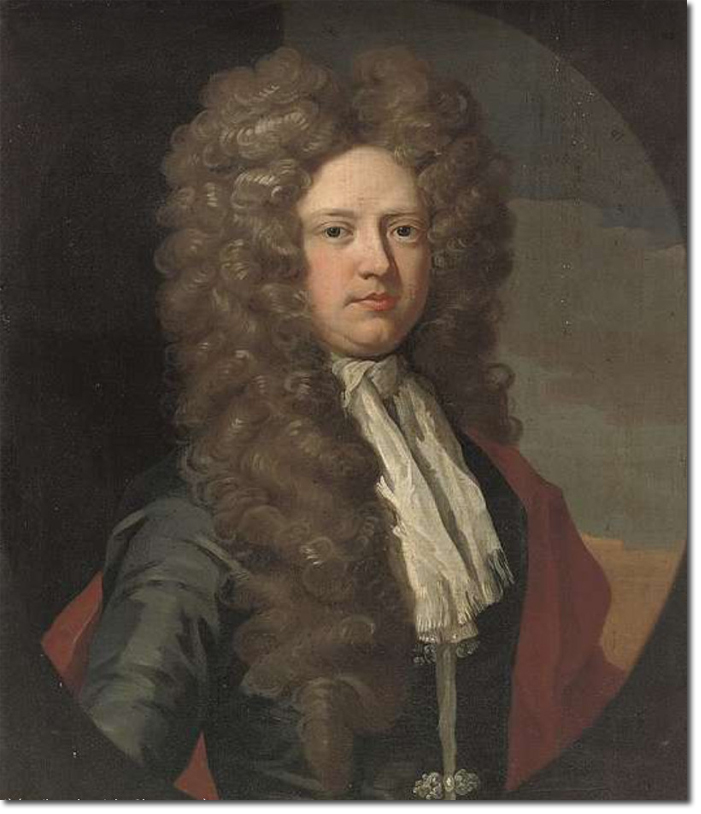
William North was born on 22 Dec 1678, at Caldecote, Cambridgeshire. He was the son of Charles North, 5th Baron North. His mother Catharine, was the daughter of Baron Grey of Warke. He was educated at Magdalene College, Cambridge and Foubert’s Military Academy. His first experience of military service was in Flanders in 1691 when he was a 13 year old Gentleman Volunteer. In the same year his father died and he succeeded as the 6th Baron North and 2nd Baron Grey of Rolleston.
In January 1703 he was appointed Colonel of what had previously been Granville’s Regiment, and commanded them in Marlborough’s campaign in Northern Europe. He distinguished himself at the sieges of Huy and Schellenberg, and at the battle of Blenheim he was seriously injured when his right hand was shot off. He continued to serve with his regiment and fought at Ramillies. In 1706 Lord North was promoted to brigadier-general and given command of a brigade consisting of the 10th, the Royals, the 21st and 26th regiments, which he led at Oudenarde. He went on to cover the siege of Lisle and proved himself again at the siege and capture of Ghent.
On 1st January 1709 he was promoted to major-general and in the following year promoted to lieutenant-general. He was appointed Lord Lieutenant of Cambridgeshire, and in 1711 a seat on Queen Anne’s Privy Council. In 1712 he was in the army of James Duke of Ormond. His services were rewarded with the appointment of the governorship of Portsmouth.
Queen Anne died on 1 August 1714, and North’s allegiance to the Stuarts put him at odds with the Hanoverian King George I. He plotted to use Portsmouth as a base for a Jacobite invasion of Britain. North’s sympathies were discovered by King George’s supporters, and he was deposed as Governor, and as Colonel of the Regiment, in June 1715. But in 1721 he was involved in the Atterbury Plot to restore James Stuart to the throne, and was arrested. Fortunately for him he was released from the Tower of London through lack of evidence, and escaped the cruel executions that were meted out to other Jacobites.
He fled the country and in 1722 served in the army of King Philip V of Spain. He died in Madrid on 31 October 1734.
He was married to Maria Margaretta de Jonge van Ellemeet. The wedding was in 1705, a year after he lost his hand at Blenheim. She was the daughter of Cornelius de Jonge van Ellemeet, Receiver General of the Republic of the United Netherlands. The marriage produced no children but he did have an illegitimate child, William Greyson, born in Spain c1724. A year after North’s death Maria married the 5th Lord Elibank. The portrait was painted by John Closterman, date unknown.

