

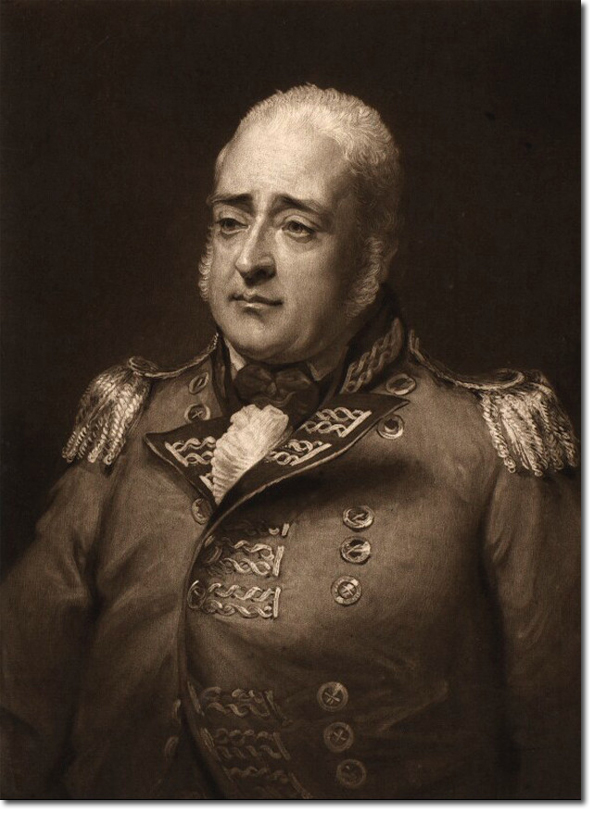
Henry Edward Fox was born on 4 Mar 1755, the son of Henry Fox, 1st Baron Holland, a prominent Whig politician, and Lady Caroline Lennox, daughter of the Duke of Richmond and great granddaughter of King Charles II. She was a baroness in her own right. Henry’s elder brother was the famous politician Charles James Fox.
He was educated at Westminster School and commissioned into the King’s Dragoon Guards in 1770. He spent a year in the Strasbourg Military Academy and was promoted to lieutenant in 1773, then captain the next year having transferred to the 38th Regiment in Boston. He fought in the American War of Independence, at Concord, Bunker Hill, the capture of Long Island, White Plains, and the expedition to Philadelphia in 1777. On 12 July 1777 he purchased a majority in the 49th Regiment which went to the West Indies but he was appointed Lieutenant-Colonel of the 38th which was facing action at New York. After the war he was promoted to colonel and appointed ADC to the King.
His next command was in Nova Scotia, from 1783 to 1789. While there he was influential in the establishment of the new colony of New Brunswick. He returned to England where he was tasked with the building of the Royal Marine Barracks at Chatham from 1789 to 1793. In 1793 he was promoted to major general and commissioned to raise the 131st Regiment in December 1793. It was disbanded 3 years later.
When Colonel James Moncrief was killed at the Siege of Dunkirk in September 1793, Major-General Fox took his place as QMG on the Duke of York’s staff in Flanders where the army was fighting in the French Revolutionary Wars. In 1795 he was appointed Inspector-General of recruitment. On 23 June 1795 he took over as Colonel of the 10th Regiment on the death of Sir Robert Murray Keith.
When Minorca was captured from the French in 1799 he was appointed Lieutenant Governor, and then in 1801 he was Commander-in-Chief of the Mediterranean. In 1803 he was appointed Commander-in-Chief in Ireland but Robert Emmet's uprising in Dublin on 23 July 1803 was badly handled and Fox was replaced by Lt-General Earl Cathcart. He returned to England to command in London but in 1804 he went back to the Mediterranean as Lieutenant-Governor of Gibraltar and then as Minister of Sicily, holding the rank of full General in 1808.
General Fox’s last appointment was Governor of Portsmouth in 1810 but he was in poor health and died on 18 July 1811. He was married, in 1786, to Marianne Clayton of Harleyford Manor. They had three children, Louisa, Caroline and Henry Stephen Fox who was a diplomat working in Italy and later as British Ambassador to the US.

