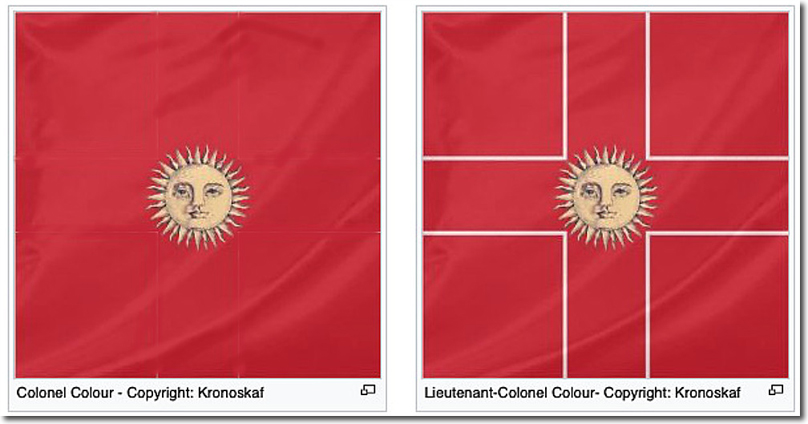
The design of the Colours underwent a change by the time that the regiment went to mainland Europe to fight in the War of the Spanish Succession. These Colours are crimson. It is not clear when the uniforms of the regiment adopted yellow facings but probably not during this period. The Colours shown here are illustrations courtesy of Kronoskaf. They show a crimson Colour for the Colonel as well as the Lieutenant-Colonel, both having a sun device in the centre. The cross of St George was the basic design of the Lieutenant-Colonel’s Colour, but in 1707 the Act of Union changed the Colour so that the Scottish saltire was added. Colours after that date changed so that the Colonel had a plain coloured flag with a small Union flag in the canton and his personal device in the centre. Lieutenant-Colonel’s Colour had the Union flag throughout.
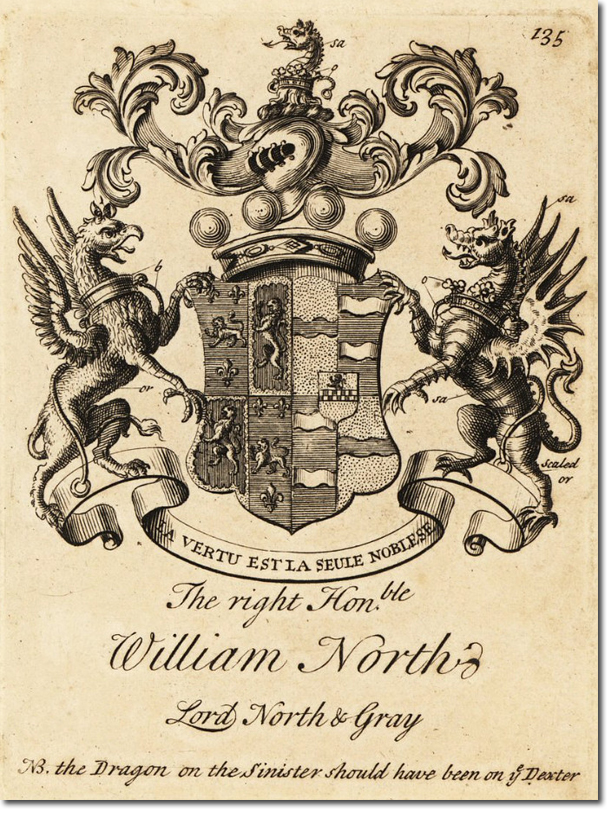
In the reign of King William III (1688 - 1702) the number of Colours carried by each regiment was reduced to those Companies commanded by the three field officers. In Queen Anne’s reign (1702 - 1714) this was further reduced to two: the Colonel’s and the Lieutenant-Colonel’s. The badge or motif in the centre, up until 1747, was the personal device of the regimental Colonel. William North, 6th Lord North & Grey was the Colonel of the regiment from January 1703 to June 1715, but the sun motif is not part of his armorial arms as can be seen by the illustration below.