A description of the Colours carried by each company of the Earl of Bath’s Regiment is given in S M Milne’s book Standards and Colours of the Army from the Restoration 1661 to the Introduction of the Territorial system 1881 (Goodall & Suddick 1893):
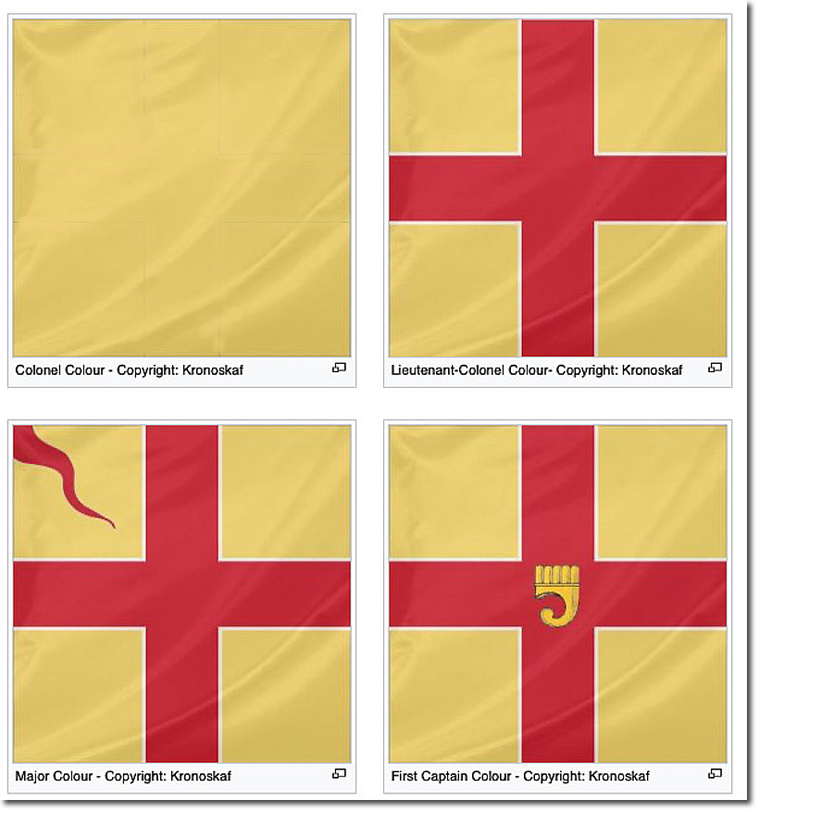
The Earl of Bath’s (later 10th Foot) “Colonel's plain light yellow; Lt-Colonel's yellow with a red cross bordered white; Major's the same with a red pile wavy; 1st Captain's as the Lt-Colonel's but with a clarion, suffle or organ rest in gold in the centre of the cross.”
This accounts for the first 4 Companies. The fifth Company was known as the 2nd Captain’s Company and would have carried a Colour similar to the 1st Captain’s except that there were two ‘clarions’. The 3rd Captain’s Company Colour had 3 ‘clarions’, and so forth. The clarions were displayed on the St George’s Cross.
The regiment was raised in 1685 to comprise eleven companies:
1st Company was the Colonel’s (John Granville, Earl of Bath).
2nd Company, the Lieutenant-Colonel’s (Sir Nicholas Stannings).
3rd Company, the Major’s (Sir Charles Carney)
4th Company, 1st Captain’s (Michael Bourk)
5th Company, 2nd Captain’s (Charles Powell)
6th Company, 3rd Captain’s (Sir Thomas Windham)
7th Company, 4th Captain’s (Edward Scott)
8th Company, 5th Captain’s (Bernard Strode)
9th Company, 6th Captain’s (John Sydenham)
10th Company, 7th Captain’s (Francis Vivian)
11th Company, 8th Captain’s (Sydney Godolphin)
Each of these Companies had its own Colour. These were large flags measuring 6’9” flying by 6’6” on the pike. The Cross of St George was displayed on every Company Colour, except for the 1st (Colonel’s) Company which was a plain colour. After the Restoration in 1661 the Cross of St George covered the whole flag, but before that date it was confined to the upper corner nearest the pike. In 1672 Captain Thomas Venn laid out the principles for the design of Colours which applied to Colours throughout the reigns of Charles II and James II. He wrote:
‘The Colonel’s Colour should be of a pure clean colour without any mixture, the Lieutenant-Colonel’s only with St George’s armes in the upper corner next the staff, the Major’s the same but with a little stream blazant and every Captain with St George’s alone, but with so many spots or several devices as pertain to the dignity of their several places.’
The Colours were of taffeta with ‘badges painted and guilded thereon’.
Wikipedia’s entry for John Granville, 1st Earl of Bath, discusses the ‘clarion’ on the family armorials:
‘The armorials of the family of Granville/Grenville of Glamorgan, Devon and Cornwall are of certain form but uncertain blazon. The charges appear in the form of musical pipes of a wind instrument, similar to pan-pipes. Authoritative sources on heraldry suggest the charges to be variously “clarions” (used by Guillim (d.1621)), the most usual blazon, which are, however, generally defined as a form of trumpet. “Rests”is another common blazon, denoting lance rests used by mounted knights.’
Other terms used to describe the object are: Organ Rest, Clavicymbal, Claricord, Rudder and Sufflue. A sufflue was a device for blowing air into an organ.
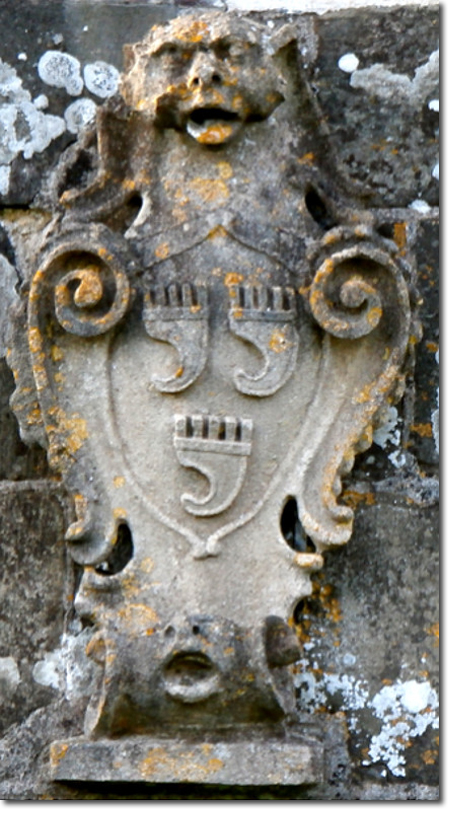
The photo shown below is a sculpted arms device that can be seen at Stowe Barton. It was originally part of Stowe House, Kilkhampton in Cornwall, a mansion built by John Granville, but later demolished. These arms display three ‘clarions’, and this triple design can be seen on other shields in Granville armorials.
The illustration is borrowed courtesy of Kronoskaf, to whom we are grateful.