

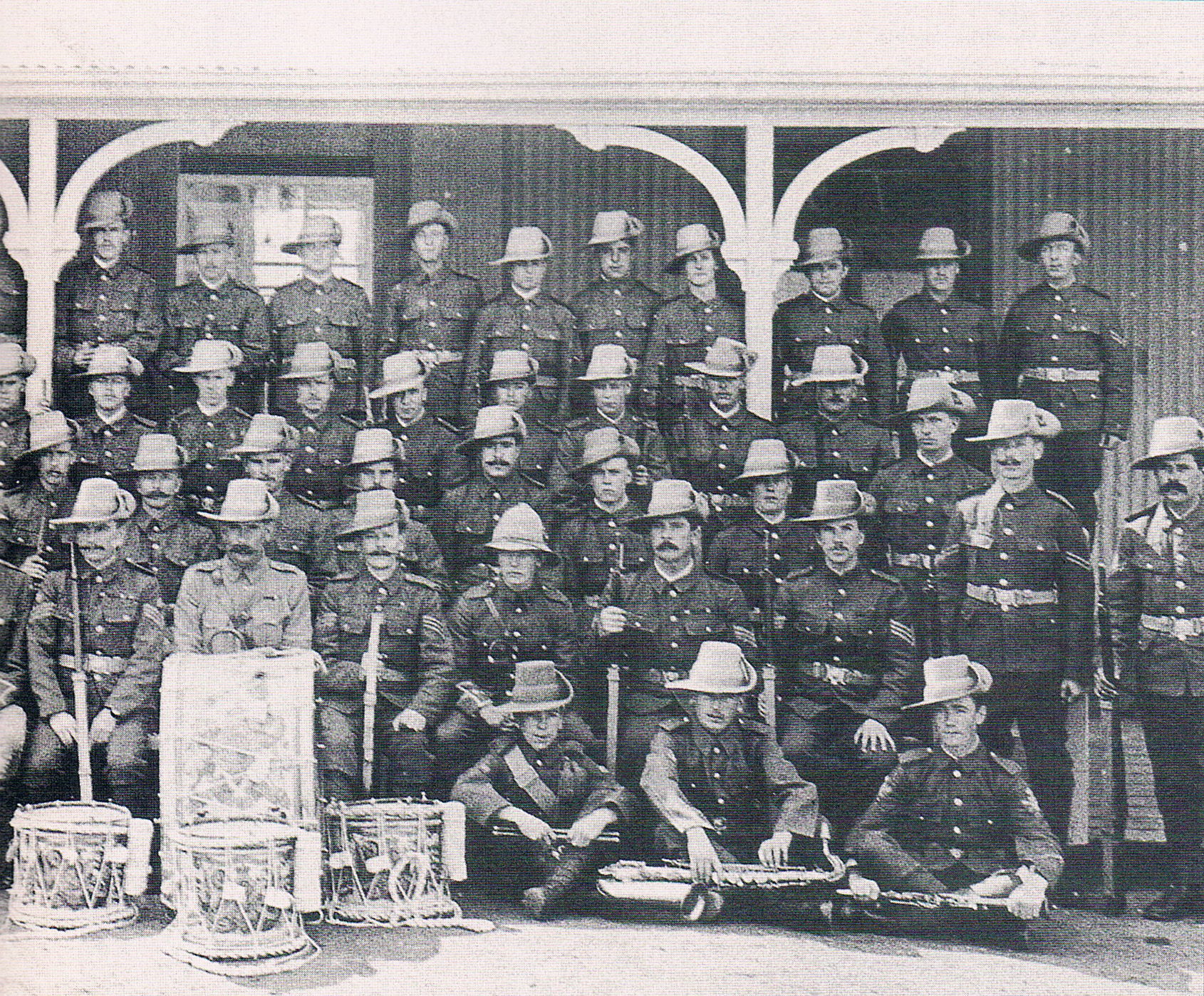
Officers and men in this group wear the khaki service dress introduced in 1902. The men wear tunics which are fastened with 5 brass buttons and have buttoned down hip and breast pockets. The collar was the fold down type, fastened up to the neck. The shoulder straps were completely detachable until 1904 when they were replaced by drab and white plaited shoulder cords. Then in 1907 the shoulder straps returned, but sewn on at the point of the shoulder. Rank stripes were drab and worn on both sleeves.
There are two officers in this photo, one wearing a lighter coloured service dress which doesn’t show much detail. A second lieutenant sitting to the right, wearing a helmet, has the second pattern officer’s khaki service dress. The first pattern was introduced in January 1902, with rank indicated by slim braid on a pointed cuff forming a crow’s foot. The second pattern was introduced in November 1902 and showed rank in the more familiar WW1 style that he wears. The collar was closed to the neck, and although some officers later opened it up to reveal a shirt collar and tie, this was not officially sanctioned until 1913.
The slouch hats worn by the men are in good condition and obviously had not been worn on campaign. This photo is taken from Regiment magazine Feb/Mar 1997. The caption says ‘They are wearing the Terai felt hat, which was also dubbed the ‘wide-awake hat.’' A slouch hat pattern was adopted during the Boer War but this smarter version was worn briefly as Hat, Service Dress until it was replaced by the staff pattern peaked forage cap. The turned-up side has a coloured patch with LINCOLNS in white lettering in a curve.
The trousers were also khaki, tucked into khaki puttees wound up to the top of the calf. The waist-belt is the same pattern as worn in dress uniform except that it is no longer white; it has been stained khaki. They all hold a rifle which appears to be the Lee Enfield Mark 1. It was introduced around 1902 and was charger-loading, meaning that the magazine could be loaded quickly from a five-round clip.
Regimental Details | Uniforms

