

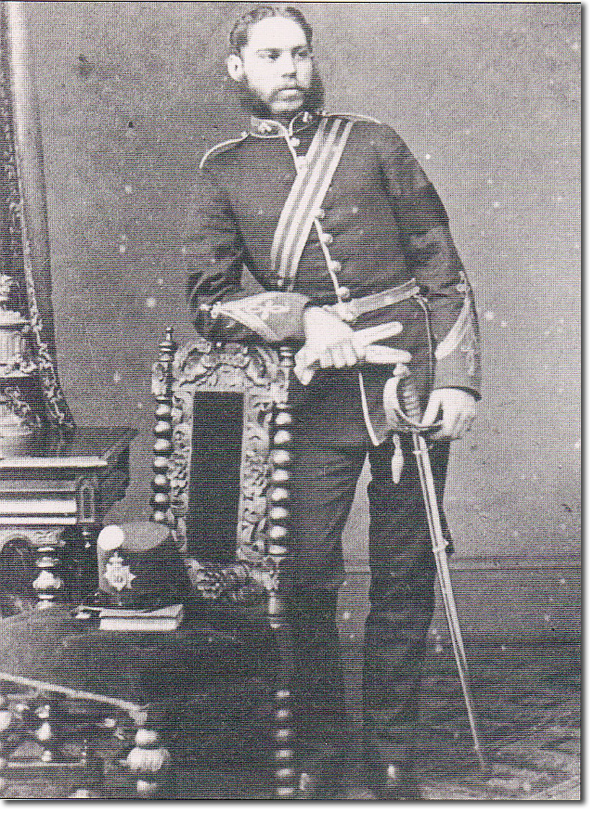
The infantry tunic underwent a change in 1868 which affected the style of the cuff. The previous yellow slash flap combined with a round yellow cuff was discontinued and replaced by a pointed yellow cuff. This photo of a junior officer shows the new pattern well. Gold lace, half an inch wide, followed the point shape, with a tracing of gold braid above and below the lace, with a light of yellow between lace and braid. Above the point the braid formed a small Austrian knot, and below, the braid formed a ‘crow’s foot and eye’. On this tunic the tailor has allowed too much yellow cuff as the crow’s foot should reach the bottom of the sleeve. A further anomaly is that one source, namely ‘The British Infantry Tunic 1855-1914’ by Brian Fosten (Military Historical Society 2023), quotes the 1868 instructions, ‘Sub-Lieutenant’s tunics will have neither lace nor braid.’ But this is not mentioned in the 1874 Dress Regulations so it may have been amended c1869.
The rank of captain was shown by having two rows of gold lace on the cuff. Major’s had two rows of lace and the top line of braid was formed into small circles. Lieutenant-colonels and colonels had small braid circles above and below the two rows of lace. Additionally rank continued to be displayed on the collar. This officer has one star, denoting the rank of ensign. In 1871 this rank was re-titled Sub-Lieutenant and in 1876 it was changed again to Second Lieutenant.
The shako on the chair is the 1861-69 pattern ‘quilted shako’ which has a gilt star plate on the front with a Victorian crown above and number 10 in open numerals. The ball tuft on top looks white which would have been the distinction of grenadier companies until c1856 when flank companies were abolished. The tuft should be two thirds white with the lower third red.
The shako should date this photo before 1870 but the ensign is wearing a black mourning armband on his left sleeve. This could be for Brigadier-General William Fenwick CB who died in May 1870. Fenwick had commanded the second battalion 10th Regiment from July 1858 and took the battalion from the Cape of Good Hope to India. He was appointed to command a brigade there but died soon after. If the ensign was serving in the second battalion he would have received his shako later than regiments serving at home. The 1st Battalion was in Japan at this time.

