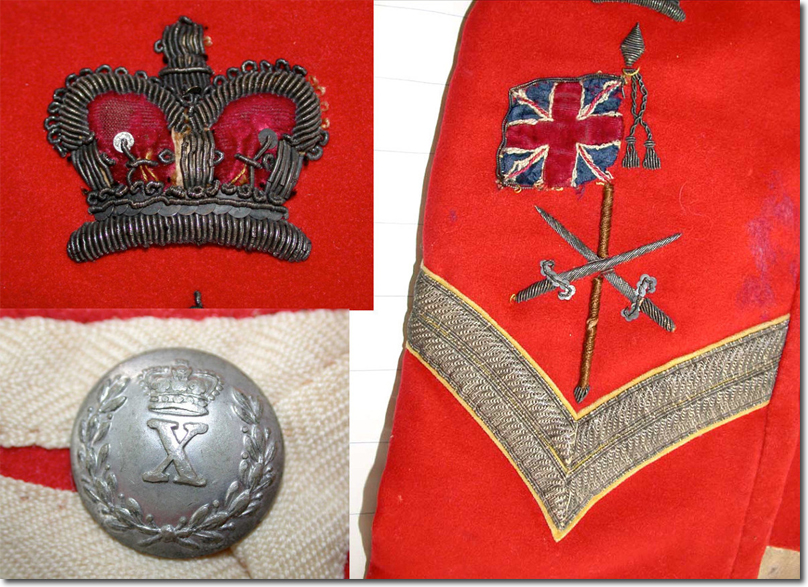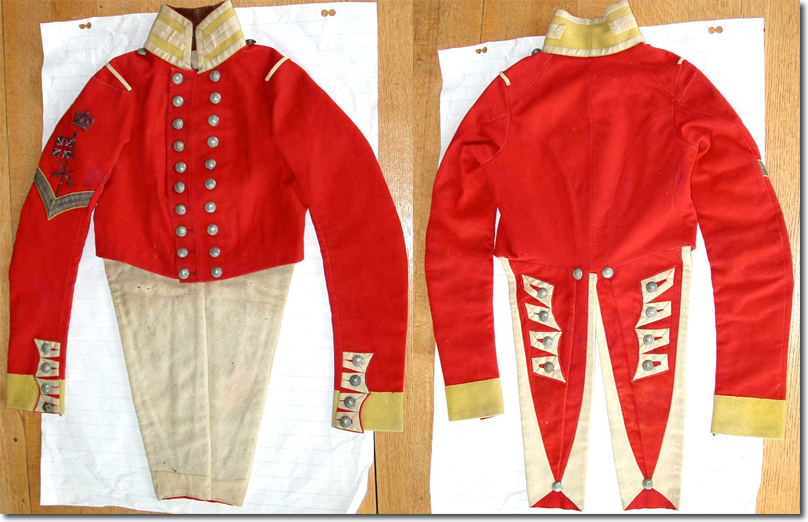
The rank of Colour Sergeant, introduced in 1813, was indicated by a single chevron on the right arm with a Union Colour, crossed swords and crown, all embroidered apart from the chevron which was a doubled length of gold lace on a backing of the facing colour. In flank companies the Colour Sergeant had this badge on the right arm and three chevrons on the left. But this coat was worn in a battalion company so had no chevrons on the left arm.
The rank-and-file wore single-breasted coatees with laced button-holes which covered the front. The lace pattern that was established in 1768 continued to be worn until 1836 when it was replaced by plain white lace. In the same year, sergeants’ lace was abolished and the coatee was double-breasted as seen in this example. The two vertical rows of 10 buttons were virtually parallel. The yellow collar was edged with white lace and had a single laced button-hole on each side, without a button.
The cuffs were yellow with a scarlet flap embellished with four white metal buttons and laced button-holes. A similar pattern was repeated on the two false pocket flaps on the coat-tails. There were further buttons on the points where the white turn-backs met at the base of the tails and two on the back at waist level. There were also two small buttons on the shoulder where white epaulettes were worn, kept in place with the two white loops on the point of the shoulder.
The details below show the Colour Sergeant’s badge and the embroidered crown which was placed above the flag. The white metal button is better quality than that worn by the men. Officers had gilt buttons from 1830, the year that the regular infantry ceased to have silver epaulettes, buttons and belt plates. However, sergeant-majors had silver lace.
It is interesting to compare this Colour Sergeant’s coat with that of a Colour Sergeant 1822 of the King’s Regiment. To see how the coat was worn on parade the print of the King’s Regiment in 1839 shows a sergeant next to the men, to compare coats, and to see the difference between officers and other ranks.
The photos are from Historical Twist Store: https://historicaltwiststore.com/index.php?main_page=product_info&products_id=413