

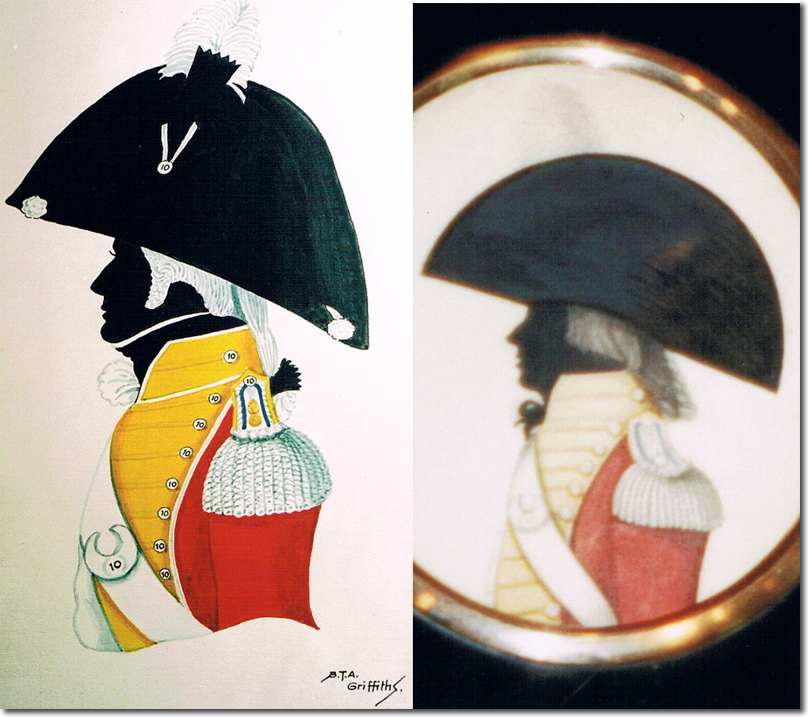
These silhouette miniatures show two officers of the grenadier company, 10th Foot. The image on the right is a poor quality photo of an actual miniature while the left-hand image is a copy of another miniature made by B T A Griffiths. The fact that they have an epaulette on the left shoulder indicates that they are either grenadiers or field officers. However, Griffiths’ painting shows a gilt grenade on the strap of the epaulette, and careful examination of the other portrait reveals a silver grenade badge. In both cases the coat is worn with the lapels buttoned back, fastened down the front with hooks and eyes. This indicates that the officers are in full dress. The buttons are evenly spaced and the button-holes are twists of yellow thread instead of silver lace as seen in the 1795 miniature. The Griffiths portrait appears to show the coat only fastened near the top so that the officer’s shirt, or waistcoat is exposed. There is also a difference in the neckwear. In one case a white ruffled frill appears and in the other a black bow, and no sign of shirt collar above the black stock. The white edging around the collar and lapels is only seen in one of the images.
The epaulettes appear similar to the one seen in the 1795 miniature except for the blue line tracing the rope-like edge, perhaps inspired by the rank-and-file lace pattern. The buttons are marked with 10 and the crescent-shaped belt plate also has the number.
The cocked hat worn fore-and-aft, as in the 1798 portrait, was worn on dress occasions. For parades they would probably wear their fur caps. On campaign, either a plainer cocked hat or the first pattern shako. The dress hat worn by Griffiths’ officer has a silver lace strap and button just below a black silk cockade and a white plume. There are silver rose-like ornaments on the front and back corners. The hat in the other painting has less ornamentation, but there is the suggestion of a white plume attached to the other side of the hat. Perhaps the hat could be worn either way round.
The hair is powdered in both cases, tied with a bow in the left-hand painting, and plaited and turned up in the right-hand painting

