

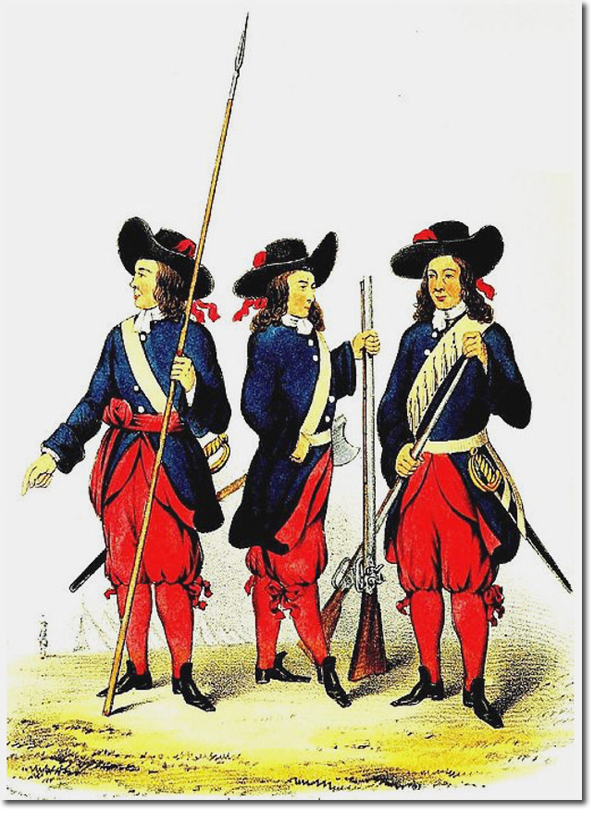
This print was published in Cannon’s Historical Record of the Tenth. They represent three types of infantrymen. The musketeer on the right is armed with a snaphance or flintlock musket and has a bandolier on his shoulder with cartridges. He also has a sword. The pikeman on the left also has a sword and carries a pike which varied in length from 13 to 18 feet. Pikemen and sergeants wore a sash around their waist. The central figure is a grenadier who is armed with a hatchet and a bag of grenades slung from the left shoulder. The grenades would need to be ignited using a burning taper kept in a match-case attached to his shoulder-belt, but not seen here. His musket was at this time a better one than those carried by the musketeers, a lighter flintlock, but should have a sling attached.
The Earl of Bath’s (Granville’s) Regiment of Foot was unusual in having blue coats when it was raised in 1685. These were faced with red, and waistcoats and stockings were also red. The reason for blue is not known but the livery for the Earl of Bath at this time was blue with red cuffs and linings, so he may have had some clothing available. The regimental history states that the blue coats were changed to red with red facings in 1691. It must be mentioned that blue-coated infantry did appear in England as a compliment to the Prince of Orange when he arrived in 1688 as his Dutch troops wore this colour, and regiments raised in England by King William often had blue coats. The blue coat became discontinued and this brought back the red coat of the Stuarts. The linings may have been changed to yellow in William’s reign (1689 - 1702), and continued until 1881.

