

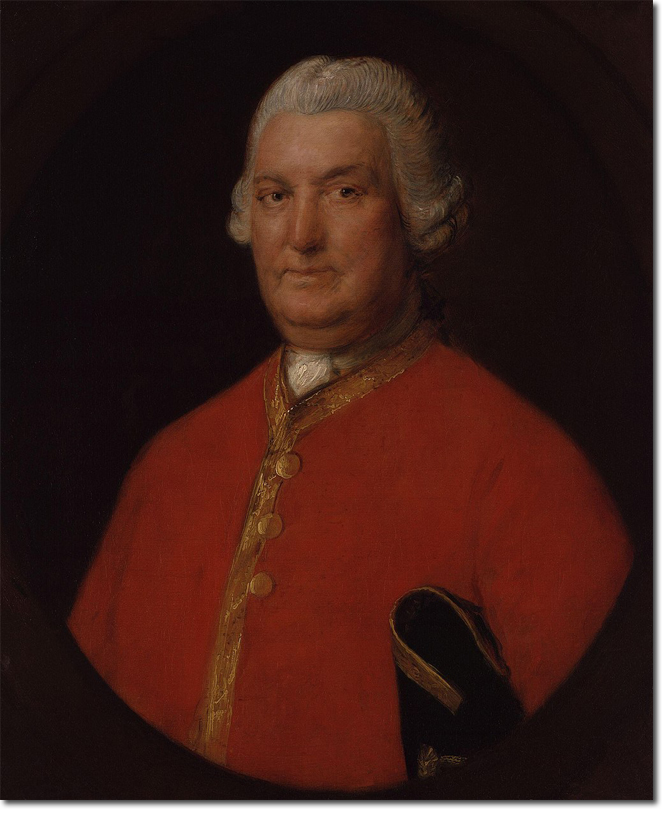
Stringer Lawrence began his military career in 1727, serving in Gibraltar and Flanders before participating in the Battle of Culloden. By 1748, he had attained the rank of major and was widely respected as a seasoned soldier. That year, he was dispatched to India to take command of the East India Company’s forces at a time when French ambitions—led by Joseph François Dupleix—threatened British dominance in the south.
Soon after arriving at Fort St David, Lawrence was drawn into active conflict. He thwarted a surprise French attack at Cuddalore but was later captured by a French cavalry patrol at Ariancopang (modern-day Ariankuppam) while en route to assist Admiral Edward Boscawen in the Siege of Pondicherry. He remained a prisoner until the Treaty of Aix-la-Chapelle brought peace.
In 1749, Lawrence led the successful capture of Devicota. Among his junior officers was Robert Clive, who would later rise to become Commander-in-Chief of British India. Their collaboration sparked a lifelong friendship. When Clive was later honoured with a ceremonial sword, he insisted that Lawrence receive one as well, recognizing him as the true founder of the Indian army.
Lawrence returned briefly to England in 1750 but was back in India by 1752. Upon arrival, he found Clive commanding a force tasked with relieving Trichinopoly. As the senior officer, Lawrence assumed command but made a point of crediting Clive for his contributions. Their efforts led to the successful relief of the city and the surrender of the French besieging force.
Over the next several years, Lawrence continued to distinguish himself. In 1752, he defeated the French at Bahour despite commanding a smaller force. He again relieved Trichinopoly in 1753 and spent the next seventeen months defending it, culminating in a three-month armistice that evolved into a conditional peace treaty. He remained commander-in-chief until regular Crown forces arrived.
In 1757, Lawrence participated in operations at Wandiwash, and from 1758 to 1759, he commanded Fort St George in Madras during a French siege led by General Lally. Ill health forced his return to England in 1759, but he resumed his post in 1761 as major-general and commander-in-chief. In recognition of their enduring friendship, Clive granted Lawrence an annual annuity of £500 to supplement his modest income.
In 1765, Lawrence chaired the board responsible for reorganizing the Madras army. He retired the following year.
Lawrence spent his retirement as a cherished guest of Sir Robert Palk, 1st Baronet, at Haldon House in Dunchideock, Devon. Palk, a fellow East India Company officer and former Governor of Madras, remained a close companion.
Lawrence died in London on 10 January 1775 and was buried in Dunchideock Church, the parish church of Haldon House. In a final gesture of friendship, he bequeathed £50,000 to Palk—a staggering sum at the time.
To honour Lawrence’s memory, Palk commissioned several grand monuments. The most striking is the 85-foot (26-metre) triangular Lawrence Tower at Haldon House, featuring a life-size statue of Lawrence dressed as a Roman general and adorned with tablets detailing his military achievements. A mural monument was also installed in Dunchideock Church.
Palk named his son and heir Lawrence in tribute, beginning a family tradition that would endure for generations.
Portrait of Stringer Lawrence by Joshua Reynolds

