

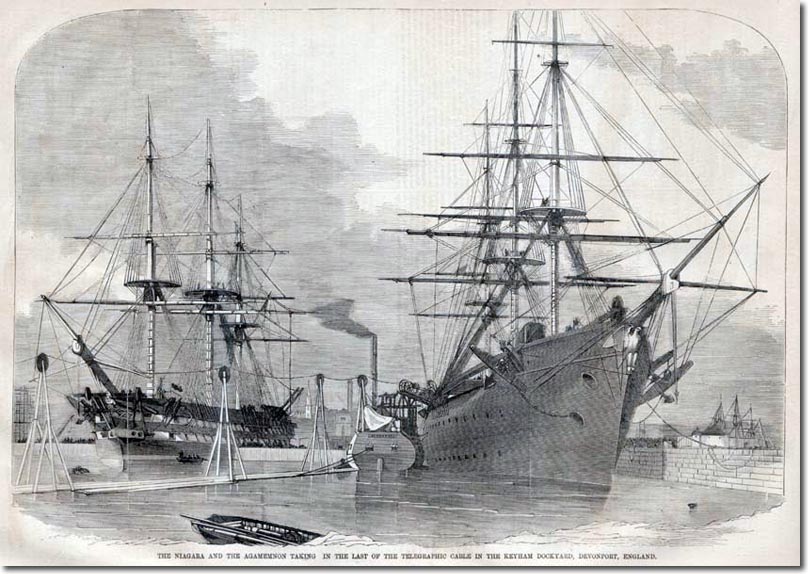
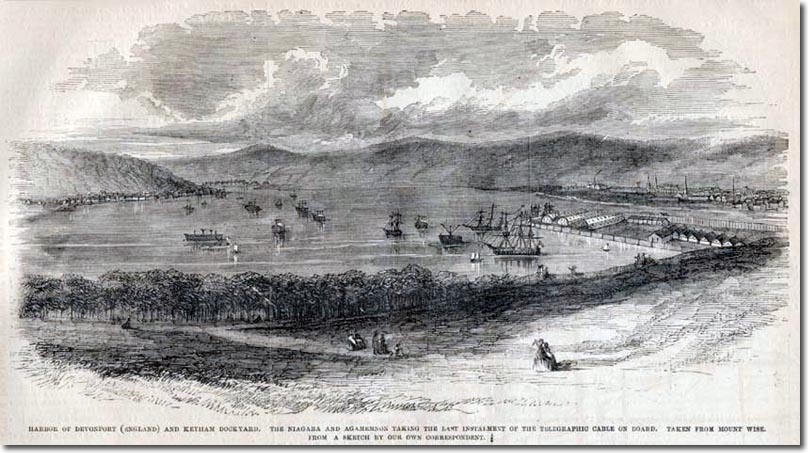
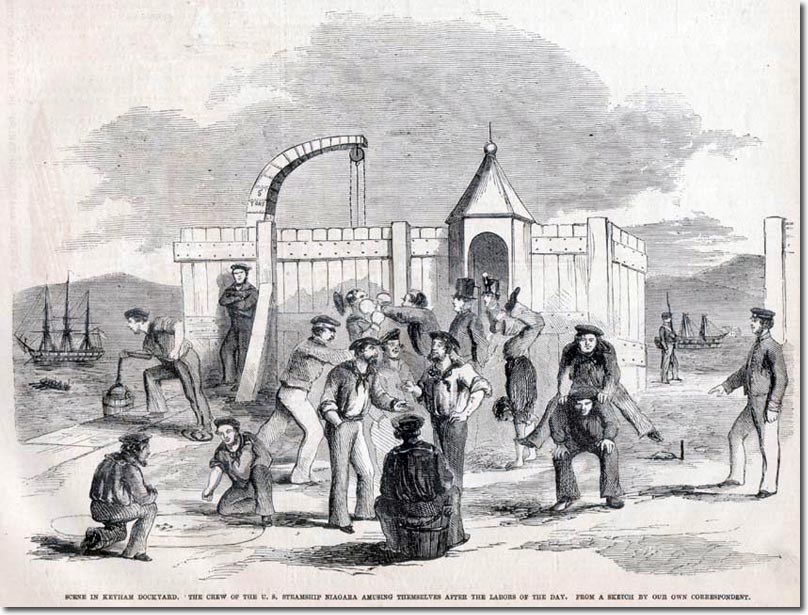
In the summer of 1858, two ships—HMS Agamemnon and USS Niagara—lay moored at the Keyham Steam Yard in Devonport, their hulls heavy with a singular cargo: over 3,000 miles of insulated copper cable. The image above, showing the Niagara and the Armstrong docked at Keyham, captures a pivotal moment in the history of global communication. It was here, in the newly built yard, that the final preparations were made for one of the most ambitious engineering feats of the nineteenth century: the laying of the first functioning underwater telegraph cable between Europe and North America.
The project was a joint Anglo-American venture. HMS Agamemnon was donated by the British government, while USS Niagara was provided by the United States. Both vessels had visited Plymouth the previous year, returning from an unsuccessful attempt to lay the cable in 1857. That earlier expedition had been plagued by technical failures and poor weather, resulting in the loss of the cable mid-ocean. But lessons were learned, and in 1858, the ships returned to Keyham to reload with fresh cable and renewed determination.
Keyham itself was emblematic of Britain’s industrial confidence. The steam yard had been recently expanded to accommodate the growing demands of naval engineering and maritime logistics. Its dry docks and cable-handling equipment were among the most advanced in the empire, making it the ideal staging ground for a transatlantic operation. The cable—coated in gutta-percha and armoured with iron wire—was carefully coiled into the holds of both ships, its weight distributed to maintain balance during the voyage.
Once loaded, the Agamemnon and Niagara sailed westward, meeting mid-Atlantic to begin the delicate process of cable laying. The operation required constant coordination, precise navigation, and steady deployment of the cable from the stern. This time, the effort succeeded. The cable was laid from Valentia Island in Ireland to Heart’s Content in Newfoundland, linking the continents by electric signal for the first time in history.
The achievement was more than technical—it was symbolic. Messages that once took weeks to cross the ocean could now be transmitted in minutes. Diplomacy, commerce, and journalism were transformed. Plymouth’s role, and Keyham’s contribution in particular, placed the city at the heart of a global revolution in communication. The image of the Niagara at dock, smoke rising from its stacks, stands as a visual testament to that moment of convergence—where steam, steel, and signal met to shrink the world.

