

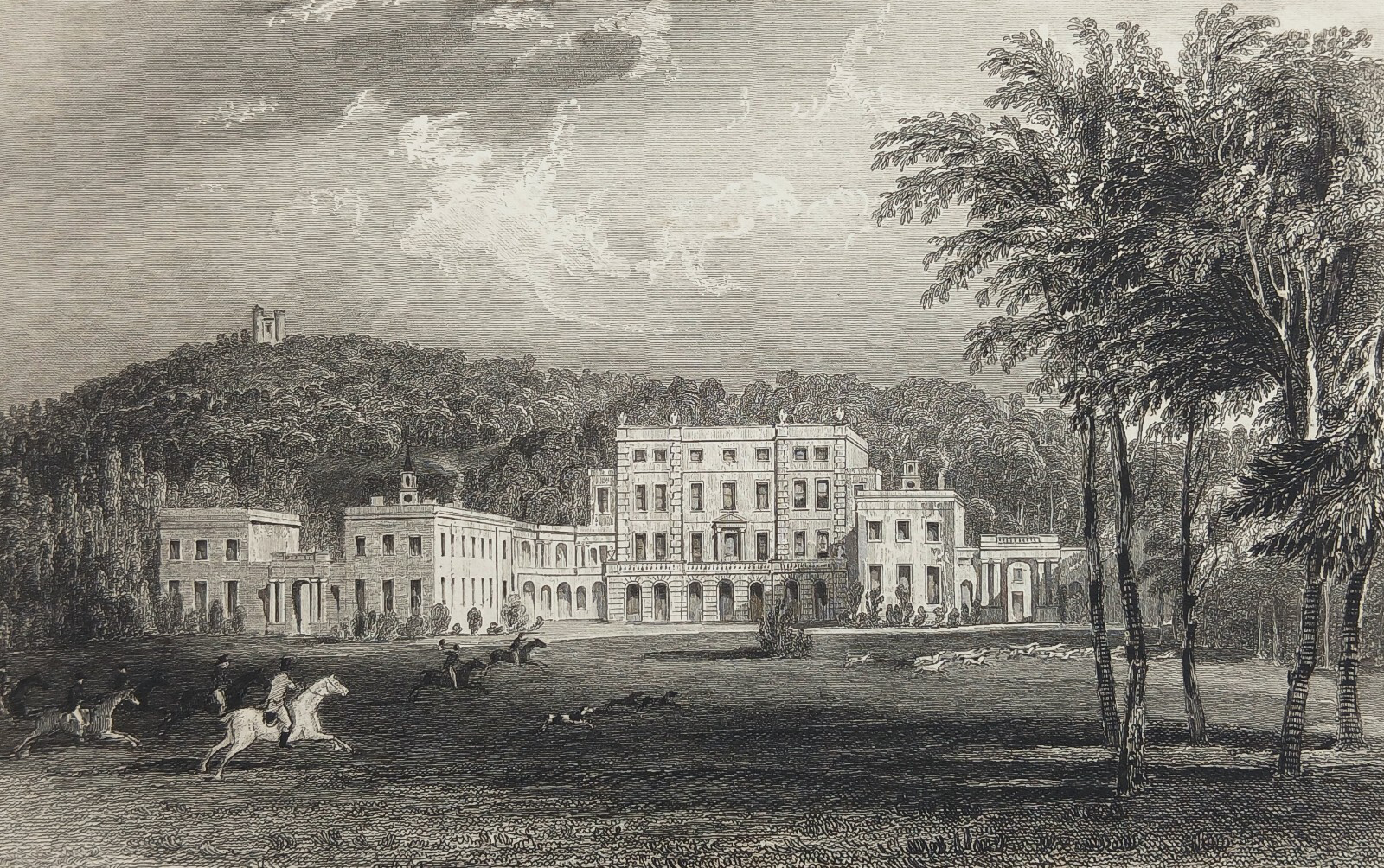
The picture above shows a hunt riding past Haldon House in 1829 it was engraved by W. Le Petit in 1829. You can clearly see Lawrence's Castle in the background. Below you can see a painting of the wider area from 1780 which was before Lawrence's Castle was constructed.
Haldon House was constructed around 1735 by Sir George Chudleigh, 4th Baronet (d. 1738), and is believed to have been inspired by Buckingham House in London, built circa 1715. Upon Sir George’s death, his daughter Frances inherited the Haldon and Ashton estates. She married Sir John Chichester, 5th Baronet (1721–1784), who already owned the grand Youlston Park in North Devon. Frances and Sir John sold Haldon to Mrs Anne Basset.
Anne Basset (née Prideaux, 1718–1760) was the daughter and co-heiress of Sir Edmund Prideaux, 5th Baronet of Netherton. She had previously been married to John Pendarvis Basset (1713–1739) of Tehidy in Cornwall, a member of a junior branch of the prominent Basset family of North Devon. Following the death of her only son, John Prideaux Basset, in 1756 at age 16, Anne sold Haldon to John Jones, Esq., who then sold it to William Webber. Webber eventually sold the estate to Sir Robert Palk.
Sir Robert Palk, 1st Baronet (1717–1798), a former East India Company officer and Governor of Madras, purchased Haldon House for £10,000. He undertook extensive renovations, enlarging the structure and enhancing the grounds. He added two projecting wings to the east-facing front and, according to historian Richard Polwhele (writing in 1793), lowered the surrounding terrain to expose the basement level, effectively transforming the house from three to four storeys. Palk also covered the original brickwork with stucco to mimic stone, installed two geometrical staircases, and laid a new hall floor using red and yellow wood taken from the French during a siege in the East Indies.
Not everyone admired Palk’s alterations. John Swete (1752–1821), a nearby resident of Oxton House and chronicler of Devon’s gentry estates, criticized the addition of the wings. Nonetheless, Polwhele noted that Palk had planted thousands of trees and relocated the formal garden further from the house, creating a fifty-acre landscape of lawns and plantations.
Major-General Stringer Lawrence (1697–1775), Palk’s close friend from their time in India, spent his retirement at Haldon House. Upon his death, he bequeathed £50,000 to Palk. In tribute, Palk erected the 26-metre-high triangular Lawrence Tower (also known as Haldon Belvedere) in 1788 on a nearby ridge. The tower remains a prominent landmark. Among the distinguished visitors to Haldon House was King George III, whom Palk personally escorted to view the tower via a specially constructed carriage drive.
Sir Robert Palk was succeeded by a line of heirs: Sir Lawrence Palk, 2nd Baronet (c. 1766–1813); Sir Lawrence Vaughan Palk, 3rd Baronet (1793–1860); Sir Lawrence Palk, 4th Baronet (1818–1883), who was elevated to Baron Haldon in 1880; and Lawrence Hesketh Palk, 2nd Baron Haldon (1846–1903). The later Palks spent little time at Haldon, preferring their properties in Torquay, where they were heavily involved in the town’s development.
Lawrence Hesketh Palk, an avid gambler, inherited the estate burdened with mortgage debts reportedly reaching £400,000. He was declared bankrupt in January 1891, and the sale of Haldon’s art and valuables began the following month. In 1892, the house was sold to Thomas Bedford Bolitho, a Cornish banker and Member of Parliament.
In 1897, James FitzGerald Bannatyne of Summerville and Fanningstown Castle, County Limerick, purchased Haldon House. A Deputy Lieutenant and Justice of the Peace for Devon, Bannatyne was also one of the original subscribers to the Wireless Telegraph & Signal Company Ltd., later Marconi’s Wireless Telegraph Co. Ltd. Marconi is believed to have conducted early radio transmission experiments from the Haldon Hills.
Bannatyne married Emily Gertrude Wilson of Collipriest Cottage, Tiverton. Their daughter, Mary Stuart Bannatyne, married Major Ludovic Heathcoat-Amory, son of Sir John Heathcoat-Amory, 1st Baronet of Knightshayes Court. Bannatyne died on 18 October 1915, and his only son, Major James Fitzgerald Bannatyne, was killed in action on 14 May 1916 during World War I.
Following these tragedies, Mrs Bannatyne left Haldon in 1919 and placed the estate on the market. Unable to find a single buyer, the property was sold off in parts. By the time of its demolition in 1925, Haldon House boasted six reception rooms, 38 bedrooms, a ballroom, theatre, and chapel seating 100. The house and its gardens, along with a five-acre field, failed to sell even at £1,350. The final parcels of the estate were sold that same year. The chapel’s furnishings were acquired by Clifton College for use in its own chapel.


