Coffee takes at least four years from the planting of seedlings to getting a viable crop, so you had to find ways of living in the meantime... Then there was the depression in the 20s. not as bad as the one in the 30s but quite bad - and the price of coffee went right down and so we struggled on until my father had to sell the farm in 1923 or 1924." Elspeth Huxley
 |
|
|
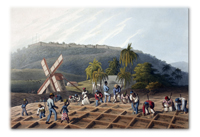
A staple form of agricultural production throughout the entire history of the British Empire was the plantation. From the earliest phases of imperial expansion, it was evident that the plantation model offered sufficient economies of scale to make the cultivation of export-oriented goods viable across a wide range of climates and geographies. The first wave of plantations emerged in the New World, focused on the production of sugar, tobacco, and cotton—commodities that were in high demand across Europe and beyond. These estates were often vast, with monocultural farming practices tailored to maximise output and simplify logistics. The plantation system proved remarkably durable, surviving well into the twentieth century and adapting to new contexts. Coffee in East Africa, rubber in Malaya, and tea, indigo, and jute in India are all examples of crops that were cultivated under this model into the era of independence and beyond. In Ceylon, tea estates became synonymous with British commercial identity, while in Assam and Bengal, jute mills and indigo vats formed part of a broader industrial landscape tied to imperial trade. In Fiji and Mauritius, sugar remained the dominant crop well into the postcolonial period, shaping both the economy and the demographic profile of these island colonies.
Establishing a plantation typically required a substantial initial outlay. Land acquisition, housing for workers, irrigation systems, and the procurement of seeds or saplings all demanded capital. While some technical knowledge was necessary, the focus on a single crop often allowed for rapid accumulation of expertise. Much of this was acquired through trial and error, with planters testing a range of crops before settling on one that suited local soil and climate conditions. In East Africa, for instance, early experiments included cotton, sisal, and even vanilla before coffee emerged as the most viable option. Even then, planters debated the merits of Arabica versus Robusta beans, with varietal selection influenced by altitude, rainfall, and market preferences. The Empire facilitated the movement of seeds, cuttings, and agricultural techniques across continents, creating a vast network of botanical exchange. Kew Gardens played a central role in this process, acting as a clearinghouse for specimens and a hub for imperial agronomy. Experimental farms and botanical stations were established in colonies from Jamaica to Calcutta, each contributing to the refinement of crop selection and cultivation methods.
 |
|
|
Despite its scale and reach, the plantation system faced two persistent challenges. The first was the sheer volume of labour required to maintain operations; the second was its vulnerability to fluctuations in global commodity prices. In the New World, the labour problem was initially addressed through the transatlantic slave trade, which supplied a workforce for sugar and cotton estates in the Caribbean and American South. The abolition of the slave trade in 1807, followed by the outlawing of slavery itself in 1833, did little to reduce the demand for cheap, controllable labour. Many plantation owners turned to indentured labour schemes, recruiting workers from densely populated regions such as India and southern China. These migrants were contracted to work for fixed periods in exchange for passage, subsistence, and nominal wages. The system led to large-scale internal migration within the Empire, with workers dispatched to colonies as far afield as Trinidad, British Guiana, Natal, and Malaya. In practice, the conditions were often harsh, with long hours, minimal pay, and limited legal recourse. The Indian government formally banned indentured emigration in 1917, but by then, the system had already shaped the demographic and economic contours of numerous colonial societies. Even after formal abolition, many workers remained tied to plantation economies, their livelihoods dependent on the rhythms of harvest and export.
The inability of plantations to adapt to shifts in global commodity markets proved to be one of their most persistent structural weaknesses. Geared toward the cultivation of a single crop, these estates were inherently inflexible. Agricultural planning required long lead times, and once land had been cleared, infrastructure built, and labour systems established, it was rarely feasible to pivot to alternative produce. Soil conditions, climate, and local expertise often reinforced this rigidity. Sugar in the West Indies offers a clear example: when European producers began cultivating sugar beet—a crop that could be grown in temperate climates and processed with relative ease—the demand for Caribbean cane collapsed. Entire estates became economically unviable almost overnight, and thousands of workers, including enslaved and indentured labourers, were rendered surplus to requirements. Similar disruptions occurred with indigo in Bengal after the rise of synthetic dyes, and with rubber in Malaya when competition from Brazil and later synthetic alternatives altered global supply chains.
 |
|
|
This pattern repeated itself across the Empire well into the twentieth century. The economic model underpinning plantation agriculture was predicated on imperial integration: colonies specialised in particular commodities and traded within a protected network. Once that network fragmented—through decolonisation or shifts in trade policy—individual countries found themselves exposed to the volatility of international markets. Nations like Guyana, Malawi, and Sri Lanka inherited economies heavily reliant on a narrow range of exports, making them vulnerable to price shocks and demand fluctuations. Even during the height of imperial cohesion, planters frequently voiced frustration at commodity prices being set in distant financial centres such as London, Paris, New York, or Chicago. These grievances fuelled calls for imperial preference, protective tariffs, and guaranteed markets—measures that were occasionally adopted but never fully resolved the underlying fragility. In the interwar years, conferences on imperial trade policy often featured plantation representatives lobbying for stabilisation schemes and subsidies, particularly for crops like rubber, cocoa, and tea.
Plantations were unwieldy and unpleasant institutions at the best of times, but their existence and operation were often critically important to the lifeblood and economic development of many of the colonies. They shaped land use, labour patterns, and demographic structures, often leaving a lasting imprint on rural economies and settlement geographies. Estate boundaries, irrigation systems, and transport links built to serve plantation needs still influence infrastructure in former colonies. In places like Mauritius, Trinidad, and Kerala, the legacy of plantation labour systems continues to inform social hierarchies and community identities. While the system was often harsh and inflexible, its historical significance in structuring imperial economies remains evident in the agricultural and economic landscapes of the postcolonial world.
|



