|
In 1858, Sir Charles Trevelyan, Governor of Madras, confidently declared that “Arthur Cotton’s name will be venerated by millions yet unborn, when many who now occupy a much larger place in the public view will be forgotten.” The statement proved profoundly mistaken. Far from being venerated, General Sir Arthur Cotton is scarcely remembered today. Yet Trevelyan’s prediction, though unfulfilled, was not without justification: Cotton’s work saved millions of lives.
Cotton was an engineer of uncommon vision. In India, he designed and constructed dams and irrigation canals that transformed barren landscapes into fertile agricultural zones. During one of the subcontinent’s devastating famines, in which four million people perished, his irrigation works were credited with preserving the entire population of his district and producing sufficient surplus to sustain an additional three million elsewhere.
His achievements were remarkable, though not unique. Cotton belonged to a distinctive cohort of nineteenth‑century British engineers whose feats were so frequent and transformative that contemporaries came to regard their “miracles” as routine. Like him, most have since faded into obscurity, their names preserved only in parliamentary reports and company archives. Yet collectively they reshaped the modern world.
These engineers extended the Industrial Revolution to the furthest reaches of empire and beyond. They introduced railways into regions unfamiliar even with the wheel, and they carried the electric telegraph through jungles scarcely removed from the Stone Age. They tamed rivers long feared for their destructive force and redirected them to irrigate deserts. They excavated mines, constructed harbours that converted villages into international ports, and devised sanitation systems that curbed epidemics in cities notorious for disease. To societies reliant on animal power, they introduced the machinery of modern industry.
In the course of a single century, they laid the infrastructure of modern life for Britain’s colonial subjects—foundations upon which many contemporary nations still depend. While critics today argue that the political and economic costs of imperial domination were excessive, the material contributions of these engineers cannot be dismissed.
The exploits of such men were celebrated in the Victorian press, often with patriotic fervour. A report in the Daily Mail on William Willcocks’s completion of the Great Nile Dam in 1902, for example, depicted the English engineer as a solitary figure of authority, directing a vast and diverse labour force with apparent ease. Such accounts reinforced Britain’s sense of national superiority, presenting engineering as both a civilising mission and a demonstration of imperial power.
Yet the reality of an engineer’s life abroad was far harsher than these romanticised portrayals suggested. As Rudyard Kipling observed, they “mostly cursed their work, yet carried it through to the end, in difficult surroundings, without help or acknowledgement.” Isolated from their families—or forced to watch them endure the same hardships—engineers contended with disease, hostile climates, sudden death, and at times violent resistance from local populations. Cotton himself was repeatedly incapacitated by fever, while Alex Taylor, who oversaw the Punjab section of the Grand Trunk Road, suffered temporary blindness, a common affliction under the Indian sun. Many others perished in floods, construction accidents, or remote outposts where their bodies were scarcely recovered.
Despite these conditions, they persevered, motivated by a conviction that their work served humanity. The Victorian essayist Thomas Carlyle described this as history’s assignment to Englishmen: “the grand industrial task of conquering half or more of this terraqueous planet for the use of man.” For a time, Britain was uniquely positioned to fulfil this role, as the world’s first industrialised nation, its sole great workshop, and its dominant trading and investing power. The exhilaration of mastering nature was, for Victorians, both a national mission and a personal calling.
Not all local populations welcomed these projects, but some engineers demonstrated a pragmatic ability to negotiate cultural resistance. When the Zakka Khel tribes of the North‑West Frontier opposed the construction of the Khyber Pass Railway, Victor Bayley persuaded their chief by pointing out the opportunities for looting the slow‑moving, merchandise‑laden trains. The chief, recognising the advantage, relented: “The Sahib builds the railway; we loot the trains. Build that railway quick, Sahib.”
Nowhere, however, were British engineers more influential than in India, which Victorians hailed as “the greatest achievement of the English race.” This achievement was largely the work of a small cadre of men, many trained at the East India Company’s Addiscombe College near Croydon. Of the 3,600 cadets educated there over fifty‑two years, only about 500 became engineers—yet their impact was immense.
Among them was Arthur Cotton. Born in 1803, the tenth son of the tenth son of a baronet, he came from a family distinguished more by service than by wealth. His brothers included generals, an admiral, a Royal Engineers officer, a civil servant, and a clergyman who became Provost of Worcester College, Oxford. Cotton himself entered Addiscombe at fifteen and by twenty‑three had already gained experience in both warfare and engineering. He fought in the Burmese War of 1824–26, which he described as “a very melancholy business, inconceivably mismanaged,” yet distinguished himself by leading seven storming parties against enemy fortresses.
Cotton embodied many quintessential Victorian traits: courage, moral rigidity, and evangelical piety. After losing £20 in a card game, he renounced gambling altogether and forbade playing cards in his household. He was equally forthright in his religious convictions, once provoking fellow officers on a voyage to India by requesting a Bible in the midst of a gin‑soaked saloon. His engineering talents soon became evident, particularly in his work on the Cauvery River in southern India, where vast quantities of water flowed unused into the sea. Cotton devised a scheme to harness this resource for irrigation, though recurring bouts of fever repeatedly interrupted his efforts and eventually forced him to return to England on sick leave in 1830.
By the mid‑1830s, Cotton was able to implement his long‑conceived plans for the Cauvery. The project, unprecedented even in Europe, comprised two major dams and extensive canal systems. An official described it as “the greatest blessing that had ever been conferred” upon the province. The East India Company, measuring success in financial rather than humanitarian terms, was equally satisfied: one system yielded a 69 per cent annual return on capital, the other an extraordinary 100 per cent.
Ill‑health, however, remained a constant adversary. In 1838 Cotton was again forced to leave India, this time for Australia. There he indulged his fascination with machinery, designing a centrifugal steam engine that anticipated later turbine technology. The experiment ended in disaster when the boiler exploded, severely injuring his legs, though he proudly reported achieving 150 revolutions per minute. During this period he also pursued a more personal ambition: marriage to Elizabeth Learmonth. “If God would give me so great a gift,” he wrote, “I would marry that girl.” In 1841 he returned to India with her as his wife.
Life for the young family was precarious. Jackals prowled outside their home, snakes dropped from rafters into cradles, and blasting from nearby works forced Elizabeth to bring the children indoors almost daily. Stones shattered walls, floods swept through the house, and snakes sought refuge inside. On one occasion she barely managed to save the family’s two most treasured possessions: a copy of Madame Guyon’s Autobiography and her husband’s cocked hat. Cotton expected his family to endure such hardships stoically. “If you want rest,” he instructed his children, “vary your employment.”
He also instilled in them the quintessential Victorian virtues of religion and patriotism. Each morning at six he led family prayers—any later would have been too hot. Patriotism was treated with equal seriousness. His daughter later recalled the family standing on the deck of a ship in Mauritius Harbour, moved to tears as they heard God Save the Queen. Wherever they travelled, they believed themselves secure under the protection of Empire, and often this faith was vindicated.
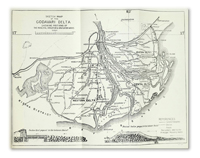
In 1844 Cotton undertook his most ambitious project: the regulation of the Godavari, India’s third‑largest river. The region south of Madras through which it flowed was among the poorest in the subcontinent, repeatedly devastated by famine. Corpses lined the roads, peasants sold their daughters for food, and grain convoys required armed escorts. Summoned to assess the crisis, Cotton observed bluntly: “I could not help seeing what it wanted, which was simply everything.”
What it required above all was irrigation. Yet damming the Godavari was a formidable challenge. Its discharge—1.5 million cubic feet per second—was three times that of the Nile at Cairo and two hundred times that of the Thames at Staines. Cotton requested six officers and eight sappers to conduct a detailed survey. The parsimonious Company, however, allotted him only “one young hand to teach and two apprentice surveyors.”
Despite these obstacles, Cotton pressed ahead. The Godavari anicut, completed in 1852, stretched nearly two miles across the river and fed a vast network of canals. The project irrigated hundreds of thousands of acres, stabilised food supplies, and created conditions for sustained agricultural prosperity. Contemporary observers described the transformation as miraculous: famine gave way to surplus, and a once‑desolate region became one of the most fertile in southern India.
 |
|
|
The financial returns from the Godavari works were as striking as their humanitarian impact. Revenues from water rates and the increased productivity of irrigated land quickly repaid the initial investment, vindicating Cotton’s conviction that irrigation was both a moral imperative and an economic necessity. Yet his triumph did not silence his critics. Within the East India Company, many officials regarded him as visionary but impractical, a man whose evangelical zeal and impatience with bureaucracy made him as troublesome as he was brilliant.
By the 1850s, Cotton had become as much a public advocate as an engineer. He argued relentlessly that irrigation should be adopted as a systematic policy across India, not merely as a series of isolated projects. In pamphlets, reports, and speeches, he insisted that the prevention of famine through irrigation was far less costly than the periodic expenditure on relief, and that the prosperity of India was inseparable from the stability of the Empire. His writings, widely circulated in Britain, gave him a reputation as a reformer who combined technical expertise with moral urgency.
This advocacy, however, often placed him at odds with the Company’s priorities. Cotton denounced bureaucratic inertia in uncompromising terms, and his independence of mind alienated many of his superiors. His proposals for large‑scale irrigation schemes were frequently dismissed as unrealistic or too costly. Yet his influence endured. Younger engineers and reformers drew inspiration from his example, and his arguments helped to shape later debates on colonial infrastructure and famine prevention.
Ill‑health continued to dog him, forcing repeated absences from India. During these periods he wrote extensively, producing a body of literature that blended technical detail with evangelical fervour. He presented irrigation as a Christian duty, a means of saving lives and fulfilling Britain’s providential role in the world. This fusion of engineering and moral mission made him a distinctive figure in the Victorian imagination: part scientist, part prophet.
In retirement, Cotton remained a tireless advocate for irrigation, continuing to publish and lecture well into old age. To some, he was a humanitarian pioneer; to others, an eccentric zealot whose single‑mindedness bordered on obsession. When he died in 1899, his passing attracted little public notice, a striking contrast to Trevelyan’s confident prediction four decades earlier that his name would be “venerated by millions yet unborn.”
Yet Cotton’s legacy is undeniable. His works on the Cauvery and the Godavari transformed vast regions of southern India, saving countless lives and laying the foundations for agricultural prosperity that endured long after his death. More broadly, he exemplified a generation of British engineers whose labours carried the Industrial Revolution across continents, reshaping landscapes and societies in ways that continue to define the modern world.
Cotton’s career also illustrates the paradox of imperial engineering. His projects alleviated suffering and fostered development, yet they were inseparable from the structures of colonial domination. His life thus embodies both the humanitarian aspirations and the political contradictions of Victorian imperialism. To study Cotton is to confront the dual legacy of empire: the capacity to transform and to oppress, to save lives and to subordinate nations.
Arthur Cotton’s career exemplifies the transformative potential of nineteenth‑century engineering while also highlighting the tensions inherent in imperial contexts. His irrigation works on the Cauvery and the Godavari demonstrably altered the economic and social landscape of southern India, mitigating famine and enabling agricultural expansion on a scale previously unimaginable. These projects illustrate the capacity of applied science to reshape environments and sustain populations.
At the same time, Cotton’s work was inseparable from the structures of British colonial rule. His projects were conceived within, and facilitated by, imperial authority, and their benefits were measured not only in humanitarian terms but also in revenue and administrative control. Cotton himself combined technical expertise with evangelical conviction, interpreting engineering as both a professional duty and a moral mission.
Historians continue to debate how such figures should be remembered: as humanitarian innovators, as agents of empire, or as both. What is clear is that Cotton’s career sheds light on the broader processes by which the Industrial Revolution was exported across the globe, leaving material legacies that persist into the present. Trevelyan’s prediction that Cotton’s name would be “venerated by millions yet unborn” was not fulfilled in the literal sense, but the enduring impact of his works ensures that his influence remains embedded, if often unacknowledged, in the lived realities of those who still depend on the waters he helped to harness.
|