|
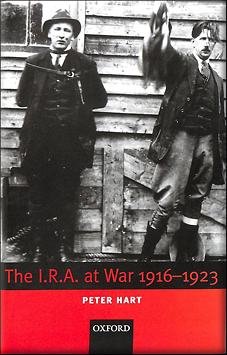
At first glance, you might think that this Oxford University Publication is a heavy weight academic tome likely to bore the pants off of anyone who wants to read it. Certainly there are many books written by academics for academics which are deadly dull for the lay reader but this book is not one of them. This book is surprisingly accessible despite the dark nature of its subject matter. It is also a book that often uses evidence to devastating effect as it explodes cherished myths and perceived wisdom and follows the data remorselessly. Indeed that is one of the core messages behind this book. That the period from 1916 to 1923 is unusual in that there is so much data and information for a war (or series of wars) so long ago. The authorities, police, courts, newspapers and even the paramilitaries were diligent in recording their movements, tracking casualties, retaining order, instructions and reporting to a number of institutions. It was also in an era when the state could be naive in matters of censorship or restrictions on the press. Unusually for historians Peter Hart contends that those studying the Irish War of Independence and the consequent Civil War have an abundance of material and data to draw upon. There are not many wars where virtually every victim can be named, his place of death known and frequently the manner of the death is understood and the killers known.
The organisation of the book into 10 chapters each of which is effectively its own essay does not immediately seem to provide a chronological overview of the three distinctive phases of the Easter Rebellion in 1916 through to the Irish War of Independence from 1919 to 1921 and on into the Irish Civil War of 1922 to 1923 but it does actually achieve a compelling overview despite the oddity and seeming randomness of the chapter titles:
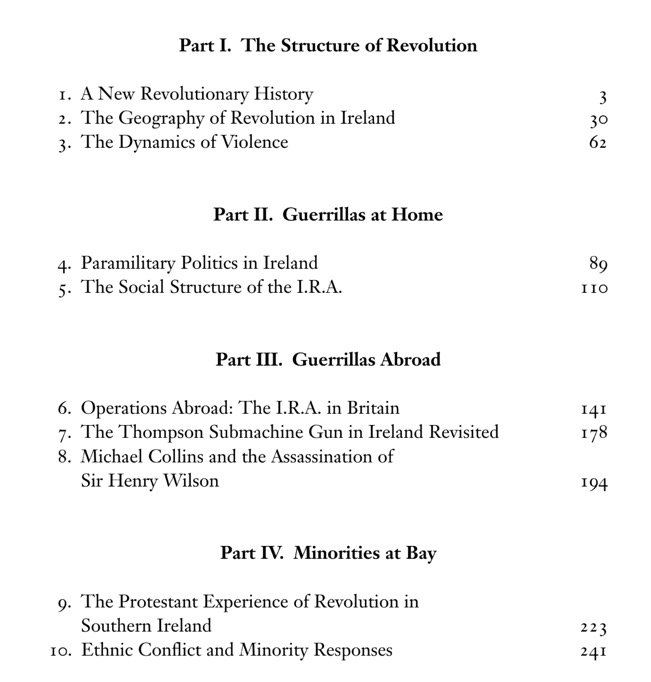
The first chapter explains the importance of the IRA in pioneering tactics in guerilla warfare and terrorism which would sadly but effectively be copied and improved upon by later revolutionaries be they Marxist freedom fighters or religious fundamentalists. Irish Nationalists like Michael Collins discovered a formula of asymmetric warfare, intimidation and violence that allowed them to take on the foremost military power of the age with its military at the largest it would ever be due to The Great War mobilisation and yet not only would they survive the ordeal but ultimately emerge victorious - if only partially victorious in their own eyes due to the severing of Ulster. Intriguingly the author ties the three distinct areas mentioned above together. He argues that the three distinct phases very much flowed from one to the other with similarities, inspirations and consequences running through all three. He also is reluctant to remove Ulster from the story as some kind of aberration on its own trajectory. He believes that there were similar motivations and tactics employed, but that it just ended up with differing consequences due to the ability of the Protestant community to mobilise political support in a concentrated form there. Protestants elsewhere in Ireland were too thinly spread to gain such political leverage. What was surprising from the data though was just how many Protestants left Southern Ireland but how few Catholics left Northern Ireland despite the separation. Chapter 9 uses data in a fascinating way to chart the ethnic consequences of the war. It is telling that the book was written in the early 2000s not long after the disintegration of Yugoslavia and its own violent, ethnic divisions. You can tell the author uses places like Bosnia and Serbia to relate the magnitude of ethnic division in 1920s Ireland. As time has passed the relevance of this comparison may be lost on younger readers who do not recall the devastating effects of ethnic division in Europe.
The second chapter uses data to understand the geographical dispersal of violence. It is not too surprising that the core of the fighting took place in Munster and especially in and around Cork. There are some intriguing explanations as to why. We also see how the war flared up in the West too. Although again using data it was interesting to see that the correlation with Sinn Fein supporting areas or Gaelic strongholds were not as strong as I had anticipated them to be. The centre of Dublin was a hotspot due to its location of the seat of the British government in Ireland, but intriguingly the area around Dublin was by far the quietest of all the areas and yet this was also the region with the largest proportion of Protestants outside of Ulster. It should be said that Ulster was indeed another hotspot but its peaks and troughs of violence did not fully coincide with those south of the border. It had its own timeline of revolution and counterrevolution.
I have to say I found the third section of Guerrillas Abroad as the most interesting of all as it is an area often under reported in those interested in Irish history. I did not fully appreciate the extent of the IRA networks in Britain especially those around Liverpool, Manchester and London. Their effectiveness could be hit or miss especially as they tended to be reluctant to carry out murders or assassinations. But their economic sabotage campaigns could be very effective indeed. And they could and did intimidate serving soldiers and auxiliaries in Ireland with threats to family members and arson to their homes on the British mainland. The chapter on the murder of Sir Henry Wilson reads like a whodunnit with the evidence of witnesses and historians gone through forensically and offering a compelling and authoritative conclusion as to who did kill the General in London and why. This rather rare political assassination has often been amplified in importance to explain the lurch in Ireland towards its own Civil War, but Peter Hart gives a far more credible explanation for what happened and why. Similarly the chapter on the eponymous Tommy Gun is fascinating. It is another weapon that has entered mythic folk lore in its importance but again these myths are somewhat deflated as the more mundane battles of diplomacy and counterintelligence effectively neutered the export of over 600 hundred Thompson submachine guns to Ireland. Peter Hart explains how the small existing smuggling networks feeding more traditional pistols, rifles and ammunition were far more effective than these high profile gambles and that eventually the use of explosives stolen from armouries and commercial mining operations were far more deadly than any Tommy Gun would ever be. Again showing the way to subsequent terrorist organisations for whom the IED has become the weapon of choice when the imbalance of technology of warfare makes itself known on the battlefield. There was something of an irony that the IRA ended up selling some of their American purchases to American gangsters to recoup their losses. Some did make it to Ireland but really only in time for the Civil War where it was used by the Irish upon the Irish.
I cannot tell you how thought provoking and interesting this book is. It really should be compulsory reading for people on all sides of the argument and none. It shows how data can be used to explain the past. The IRA has more myths (both positive and negative) about it than most organisations. This book explodes many of those myths (both positive and negative) and puts the IRA and its war firmly into the context of its era. But also the book explains just how and why the IRA was as successful as it was and why it would struggle in using similar tactics against an Irish government rather than a British one. Perhaps the biggest legacy of the IRA is how their tactics inspired so many other freedom fighters and terrorists across the world. The IRA perfected asynchronous warfare against a more powerful opponent. Sadly for them, they found that asynchronous warfare was a lot less formidable when fighting their own people and especially after the Irish Free State and much of the population had become weary of the IRA's tactics. It should also be appreciated that the Irish Free State government was often prepared to be far more ruthless than the British government that it had replaced in fighting its enemy the IRA. Sometimes it takes a thief to catch a thief. The Irish Free State and their leaders knew too much and knew how to get into the mud to fight the IRA. It is yet one more irony that the Irish Free State, initially under the command of Michael Collins no less, was far more successful putting down their insurgency with far fewer resources than the entire British Empire had had available to it when fighting the very same enemy. The IRA discovered that motivation to fight was key. They managed to destroy Britain's motivation to fight in 26 counties but they could not destroy the motivation of the Protestant Community in the 6 counties of Ulster to fight nor could they destroy the motivation of the Irish Free State to honour its diplomatic and treaty obligations. The IRA were defeated not by the British but by the Irish. |