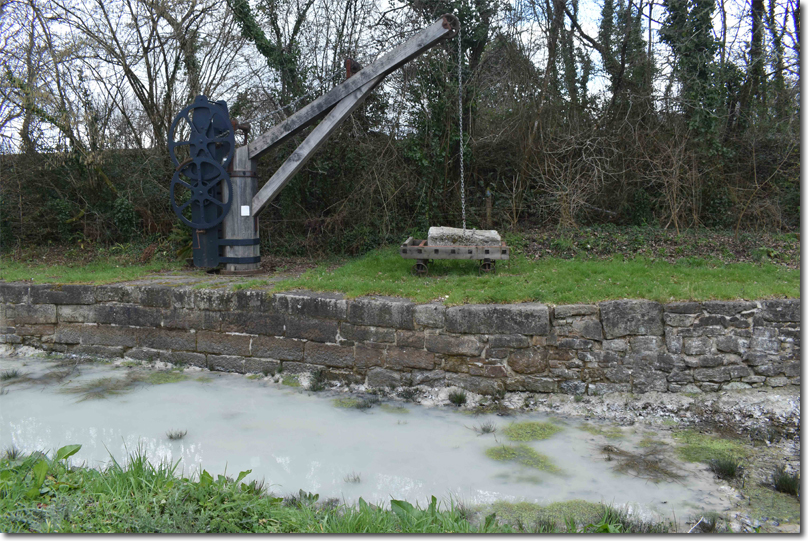
This photograph of Ventiford Canal Basin captures a key junction in South Devon’s early 19th-century transport network. The crane and rail cart visible in the image evoke the basin’s original function: transferring heavy materials—both granite and ball clay—onto canal barges for export.
Granite quarried from Haytor was brought down via the Haytor Granite Tramway, a horse-drawn rail system laid with granite rails. At Ventiford, the stone was loaded using lifting gear like the one pictured, then floated down the Stover Canal to Newton Abbot. From there, it could be shipped to London and other cities. One of the most prominent uses of Haytor granite was in the construction of the 1831 London Bridge, designed by John Rennie. The bridge incorporated granite from Devon alongside stone from Aberdeen and Peterhead, chosen for its strength and durability. Haytor granite was also used in other civic and architectural projects in London during the same period.
Ball clay, extracted from the Bovey Basin, was also exported from Ventiford. After being brought to the basin by cart or tramway, it was loaded onto barges and sent via Newton Abbot to Stoke-on-Trent, where it served as a vital raw material for the ceramics industry. Ball clay is a fine-grained, highly plastic sedimentary clay composed primarily of kaolinite, mica, and quartz. Its exceptional workability and strength when unfired make it ideal for shaping ceramic wares. It fires to a light colour and is often blended with other clays to improve casting and forming properties. The name “ball clay” derives from the traditional method of cutting the clay into cubes, which became rounded during handling and transport.
The basin thus functioned as a dual export hub, linking Dartmoor’s granite and Devon’s clay to national markets. Today, the preserved lifting gear and rail cart in the image stand as reminders of the ingenuity and labour that once powered this quiet corner of the Teign Valley. Ventiford’s role in facilitating the export of both stone and clay underscores its importance in Britain’s industrial heritage.