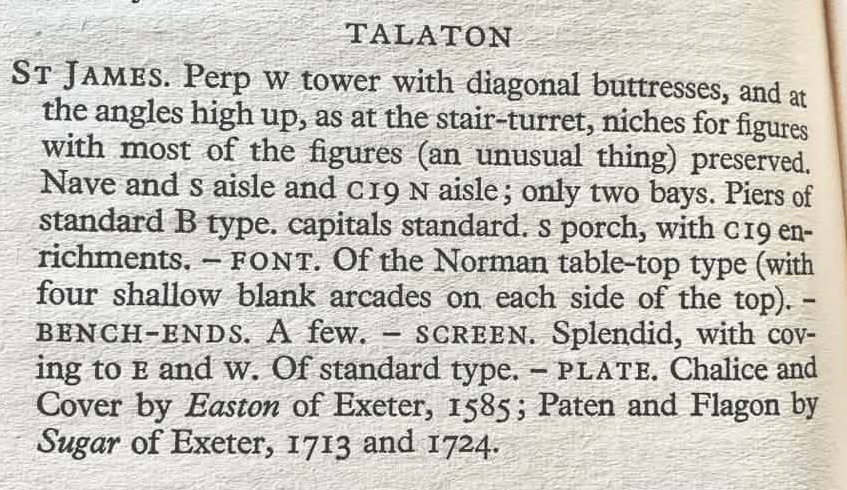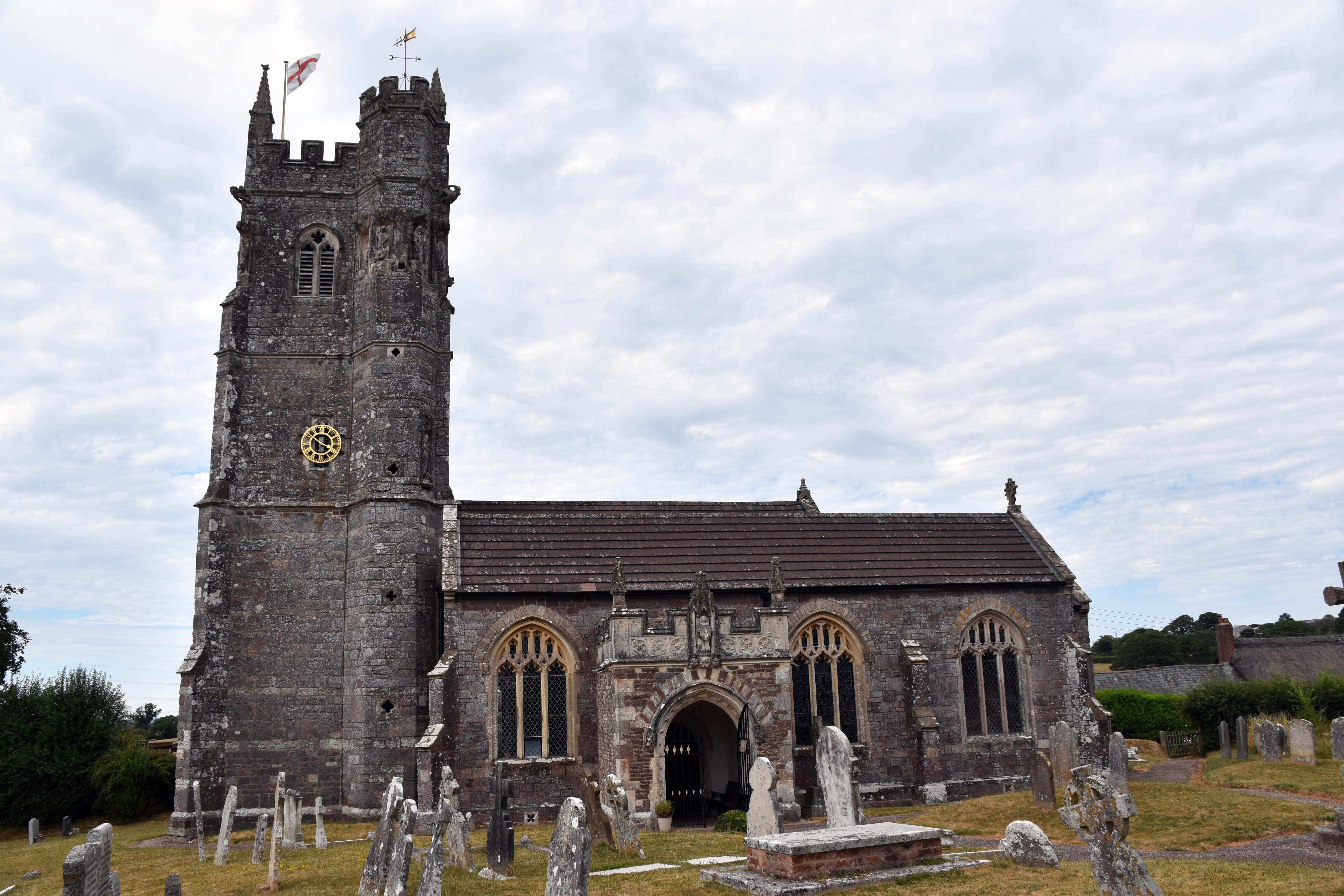
St James the Great is the parish church of Talaton, a mainly fifteenth‑century building set within a well‑kept churchyard. Although restored and altered in the nineteenth century, the medieval structure remains dominant. The church appears to have held the Right of Baptism early on, supported by the presence of a Norman font, raising the possibility of an earlier Saxon chapel on the site, though this remains unproven.
The fifteenth‑century tower is the most prominent external feature. It includes a stair turret rising slightly above the main parapet and retains original medieval gargoyles. More unusually, the tower preserves three fifteenth‑century statues in niches: St Michael defeating the dragon, the Virgin and Child, and St Matthew with his angel. These rare survivals were conserved in 1995. A clock face was added in 1925; the earlier 1725 clock had no dial and marked time only by chimes.
The porch contains further medieval carving, including small angels flanking the doorway and three statue niches above, one now filled with a modern angel holding a sundial. The red‑and‑white arch over the entrance is a notable piece of stonework.
Inside, the church retains medieval benchwork and a fifteenth‑century rood screen of high quality. The north aisle was added in the 1860 restoration to compensate for seating lost when the west gallery was removed. The nave roof includes medieval bosses, some with central pendants—an uncommon feature. These bosses were recoloured in modern times but retain their original forms. The south aisle contains earlier, simpler bosses that may predate the present church and appear to have been reused.
The Norman font is carved from Purbeck stone, likely brought by sea and up the River Otter. Its bowl is original, while the supporting columns and lower central shaft are Victorian additions. The base block appears older and may indicate a raised floor level from later restorations.
The pillar capitals in the nave are finely carved with foliage, contrasting with the simplicity of the font. The fifteenth‑century rood screen includes detailed tracery, foliage, and miniature bosses. It was painted white in 1849 when the Lord of the Manor appropriated the south aisle east of the screen as a private prayer room, adding a fireplace, coloured glass, and other fittings. Later repainting in brown obscured the original medieval colours, which may survive beneath.
Above the screen is the medieval ceilure, originally intended as a canopy over the rood. Its present colouring is later, but the structure retains its carved bosses and boarding. The sanctuary contains a unique dossal made from drapery used at the coronation of Queen Elizabeth II in Westminster Abbey.
The church contains several notable windows. The 1859 East Window is a typical Victorian composition with strong colour and movement. Another window, known locally as the “butterfly window,” was made by the AK Nicholson studio and includes butterflies around the figure of Christ. Nicholson also added small narrative scenes beneath the main panels, including a depiction of the Parable of the Sower.
A carved wooden George III coat of arms, created between 1801 and 1816, hangs within the church. Conservation work in 2014 revealed that it had been painted seven times, the earliest three in stone colour. Its lively design is unusual compared to more formal plaster examples.
The church also contains a major Renaissance‑style memorial of 1613 to John Leach, rector and canon of Exeter Cathedral. Carved from Beer stone by John Deymond of Exeter, it incorporates strapwork, putti, sphinxes, fruit, and an acrostic inscription. The design reflects the influence of continental pattern books by Jan Vredeman de Vries.
Alongside these major works, St James the Great preserves smaller vernacular pieces, including a nineteenth‑century carved table with simple geometric patterning. Together, the medieval, early modern, Victorian, and vernacular elements form a rich record of parish craftsmanship and continuity.
Below shows the Pevsner Entry for this church in the 1952 South Devon Book.