

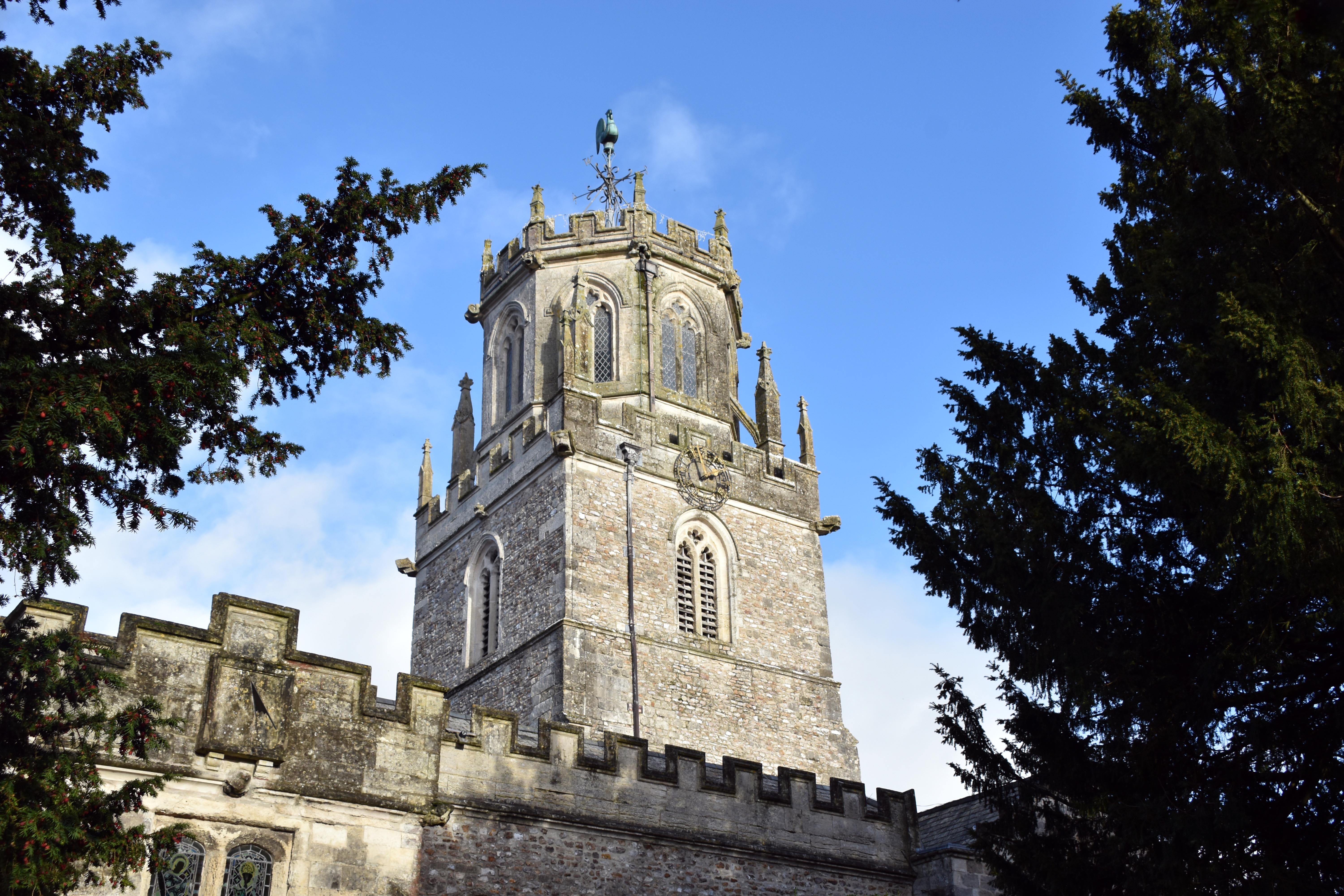
St Andrew’s Church in Colyton is one of Devon’s most remarkable parish churches, with origins stretching back over 1,300 years. The first church here was a Saxon minster around AD 744, serving as the mother church for the region. A timber building gave way to a Norman stone church in the late 12th century, laid out on a cruciform plan with a central tower. Over the medieval period, the church grew in scale and splendour: the chancel was lengthened, the nave raised, side aisles added, and a magnificent west window installed. These changes reflected Colyton’s prosperity during the wool trade boom, when the town ranked as the fourth richest in Devon in the 14th century.
The most distinctive feature is the lantern tower—a rarity among English parish churches. The tower began as a square structure, but just before the Reformation an octagonal lantern was added, inspired by Bruges Town Hall, a design familiar to Colyton’s merchants through their wool trade links. The lantern stage is adorned with battlements, pinnacles, gargoyles, and flying buttresses, and at its summit sits a copper weathercock, 4ft 6in long and weighing 70 lbs. When overhauled in 1990, it was found stamped with the date 1852 and containing an 1893 copy of Pulman’s Weekly News. The tower houses eight bells, the oldest dating from 1611.
The west window is another highlight. Installed in 1908 to replace a plain 15th-century window, it is one of the largest in any English parish church. Its glass shows Christ in Majesty surrounded by angels, apostles, and scenes from the life of St Andrew, each saint with a unique halo. Beneath it hang two brass chandeliers purchased in 1796 for £82, still used for carol services today.
Inside, the church is rich in historic features. The chancel contains handsome monuments to the Pole family and other local gentry. The Pole Chapel on the south side is particularly impressive, with a stone screen built by Thomas Brerewood, vicar from 1522 to 1544, and a collection of Renaissance-style tombs dating from 1587 onwards. Among them are memorials to Sir John Pole (1658) and his wife Elizabeth (1628), depicted lying back-to-back beneath a Corinthian canopy, and Mary Pole, shown kneeling with her nine surviving children. Sir William Pole, the noted antiquary, lies here under a simple ledger stone. On the north side of the chancel stands the Courtenay Monument, traditionally said to commemorate Margaret Courtenay, granddaughter of Edward IV, though heraldry suggests it may actually mark Margaret Beaumont, granddaughter of John of Gaunt. This monument separates the chancel from the Lady Chapel, once the private chapel of the Yonge family, accessed through a Jacobean stone screen bearing their coat of arms. In 1844, during a crowded vestry meeting, the chapel floor collapsed, sending several people tumbling into the vault below!
The oldest feature of all is the Saxon cross in the south transept. Carved from Beer stone around AD 900, it is considered the finest pre-Conquest sculpture in Devon. Originally standing in the churchyard, the cross was broken up when the Norman church was built and its fragments incorporated into the tower. Rediscovered after a fire in 1933, the pieces were reassembled and now stand proudly inside the church. The carving, though worn, shows intricate interlace patterns along the shaft—a tangible link to Colyton’s earliest Christian heritage.
Other treasures include a decorative stone pulpit carved in 1897 by A. Norman, replacing an earlier three-decker pulpit; an early 18th-century chime barrel in the Pole Chapel, once used to ring all six bells in sequence; and a display case of historic books—including a ‘Vinegar Bible’—in the south transept. The churchyard adds its own charm, with 18th- and 19th-century tomb chests scattered beneath the lantern tower’s shadow.
St Andrew’s is more than a building; it is a chronicle of faith, trade, and resilience. From its Saxon origins to its medieval grandeur, from the fire of 1933 to its careful restoration, the church embodies the story of Colyton itself. Its lantern tower remains the defining feature—a bold architectural gesture that links a Devon market town to the wider world, whether as a beacon for ships or as a symbol of mercantile ambition.

