

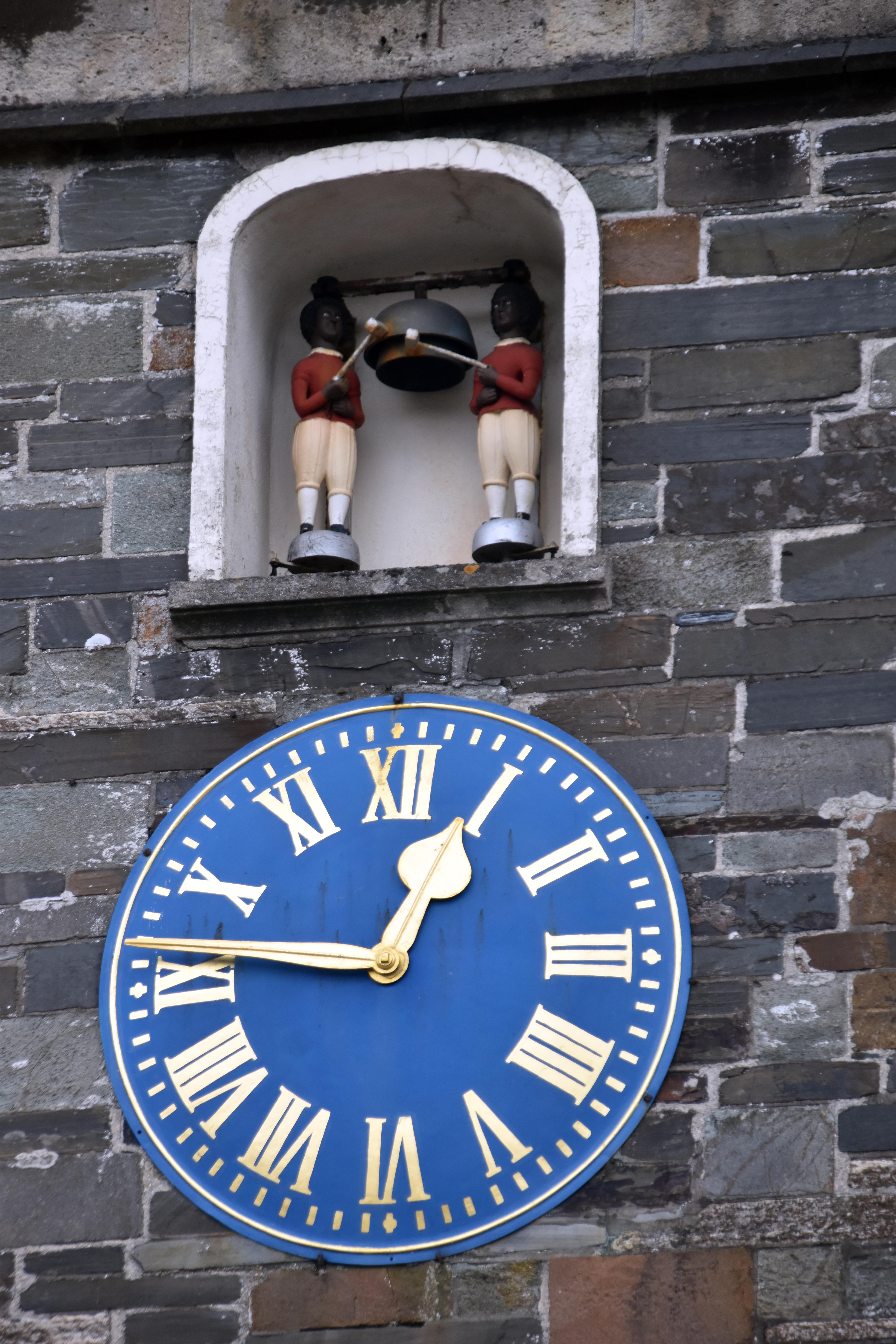
Launceston’s Guildhall stands at the junction of Westgate Street and Church Street, occupying the historic centre of civic authority in the town. The present building dates from 1881, replacing earlier municipal structures that had stood on or near the same site since the medieval period. Its position reflects the long-standing administrative geography of Launceston, where the castle, church and civic buildings formed a compact triangle of governance.
The Guildhall was designed in a restrained Victorian civic style using local stone with slate dressings. It incorporates a small clock tower that rises above the street frontage, providing a visual marker for the town centre. The building originally housed the borough court, police station and council chamber, continuing the administrative functions that had been carried out nearby for centuries. Its compact footprint reflects the tight medieval street plan, which left little room for expansion.
The most distinctive feature of the Guildhall is the pair of quarterjacks positioned above the clock face. These mechanical figures date from 1642 and were part of an earlier clock installed before the construction of the present building. They were retained and incorporated into the Victorian Guildhall because of their historical significance and their long association with Launceston’s civic identity.
The quarterjacks are carved wooden figures dressed in seventeenth‑century costume. Each holds a hammer and strikes a bell at the quarter hours. Their purpose was practical: in an age when few people owned watches, the sound of the quarterjacks provided an audible signal of time passing. This was particularly important in a market town where trade, court sessions and civic duties depended on regular timekeeping. The figures are an example of early modern public clock technology, combining mechanical function with symbolic representation.
The mechanism driving the quarterjacks has been repaired and replaced several times. The figures themselves have undergone repainting and conservation, but their form remains essentially unchanged. They are one of the oldest surviving sets of mechanical clock figures in the country and a rare example of seventeenth‑century civic timekeeping. Their survival is due partly to local attachment and partly to the practical decision to reuse them when the Guildhall was rebuilt in the nineteenth century.
The clock beneath the quarterjacks features a blue and gold dial framed by stonework that blends into the tower. The combination of dial and figures creates a distinctive façade that has become one of Launceston’s most recognisable landmarks. The clock has served as a public timepiece for centuries, and its position at the centre of the town ensures that it remains visible from multiple directions.
Inside, the Guildhall originally contained the borough court where local cases were heard. The police station occupied part of the ground floor, and the council chamber was used for municipal meetings. These functions continued well into the twentieth century before being relocated to modern facilities. The building’s civic role has diminished, but its architectural and historical significance remains.
The Guildhall and its quarterjacks illustrate the continuity of civic authority in Launceston. The figures represent a link between the seventeenth‑century borough and the Victorian town, while the building itself stands on ground long associated with local governance. The quarterjacks continue to strike the bell, maintaining a tradition that has lasted for nearly four centuries and forming a distinctive part of Launceston’s identity.


