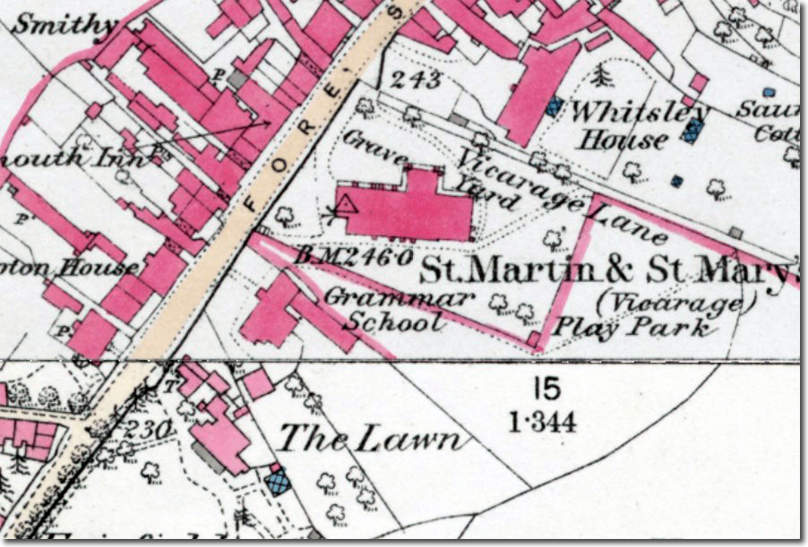
Pynsent’s Free School was founded in the later seventeenth century by John Pynsent, a native of Chudleigh who became a wealthy civil servant at Westminster. He married Mary Clifford and, despite his success in London, retained a close connection with his birthplace. In 1666 he expressed his intention to establish a free school in Chudleigh for the education of the children of the parish. He negotiated with Lord Clifford and leading parishioners to acquire part of the “sporting place” adjacent to the churchyard, amounting to about one acre. The ground was walled off to form a garden, orchard and playground, and a school building was erected to accommodate twenty boys together with a schoolmaster’s house. This frontage, with the schoolroom to the left and the master’s house to the right, survives today as a private residence, “The Old House”, in Fore Street just south of the parish church.
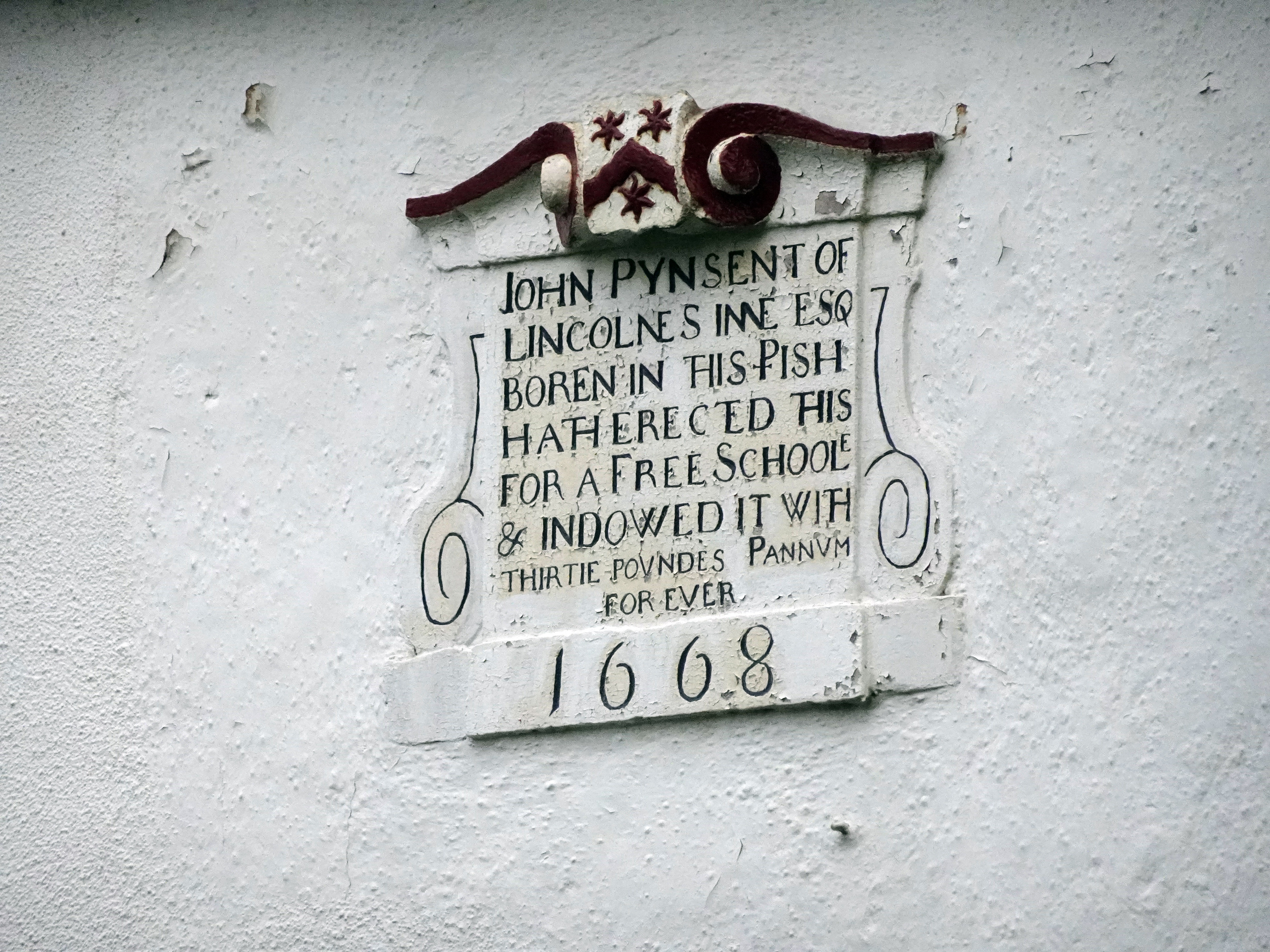
The provenance of the foundation is recorded on a tablet on the north end of the building, which reads: “JOHN PYNSENT OF LINCOLNS INNE, ESQ, BOREN IN THIS PISH HATH ERECTED THIS FOR A FREE SCHOOLE & INDOWED IT WITH THIRTIE POVNDS PANNVM FOR EVER. 1668.” Above the inscription is his coat of arms, a chevron between three stars. Delays in administering his will meant that the house was not completed until the early 1680s and the charity was not formally established until a decree in Chancery in 1682. Pynsent’s intention was for a free school for all parishioners and inhabitants of Chudleigh for ever, without payment to the schoolmaster for teaching. He directed that the trustees should appoint a master of good name and manners, conformable to the doctrine and discipline of the Church of England. Pynsent died in 1668 at his estate in Croydon before the school was finished and his wishes were never fully implemented. He was buried in St John the Baptist, Croydon, where a large memorial, later destroyed by fire in the 1930s, was erected. By his will he also left small sums to five poor boys for books and clothes, but this particular endowment does not appear to have been perpetuated.
For about a century after its establishment little is recorded, but each of the schoolmasters had taken holy orders. They were appointed for life and received £30 per annum from Pynsent’s endowment for teaching the boys, the remainder of their income coming from pupils’ fees. Out of this total the master was responsible for running costs and repairs. In 1771 the Revd Garrett was appointed at £30 a year. An advertisement for the school under his headship stated that the curriculum included the classics, some English literature, arithmetic, French, drawing and dancing. The maximum number of boys was twenty‑five and “the strictest Attention” was said to be paid to their moral and religious principles. Board and schooling cost twenty guineas per annum plus a three‑guinea entrance fee. The advertisement emphasised “security and separation from the Town” and that the boys were confined within fenced grounds, suggesting an elite establishment rather removed from Pynsent’s original intention of a free school for all parishioners.
By 1817, under the Revd Pulling, the school had declined to six boys and the property was in poor condition. When the Revd Cuming took over in 1818 he had to spend heavily on repairs and extensions. By October 1822 he was teaching ten Chudleigh boys and twenty‑five boarders. He built a spacious schoolroom, a two‑storey dormitory and a classroom for a second master. Under Cuming the school appears to have come closest to fulfilling Pynsent’s wishes, combining local boys with fee‑paying boarders. Two trustees, however, objected to his insistence on strict conformity to Church of England doctrine, arguing that Catholics and other nonconformists were being denied free education, but they were overruled.
In 1843 the Revd Collins took over a flourishing school, adding another classroom and a third master before retiring to Cornwall after seven years. He was succeeded by another Cornishman, the Revd Moyle. White’s Devon Directory of 1850 described the school as being of high repute, and Moyle was held in esteem, as shown by a commemorative plaque in the parish church presented by two former pupils after his early death in November 1861. An advertisement in the Chudleigh Weekly Express following his resignation sought a new headmaster, to be a clergyman, at the customary salary of £30. It stated that the school, of high reputation, could accommodate forty boarders and had a large playground and commodious residence.
A Charity Commissioners’ report in the early 1860s shows that the fathers of boarders were professional men, merchants or of independent means, while about half the fathers of day boys were farmers or shopkeepers. Discipline was said to be good, corporal punishment rare, and the conduct of the boarding houses maintained by prefects. The Revd Inman succeeded Moyle and also served as curate of Chudleigh Knighton. The 1864 Charity Commissioners’ report suggested that the school was running well, with an expanding curriculum, but it was becoming costly to maintain. Boarders were drawn from as far away as Wolverhampton and Melton Mowbray. By 1867 numbers had fallen to nineteen boys, eight boarders and eleven day boys, one of them a free pupil. Boys from the National School in Chudleigh sometimes went to Pynsent’s to be “finished”. Rising costs, falling admissions and neglected repairs placed the school under strain.
By 1872 the school was at a low ebb. An inspector for the Charity Commissioners found it inefficient and recommended abolition, proposing that the income be used instead to advance the education of boys attending the public elementary schools in Chudleigh. The school closed and the last three Chudleigh boys were Ellis, the son of a landowner, Lillies, a doctor’s son, and Doke. The master remained in occupation of the house and in 1874 was served notice to quit, with the threat of legal proceedings. It was believed that Inman had devoted himself to agricultural pursuits and neglected the school. Local residents, particularly farmers, were keen to see the school revived. In January 1875 the trustees wrote to the Charity Commissioners seeking permission to repair the old schoolhouse, demolish Cuming’s temporary extension and appoint a new master. They recognised that a revised financial scheme was needed, but still thought the school could operate successfully as a county school, even though it was already considered old‑fashioned.
In 1877 the Pynsent Exhibition Foundation was created under a scheme made under the Endowed Schools Act. It provided three scholarships for boys who had attended the National School, covering their tuition fees. A circular to old boys appealed for funds to repair the buildings; sufficient money was raised and the school reopened. The Revd Crofton Green became schoolmaster and employed a second master, Mr Mackay, who taught languages and mathematics and was widely liked. Kelly’s Directory of 1889 noted that the three scholarships were in operation. By the early twentieth century the curriculum had expanded to include algebra and geometry, and boys came from France, Holland and Germany. A local boy, Albert Victor Knight of Little Silver, Old Exeter Street, attended in 1911 and later became an officer in the Merchant Navy; he was lost at sea in 1919, three years after his elder brother had been killed on the Western Front.
During the early twentieth century many small endowed grammar schools either closed or were absorbed into the state system. Pynsent’s Free School followed this pattern. By the end of 1912 only five pupils remained and the decision was taken to close the school on 31 July 1913. The Pynsent Educational Foundation then concentrated on funding scholarships for Chudleigh boys to attend Newton Abbot Secondary School. These scholarships, typically valued at £10 for three years, covered fees and sometimes maintenance. In 1915 five boys held Pynsent scholarships at NASS; in 1917 four more were awarded, though only two were taken up. The Foundation’s support was important for working‑class families, for whom the cost of travel and school expenses could be prohibitive, but some parents regarded secondary schooling as socially inappropriate or beyond their children’s station, and a proportion of scholarship places went unused.
When the school closed, the property was sold to Mr Mackay for £700, below market value, as a modest recognition of his years of teaching on a low salary. The house became the Mackay family home; he died in a nursing home in Truro in 1919 and his widow remained there until about 1925. The building survives as “The Old House”, its tablet and arms preserving the memory of John Pynsent’s foundation. Although the school itself did not survive the educational reforms of the twentieth century, the Pynsent Exhibition Foundation continued to shape educational opportunity in Chudleigh by supporting boys progressing from the elementary school to secondary education. Pynsent’s Free School thus stands as an example of a rural endowed grammar school whose fortunes reflected wider changes in English education, social hierarchy and access to learning.