

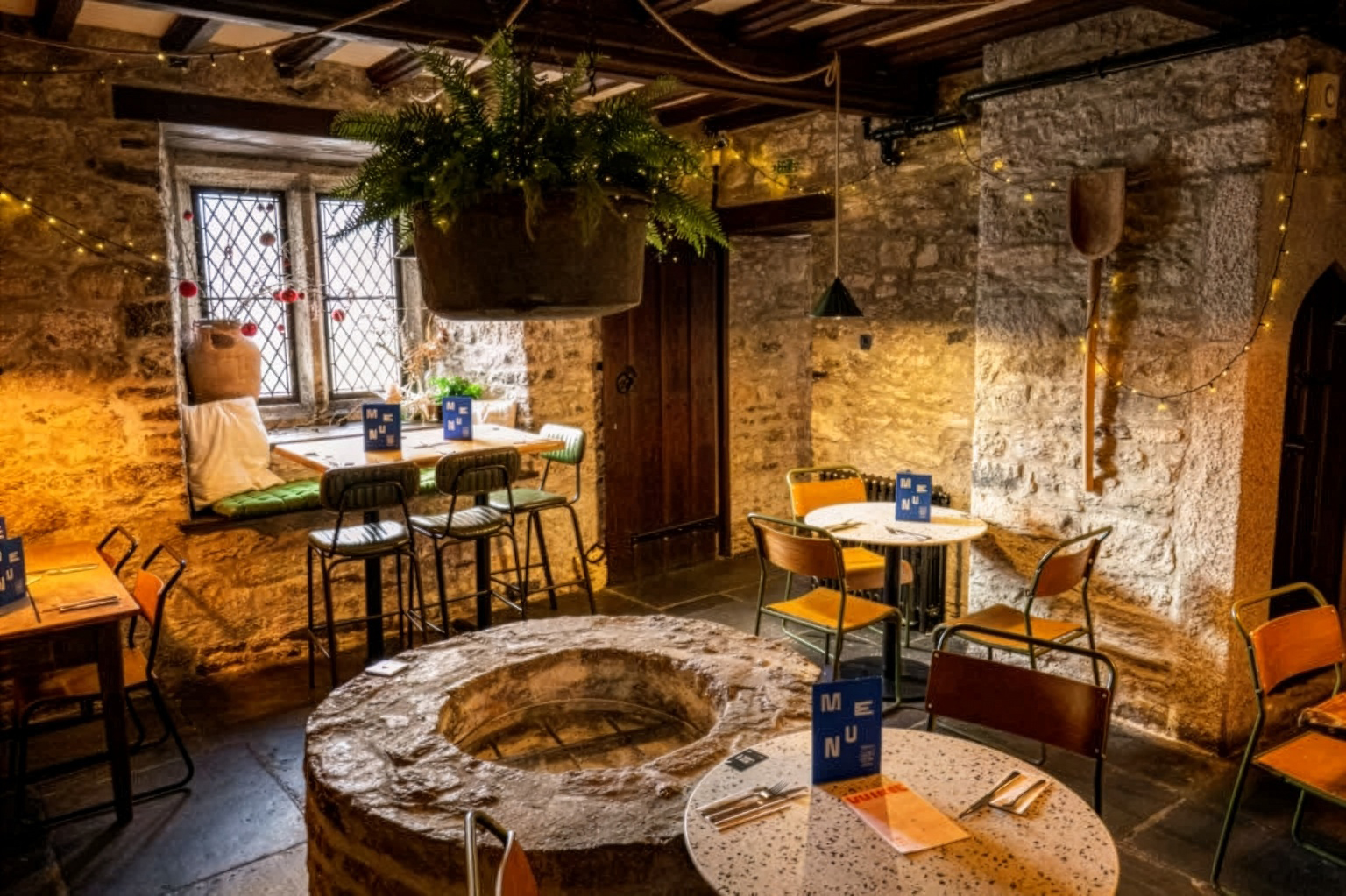
The well preserved within Prysten House is one of thee of the oldest surviving secular buildings in the city, the well is equally significant as a rare survivor of the water supply system upon which Plymouth depended before the arrival of Drake's Leat. In a city that underwent repeated rebuilding and suffered extensive destruction during the Blitz, the survival of such a feature is remarkable.
Prysten House was built in the late fifteenth century by the wealthy merchant Thomas Yogge. At the time, Plymouth relied upon a combination of private wells, public wells, springs and small streams for its fresh water. Every household, workshop, inn and merchant house required dependable access to water. A substantial property such as Prysten House therefore needed its own reliable source. The well formed an essential part of the daily operation of the household, providing water for drinking, cooking, cleaning and numerous other domestic activities.
Today it is easy to overlook how dependent towns once were upon wells. Before the construction of Plymouth Leat in 1590, there was no large-scale system bringing fresh water into the borough from outside. Water was sourced locally and its availability varied considerably. As Plymouth's population grew during the sixteenth century, increasing demands were placed upon these traditional supplies. Wells could become contaminated, run dry during periods of prolonged drought or simply prove inadequate for a growing urban population.
The difficulties associated with these local water sources were among the factors that encouraged Plymouth Corporation to pursue the ambitious project of bringing water from the River Meavy on Dartmoor. The resulting Plymouth Leat transformed the borough's access to water, providing fresh moorland water through a system of conduits and later reservoirs. However, before that transformation took place, wells such as the one at Prysten House remained the principal means through which people obtained water.
The significance of the Prysten House well is enhanced by the disappearance of almost all comparable examples within Plymouth. Wells were frequently filled in once they became redundant. Others were destroyed as buildings were enlarged, cellars excavated or streets widened. Successive phases of redevelopment erased many of the physical traces of medieval and Tudor Plymouth. Whilst the names of some wells survive in street names such as Finewell Street and Halwell Street, the actual structures themselves have almost entirely vanished.
The well adds to the historical importance of Prysten House itself. The building is already among the finest surviving examples of late medieval domestic architecture in Plymouth. The presence of the well strengthens its value as a record of how a prosperous merchant household functioned at the end of the fifteenth and during the sixteenth centuries. Together, the house and well provide a rare glimpse into a period of Plymouth's history that survives only fragmentarily elsewhere.
Although the arrival of Drake's Leat gradually reduced Plymouth's dependence upon local wells, they did not vanish immediately. Many continued to be used for generations alongside the newer water supply. Eventually reservoirs, pumping stations and piped distribution networks rendered most of them obsolete. The Prysten House well is therefore not simply an architectural curiosity but a surviving element of a water system that sustained Plymouth for centuries before the coming of the leat.

