

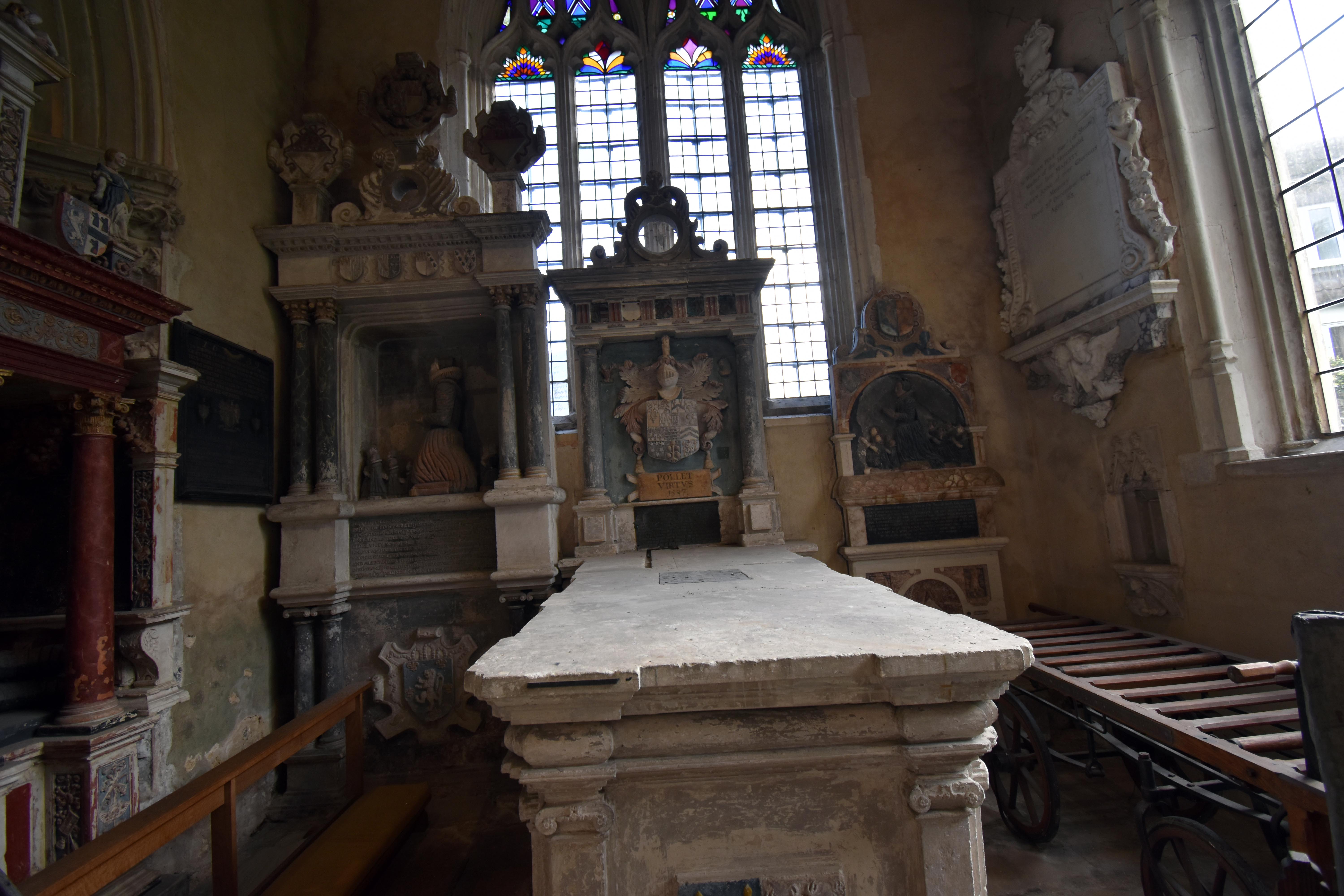
The Pole family of Colyton in Devon trace their lineage to ancient roots, with branches established in Cheshire, Cornwall, and Devonshire. Their arrival in Colyton dates to the sixteenth century, when William Pole acquired Shute House and lands, along with part of the Colcombe Castle estate. Born in 1515, William married Katherine Popham and fathered seven children, though only two survived into adulthood. His tomb in Colyton Church is a commanding monument, inscribed with a pedigree epitaph and adorned with a shield bearing fourteen quarterings, three crests, and the family motto, Pollet Virtus. Beside him lies the kneeling memorial to Katherine, who died in 1588.
William’s son, Sir William Pole, born in 1561, became one of Devon’s most notable figures. Knighted by James I in 1606 for his service to the Crown and the local community, he married twice—first to Mary Peryam, who bore him eleven children before her tragic death from a fall, and later to Jane How, widow of Roger How. Jane’s daughter Elizabeth would later marry Sir William’s eldest son, John, thus intertwining the family’s fortunes. Sir William is best remembered as a historian, earning the sobriquet “The Antiquary.” His manuscript, Collections towards a description of Devonshire, rivals the Domesday Book in scope, containing parish descriptions, genealogies, and lists of local dignitaries. Though some volumes were damaged during the Civil War, many survived and were printed in 1791 by his descendant Sir John William de la Pole. His work on heraldry and transcribed charters remains a valuable resource for scholars.
Among Sir William’s children, Elizabeth and William stand out for their transatlantic legacy. Elizabeth, born in 1588, and William, born in 1594 as one of triplets, were among the earliest settlers in New England. Encouraged by their cousin Sir Walter Erle and the Reverend William Hook of Axmouth, they sailed in 1635. Elizabeth is remembered in Massachusetts as the foundress of Taunton, reputedly purchasing land from the Tetiquet tribe for a bag of beans and a knife. She died in 1654. William settled in Dorchester, where he earned a reputation for education and piety, dying in 1674 and leaving behind a widow and children.
Sir John Pole, born in 1588 and created a baronet in 1628 by Charles I, married his stepsister Elizabeth How. The baronetcy, a creation of James I to raise funds for the Ulster plantations, is reflected in the Pole coat of arms, which bears the red hand of Ulster. Sir John served as a Member of Parliament for many years and was buried in Colyton alongside his wife. Their tomb, with effigies lying back to back in contemporary costume, remains one of the most striking features of the Pole Chapel in St Andrew’s Church. This chapel, rich in memorials and historical resonance, stands as a testament to the enduring presence of the Pole family in the parish and their contributions to local and national history.

