

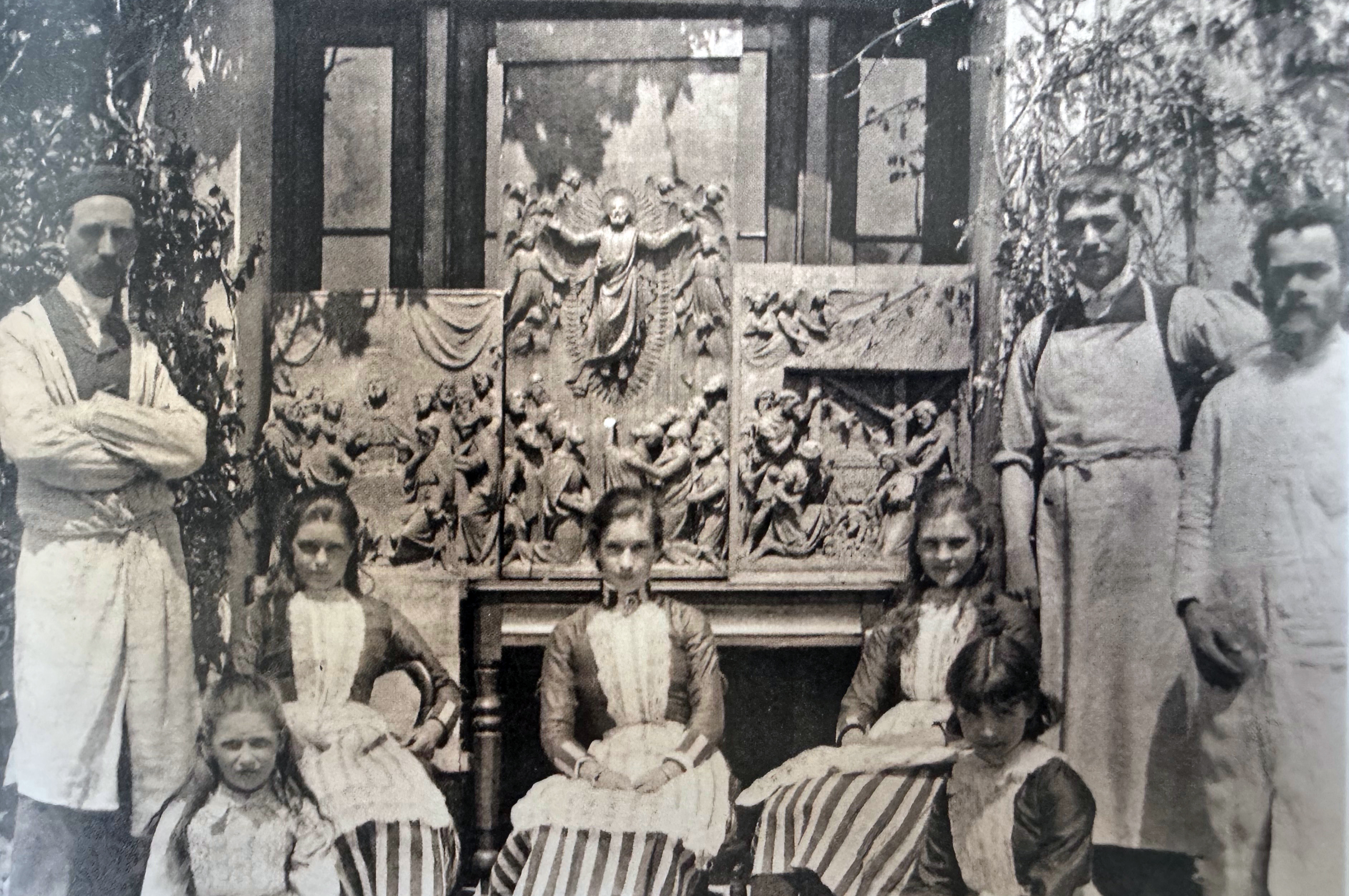
The Pinwill Sisters began their carving work in the vicarage at Ermington, South Devon, where their father, the Reverend Edmund Pinwill, encouraged practical training in woodcarving as part of the restoration of the parish church. The instruction was direct and workshop‑based, with the sisters learning tool handling, relief carving and structural joinery from craftsmen employed on the building. The Ermington environment provided consistent access to real ecclesiastical work rather than theoretical study, and the sisters developed a disciplined approach to carving that avoided decorative excess and relied on accurate drawing and clean toolwork.
The three sisters most associated with the early output were Mary, Ethel and Violet. Their work was initially produced under the collective name “Rashleigh, Pinwill and Co.” before Violet Pinwill later established the long‑running Plymouth workshop under her own name. The Ermington period was formative, establishing the technical standards and working methods that defined their later commissions across Devon and Cornwall. The emphasis was on structural clarity, controlled relief and the ability to work within the architectural language of medieval and Victorian church interiors.
Their first known commission was the carved oak reredos at St Mary’s Church, Chilthorne Domer, Somerset. This early work consists of three panels depicting the Nativity, Ascension and Last Supper. The carving is direct and economical, showing the sisters’ early style before the more elaborate detailing of their later Plymouth period. The Chilthorne Domer reredos demonstrates their ability to integrate new work into an existing medieval interior without stylistic conflict, and it marks the point at which the Ermington training translated into independent professional output.
The Chilthorne Domer commission also illustrates the practical organisation of the early workshop. The panels were designed, carved and finished at Ermington before installation on site. The work shows consistent tool control, clear figure modelling and a disciplined approach to background treatment. Although modest in scale, the reredos established the sisters as competent ecclesiastical carvers capable of producing work that aligned with the expectations of late nineteenth‑century church restoration.
From this first commission the Pinwill Sisters expanded their practice, producing pulpits, screens, reredoses, pew ends and figure carving for churches throughout the West Country. The Ermington training remained the foundation of their method, and the Chilthorne Domer reredos stands as the earliest surviving example of their independent work. It provides a clear record of their technical ability at the outset of a career that would become one of the most significant contributions to ecclesiastical woodcarving in the region.

