

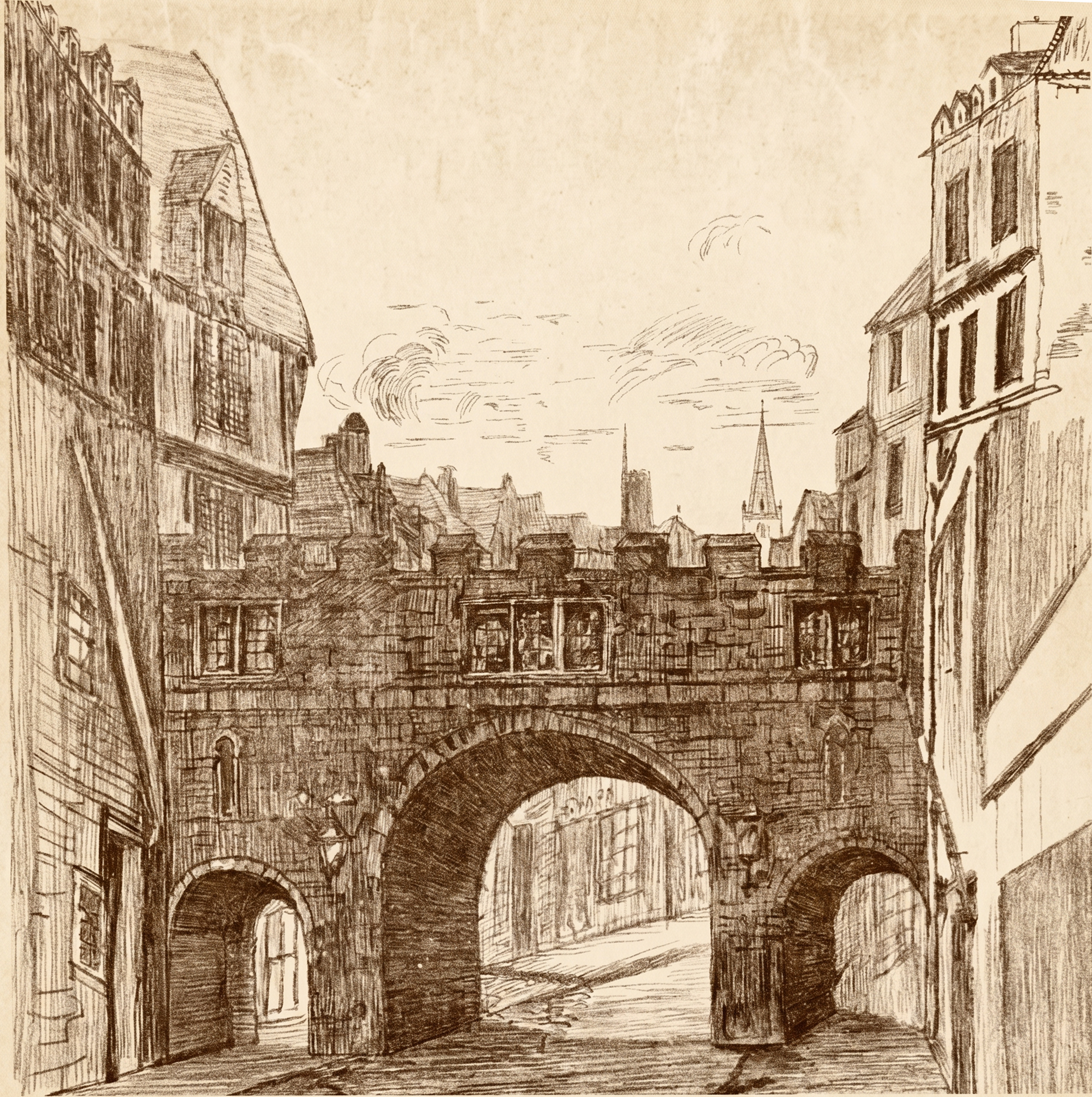
Old Town Street Gate stood at the eastern entrance to medieval Plymouth and controlled access along one of the town’s busiest and most important routes. Travellers approaching from the countryside passed through this gate before entering the narrow streets of the walled town. Its position at the end of Old Town Street made it a focal point for movement, trade and administration. The gate marked the boundary between the urban centre and the surrounding manors, and it served as a checkpoint for goods, livestock and packhorses entering Plymouth.
The area around the gate developed early as a commercial zone. Shops, workshops and small markets clustered near the entrance, taking advantage of the steady flow of people passing through. The gate also acted as a landmark for orientation within the town, with several important streets radiating from it. As Plymouth expanded, Old Town Street remained one of the principal arteries leading into the centre, and the gate’s location continued to influence the pattern of development long after the physical structure had disappeared.
One of the most significant features near Old Town Street Gate was the presence of the town’s early water conduits. These conduits were fed by Drake’s Leat, which entered Plymouth from the north and supplied fresh water to public points throughout the town. A conduit stood close to the gate, making it one of the first places where travellers and residents could draw water. This proximity was deliberate: placing a conduit near a major entrance ensured that water was available for domestic use, for nearby workshops and for the markets that operated along Old Town Street.
The relationship between the gate and the water supply highlights the importance of this part of Plymouth in the late sixteenth and early seventeenth centuries. The leat’s arrival transformed the town’s access to fresh water, and the conduit near Old Town Street Gate became a vital resource. It supported daily life, contributed to public health and provided water for firefighting in a densely built area. The gate therefore stood not only as a defensive and administrative structure but also as a point where the town’s new civic infrastructure met its medieval layout.
As Plymouth grew beyond its walls, the gate was eventually removed to accommodate wider streets and increased traffic. Although the structure itself has vanished, its location remains identifiable through the alignment of Old Town Street and the historical records that describe its role. The memory of the gate survives in the modern streetscape, and its association with the early water conduits marks it as a key site in the story of Plymouth’s development and in the history of Drake’s Leat.

