

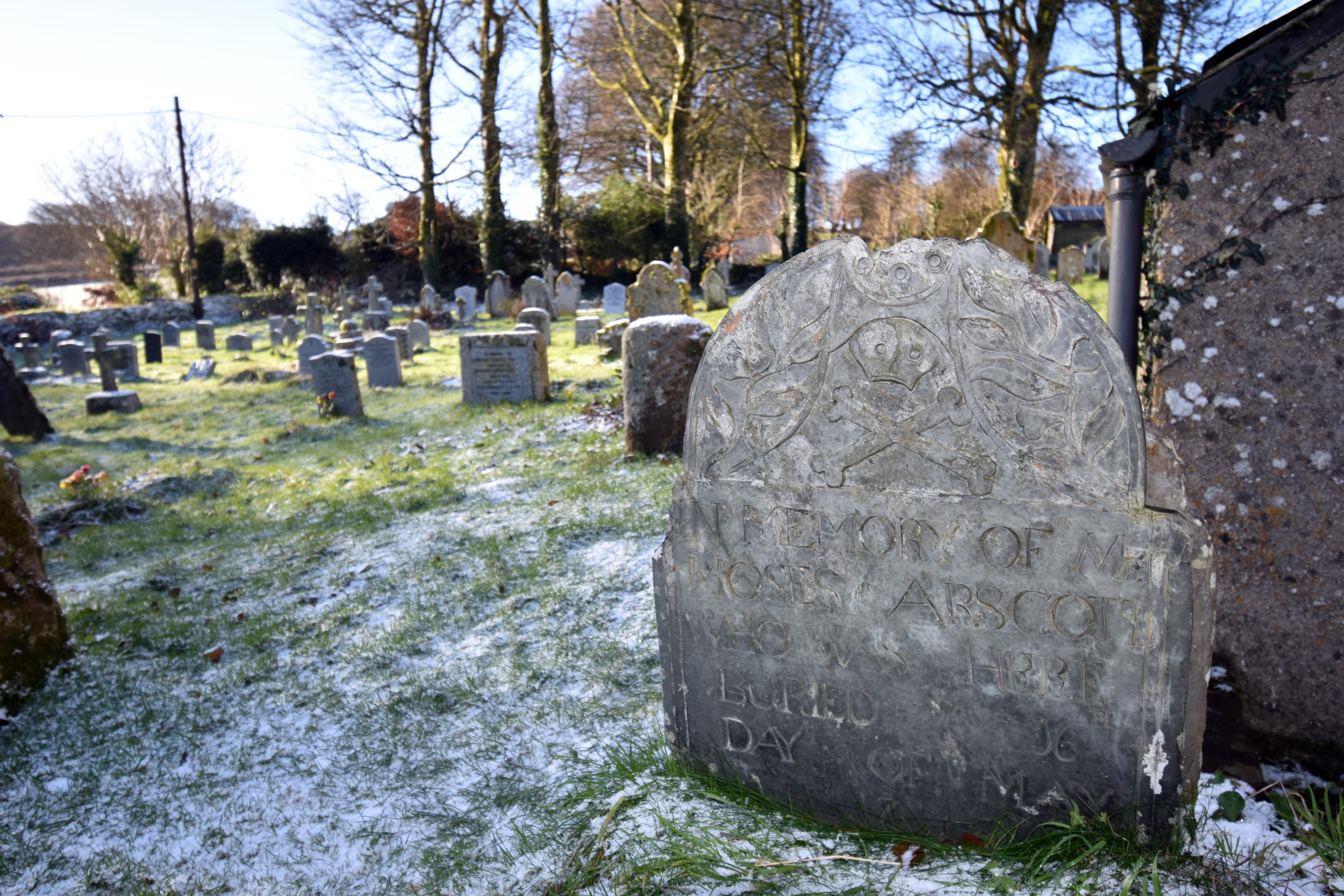
If you walk a little way south of the south‑aisle chapel at St Mary the Virgin, you come across two slate headstones set back‑to‑back in the grass. They are easy to miss unless you know where to look, but once you do, they become some of the most intriguing stones in the churchyard. The western one is the older: a small, round‑headed slate marker, about sixty centimetres high, with a simple incised border and large Roman capitals recording the death of John Arscott in 1711. It is plain, steady, and exactly what you would expect of an early eighteenth‑century rural grave.
The other stone, facing east, is harder to ignore. Taller, with a nowy‑shaped head and a carved panel at the top, it carries a skull and crossbones flanked by curling fronds. The carving is low relief but unmistakable, and the inscription beneath it — again in large Roman capitals — records the death of Moses Arscott in 1746. It is this stone that has given rise to one of Belstone’s most persistent stories: that Moses was a pirate, or at least a man who had spent time at sea acquiring wealth in ways that were not entirely respectable.
The tale goes that Moses returned to Belstone late in life with money that no one could quite account for. According to the story, he approached the rector with an offer: he would donate a portion of his “ill‑gotten gains” to repair the church roof, on the condition that he be buried on consecrated ground. The implication, never stated outright but always hovering in the background, is that the rector accepted the bargain. The roof was mended, and Moses was laid to rest in the churchyard with a headstone that made no attempt to hide the reputation he carried.
Whether any of this is true is another matter. The skull and crossbones was a common memento mori motif in the eighteenth century, used to remind the living of mortality rather than to advertise a life of piracy. Slate carvers in Devon and Cornwall certainly did use it from time to time. But stories have a way of attaching themselves to anything that looks even slightly out of the ordinary, and Moses’s stone — with its bold carving and its position beside the plainer marker of John Arscott — has always invited speculation.
What is certain is that the Arscotts were a local family, and that Moses died in 1746. Beyond that, the records fall silent. There are many more recent Arscotts buried in the churchyard - all presumably related to Moses in one form or another. The rest is village memory: the idea of a man returning from the sea with money to spare, the whispered suggestion that the church roof was repaired with funds of questionable origin, and the quiet satisfaction of having a “pirate” buried in Belstone, even if the evidence is mostly decorative.
The charm of the story lies not in its accuracy but in the way it fits the place. Belstone is a moorland village, but like many rural communities it has always had ties to the wider world. Young men went to sea, joined the navy, or worked in coastal towns; some returned with tales, others with nothing at all. Moses’s stone, with its skull and crossbones, stands as a reminder that even in a small Dartmoor parish, lives could be larger and stranger than the landscape suggests.
Today the two Arscott stones sit quietly in the grass, leaning slightly with age, the carvings softened by weather. Visitors often pause at Moses’s stone, drawn by the skull and crossbones and the hint of a story behind it. Whether he was a pirate, a sailor, or simply a man with a flair for dramatic headstones, he has earned his place in Belstone’s folklore. And if the church roof really did benefit from his generosity, then the village has been living with the results of his bargain for nearly three centuries.


