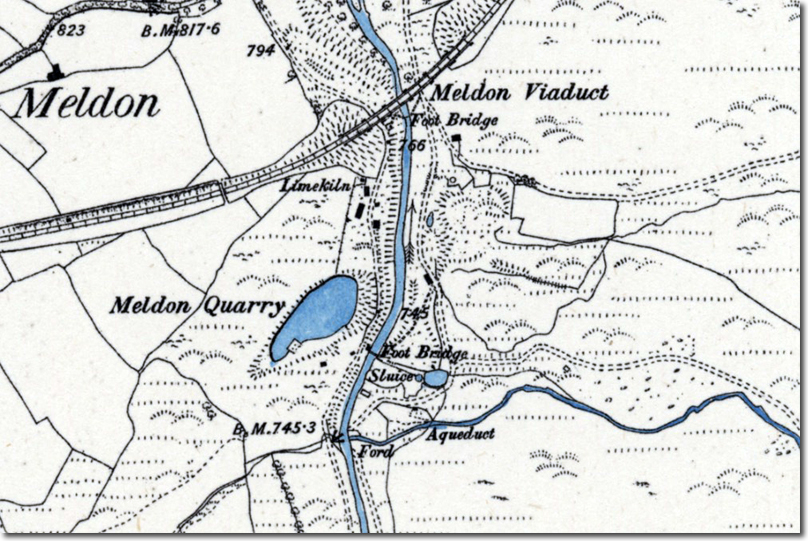
Meldon Quarry in 1902 was a site in transition, where the long‑established limestone workings of the nineteenth century overlapped with the newer aggregate quarry opened by the London & South Western Railway. The older limestone pits, first worked from around 1790, had by this date largely fallen silent. The eastern quarry had been driven to a depth of about forty metres before extraction ceased, and by the end of the nineteenth century the abandoned workings had flooded to form what became known as Meldon Pool. As your document notes, “by 1885 the main activity was that of aggregate quarrying,” marking the shift away from lime burning and towards large‑scale stone production.
The limestone quarries still dominated the physical landscape in 1902. Five separate pits, two lime kilns, spoil heaps, tram‑roads, and the remains of weigh‑houses and ancillary buildings stood around OS grid reference 965 921. Much of this infrastructure was already decaying by the turn of the century. The weigh‑house, for example, survived only as ruins, though its cast‑iron bedplate—made by Bartlett & Son of Bristol—remained in place. One of the original lime kilns still stood beneath what later became the western embankment of the viaduct, complete with the iron anchoring point and chains from the hundred‑metre winching system once used to haul stone up to the charging platform.
Keeping the old limestone workings dry had always been a challenge, and in earlier decades this had been achieved by pumps driven by two large waterwheels on the eastern side of the West Okement. These wheels were supplied by an elaborate network of leats and reservoirs drawing water from the river and the Red‑a‑Ven Brook. By 1902 the wheels were still visible as stone‑lined pits, though their operational role had diminished as the focus of the quarry moved to the newer hornfels deposits.
The aggregate quarry—opened in 1897 after railway engineers discovered the exceptional hardness of the local hornfels—was the centre of activity in 1902. The stone’s crushing strength of 75–80,000 pounds per square inch made it ideal for railway ballast, and its proximity to the LSWR line meant it could be transported directly by rail. The quarry rapidly became one of the largest employers in the district, drawing labour from Okehampton and surrounding villages. A terrace of workers’ cottages was built between 1895 and 1906 to house some of the workforce, and the site included sidings, weighbridges, tramways, and a growing complex of service buildings.
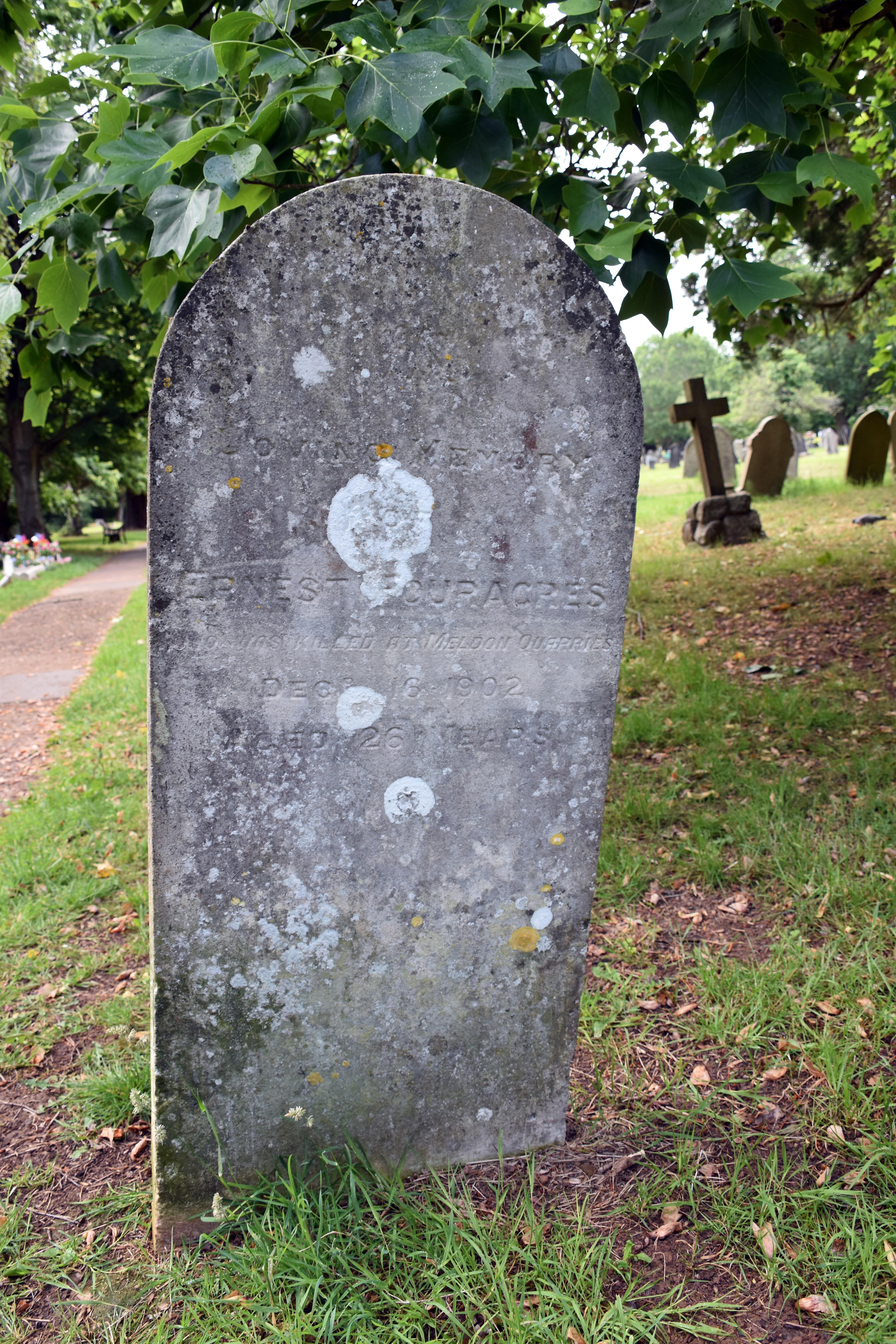
Working conditions in 1902 were harsh and often dangerous. The quarry floor was exposed to Dartmoor’s weather at an elevation of around 300 metres, and much of the labour involved heavy manual work: breaking stone, loading wagons, and maintaining the faces. The document records that “1902 – One man killed and another seriously injured when a heap of earth weighing about a ton fell on them.” The fatality was Ernest Fouracre, aged twenty‑six, who had only recently begun work at Meldon. He was buried when a sudden slip of waste material collapsed without warning, a type of accident typical of the unstable spoil tips created during the quarry’s early expansion.
Waste disposal was a constant problem. The steep valley of the West Okement left little room for spoil, so material was tipped into linear dumps on both sides of the river. On the western side, revetted embankments and stone abutments—still visible today—supported temporary rail tracks that carried waste across the river. These unstable tips were precisely the sort of feature that could collapse suddenly, as happened in the accident that killed Ernest Fouracre in 1902.
In summary, Meldon Quarry in 1902 was a busy, hazardous industrial site where the new hornfels quarry was expanding rapidly while the remnants of the older limestone workings still shaped the terrain. The combination of steep ground, heavy waste tipping, exposed weather conditions, and largely manual labour created an environment in which accidents were tragically common. The death of Ernest Fouracre occurred against this backdrop of intense activity, limited mechanisation, and the inherent risks of early twentieth‑century quarrying on Dartmoor.