

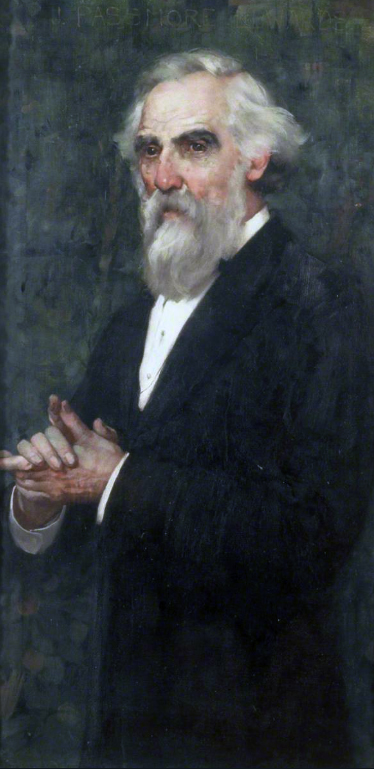
John Passmore Edwards was born in 1823 at Blackwater, near Truro, into a modest Cornish family whose livelihood depended on small‑scale agriculture and mining. His early education was limited, but he developed a strong interest in reading and public affairs. This background shaped his later belief that access to knowledge should not depend on wealth or social position. His career began in journalism, first as a contributor and then as an editor, before he moved into newspaper ownership.
Edwards made his fortune through a series of successful publications, most notably the Illustrated London News and the Echo. Rising literacy rates, improved printing technology and expanding railway networks created a national market for affordable newspapers. Edwards understood the commercial potential of mass readership and invested in titles that combined accessible reporting with wide distribution. His business success provided the financial foundation for his later philanthropic work.
From the 1880s onwards Edwards devoted much of his wealth to public institutions. His philanthropy focused on libraries, reading rooms, schools, hospitals and convalescent homes. He believed that education and self‑improvement were essential to social progress, and he funded buildings that provided free access to books, lectures and medical care. His approach was practical rather than ceremonial; he preferred to finance construction directly rather than endow large administrative bodies. Many of his institutions were built in working‑class districts where public provision was limited.
Architecturally, Edwards worked closely with designers such as Silvanus Trevail, the leading Cornish architect of the period. Trevail produced functional yet dignified buildings that reflected Edwards’s belief in civic improvement without unnecessary ornamentation. The Passmore Edwards libraries and institutes typically featured robust masonry, clear internal layouts and prominent entrances intended to signal public accessibility. Their design was consistent across Cornwall, Devon, London and other regions where Edwards funded projects.
In Launceston, the Passmore Edwards Institute on St Thomas Road was constructed in the late Victorian period as a library and reading room. It formed part of Edwards’s wider programme to expand educational facilities in towns that lacked substantial municipal investment. The building served as a centre for literacy, lectures and community activity until the twentieth century, when county‑level library provision replaced many privately funded institutions. Although the Launceston building has since been converted to housing, its structure remains a reminder of Edwards’s influence on the town.
Edwards’s philanthropy extended beyond libraries. He funded art galleries, technical schools, cottage hospitals and convalescent homes. His projects were often linked to the needs of industrial and mining communities, reflecting his Cornish origins and his understanding of the hardships faced by labourers. He supported temperance organisations, adult education societies and scientific institutions, seeing them as means to improve public welfare without reliance on state intervention.
Politically, Edwards was aligned with radical Liberalism. He advocated peace, anti‑slavery causes, and international arbitration. He served briefly as a Member of Parliament for Salisbury, though his parliamentary career was short and undistinguished. His real impact came through his buildings, which provided tangible benefits to communities across Britain. He rejected honours and titles, preferring anonymity in many of his donations. His name appears on some institutions only because local committees insisted on acknowledging his contributions.
By the early twentieth century Edwards’s philanthropic model began to decline. Municipal authorities expanded their own library and health services, reducing the need for privately funded buildings. Some Passmore Edwards institutions were absorbed into public systems; others were repurposed or demolished. Nevertheless, a significant number survive, particularly in Cornwall and London, where they continue to serve educational and cultural functions.
Edwards died in 1911, leaving a legacy of more than seventy public buildings. His work represents one of the most extensive philanthropic programmes of the Victorian era, comparable to Andrew Carnegie’s library scheme but rooted in British social conditions. His institutions provided access to knowledge, medical care and community space at a time when state provision was limited. The surviving buildings remain a testament to his belief that education and public welfare could be advanced through practical investment rather than political rhetoric.
Image courtesy of Hackney Museum

