

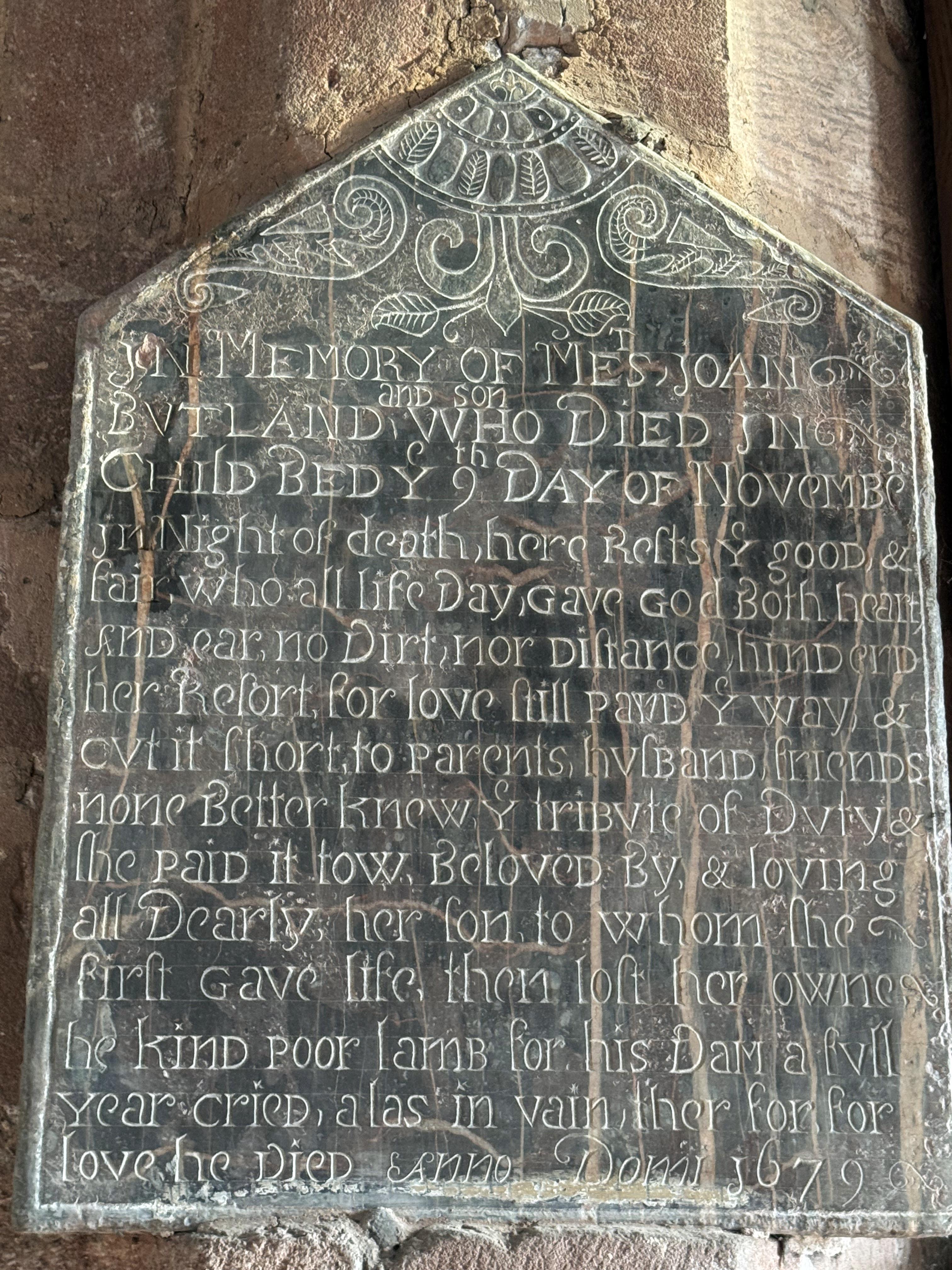
The memorial to Joan Butland is one of the most affecting stones in St John the Baptist, not because of its size or decoration, but because of the plainness with which it records a double loss. The plaque, shaped like a small gabled house and carved in the late seventeenth century, commemorates Joan and the son who died with her in childbirth on 9 November 1679. The language is archaic and uneven, but the emotion behind it is unmistakable. The inscription reads in full:
IN MEMORY OF MRS JOAN
BUTLAND (and son) WHO DIED IN
CHILDBED YE 9ᵗʰ DAY OF NOVEMBER
“In Night of death, here Rests ye good &
fair
who all life Day, Gave God Both heart
and ear,
no Dirt, nor Distance hindered
her Resort,
for love full paved ye way &
cut it short
to parents, husband, friends
none Better knew
Ye tribute of Duty &
she paid it tow (too).
Beloved By, & loving
all Dearly, her son
to whom she
first gave life, then lost her owne,
be kind poor lamb for his Day a full
year cried,
a las in vain therefore for
love he died.
Anno Dom 1679.
The stone gives no further details about Joan herself, but the Butlands were a long‑established Paignton family, appearing in parish records from the sixteenth century onwards and later associated with Preston House. The wording suggests she was well regarded locally, and the memorial’s careful carving indicates a family with the means and the will to commemorate her properly. The reference to her “parents, husband, friends” and the emphasis on duty and affection are typical of the period, when epitaphs often combined piety with a kind of domestic accounting of virtues.
The final lines, describing the infant who “for his Day a full year cried,” are ambiguous. They may refer to a child who lived only briefly, or to the grief of those left behind. Seventeenth‑century epitaphs often used poetic compression rather than literal chronology, and the phrasing here is more emotional than precise. What is clear is that both mother and child died as a result of the same birth — a tragedy that was far from uncommon in this period.
Childbirth in the seventeenth century carried significant risks for both mother and infant. Midwifery was an experienced craft rather than a medical science, and complications that are now routinely managed — obstructed labour, haemorrhage, retained placenta, infection — were often fatal. Puerperal fever, caused by bacterial infection, was one of the most common killers of new mothers, and without antisepsis or antibiotics it could progress rapidly. Infants faced their own dangers: prolonged labour could lead to stillbirth, and even healthy newborns were vulnerable to infection, exposure and congenital conditions that could not be treated. In some parishes, as many as one in ten births resulted in the death of the mother, and infant mortality was even higher.
Against that background, Joan Butland’s memorial is not unusual in its circumstances, but it is unusual in its survival and in the frankness of its wording. Many such losses went unrecorded or were marked only by a brief entry in the parish register. Here, however, the family chose to carve their grief into stone, preserving not only her name but the sense of a life cut short at the moment it was meant to expand. The plaque now sits quietly on the wall of St John’s, one of the more personal voices in a church otherwise dominated by medieval architecture and the grander ambitions of the Kirkham chantry. It remains a rare and intimate glimpse into the private sorrows of seventeenth‑century Paignton.

