

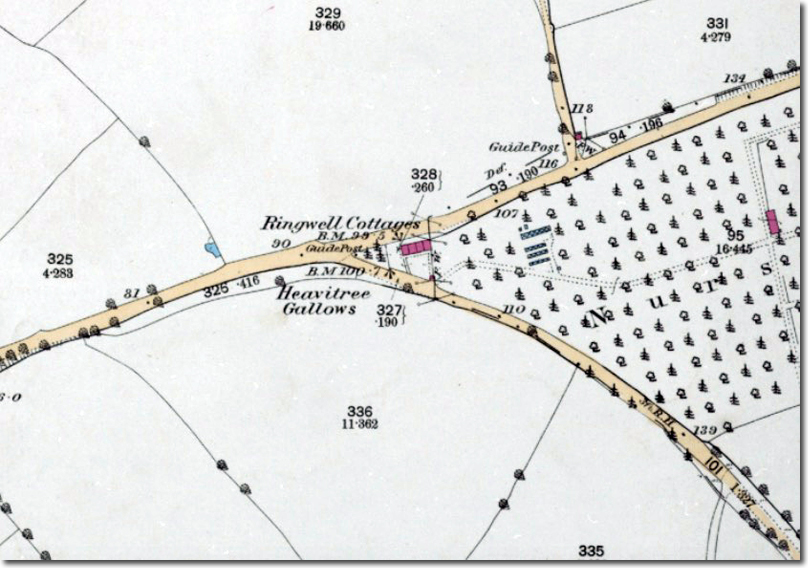
Between 1285 and 1943, two hundred and ninety-nine people were lawfully executed in Exeter. Many of these took place within the city itself, but for several centuries Heavitree served as the principal execution site for the County of Devon. This distinction between city and county jurisdiction explains why crimes committed within Exeter were punished at locations such as the Maudlin Drop or the Guildhall, while offences tried under county authority were carried out at Livery Dole and later at Ringswell, commonly known as Gallows Cross.
The earliest Heavitree execution site was Livery Dole. Between 1431 and 1531, those condemned under county jurisdiction were either burnt in front of the chapel or hanged at the crossroads where Magdalen Road meets Barrack Road. Burnings were carried out directly beside the chapel wall. When the almshouses were rebuilt in 1851, workers discovered an iron ring and chain embedded in the masonry, believed to have been used to secure prisoners to the stake. Its subsequent disappearance means its exact provenance cannot now be verified, but its discovery aligns with the documented use of the site.
From 1537 the place of execution moved eastwards to Ringswell, at the junction of Honiton Road and Sidmouth Road. This site became known as Gallows Cross and remained in use until 1794. The gallows stood on the north side of the junction. The most well-known execution here was that of the three women from Bideford—Temperance Lloyd, Mary Trembles and Susannah Edwards—who were hanged in 1682. They were the last women executed for witchcraft in England. The ground continued to yield physical evidence long after the gallows had gone. During the construction of a filling station in 1926, the remains of more than twenty individuals were uncovered behind the boundary wall. Several skeletons showed rope marks or damage to the vertebrae consistent with hanging.
The term “Heavitree Drop” refers not to a separate location but to the mechanism used at the Ringswell gallows. By the eighteenth century the trapdoor system had replaced the earlier method of suspending prisoners from a ladder or cart. The condemned were transported from Exeter Gaol in a horse-drawn cart, accompanied by officials and watched by crowds lining the route. At the gallows they were permitted to speak if they wished, after which the execution proceeded. Bodies were buried near the site rather than returned to families, a practice confirmed by the archaeological finds of 1926.
The range of offences punished at Heavitree reflects the legal priorities of different periods. Recorded crimes include heresy, piracy, treason, witchcraft, clipping coins, highway robbery, livestock theft, arson, smuggling, forgery, rape, sodomy, bestiality and various forms of homicide. Coin clipping was particularly common in the late seventeenth century, while highway robbery and livestock theft dominated the early eighteenth century. Forgery became a capital offence in the later eighteenth century as the Bank of England sought to protect its notes. Arson was treated as a major threat to agricultural property and carried severe penalties.
Executions for crimes committed within the city of Exeter took place elsewhere. These included the Maudlin Drop near St Luke’s, beheadings under the portico of the Guildhall, a firing squad execution in Southernhay during the Civil War, and earlier hangings at the crossroads of North Street and South Street. The punishment of Robert Welshe, vicar of St Thomas, who was suspended in a cage from the church tower for supporting the Prayer Book rebels in 1549, illustrates the range of penalties imposed during periods of political and religious conflict.
The use of Heavitree as a place of execution ended in 1794 when the gallows at Ringswell were dismantled. Subsequent executions were carried out within the walls of Exeter Gaol, reflecting the national move away from public punishment. Public executions themselves were abolished in 1868, and the last execution in Exeter, carried out privately, took place in 1943. The Heavitree sites remain significant for the length of time they were used and for the range of offences represented in the surviving records. They form part of the wider history of capital punishment in Devon and provide a geographical link to events that shaped the legal and social landscape of the region for more than four centuries.

