

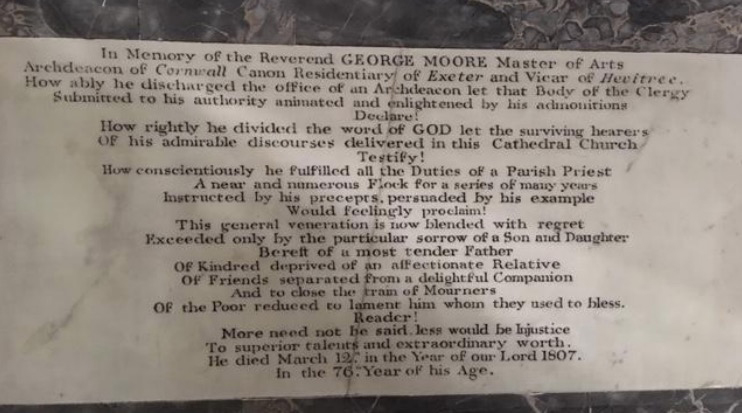
Reverend George Moore (c.1731–1807) was one of the senior clergy of the Diocese of Exeter during the late eighteenth century, serving as Archdeacon of Cornwall for nineteen years and holding several influential cathedral appointments. His memorial in Exeter Cathedral presents him as the ideal Anglican churchman: a capable administrator, a persuasive preacher and a parish priest whose flock, it claimed, would “feelingly proclaim” his virtues. The inscription, unusually expansive for the period, reflects the high regard in which he was held by colleagues, parishioners and family alike.
Moore was educated at Sidney Sussex College, Cambridge, where he took his Master of Arts degree. Little survives about his early life, but by the 1760s he was firmly established in the diocese. In 1770 he preached a charity sermon in Exeter Cathedral before the governors of the Devon and Exeter Hospital, advocating support for the infirmary founded three decades earlier. His rise within the cathedral chapter was steady: he became a prebendary in 1769 and a canon residentiary in 1776, giving him a central role in the governance of the cathedral and its finances.
His most significant appointment came in 1788 when he was collated as Archdeacon of Cornwall. The archdeaconry, which remained part of the Diocese of Exeter until 1877, covered a vast and often remote region. Moore’s duties included visitations, the inspection of church fabric, the enforcement of clerical discipline and the administration of church courts. His tenure coincided with the rapid spread of Methodism in Cornwall, a movement that challenged the authority of the established church. Moore’s role required him to uphold Anglican order in a county where mining communities and itinerant preachers were reshaping religious life.
Fragments of his administrative work survive in diocesan archives. In 1797 he officiated in probate proceedings relating to the estate of Anthony Vian of Mevagissey, binding administrators to ensure proper execution of the will. In 1801 he delivered a printed visitation charge addressing the duties of clergy and the need for pastoral diligence. He also represented the clergy of Cornwall in the Convocation of Canterbury in 1806–07. These glimpses suggest a capable and respected administrator, though the surviving record is too thin to reconstruct his work in detail.
Moore died on 12 March 1807 at the age of seventy‑six and was buried six days later in Heavitree Church, where he had served as vicar. His cathedral memorial records the grief of “a Son and Daughter bereft of a most tender Father”, confirming that two of his children survived him. His daughter, Charlotte Moore (1773–1872), lived to the remarkable age of ninety‑nine and is buried at Mount Ebford in Woodbury.
His son, also named George Moore, became the later Rector of Sowton and is buried in the Moore family vault in Sowton Church. The Sowton vault also contains a second Charlotte — the Rector’s eldest daughter — whose memorial describes her simply as “daughter of the Rev. George Moore”. She is buried beside her brother, forming the next generation of the Moore family. The presence of two Charlottes, one the Archdeacon’s daughter and the other his granddaughter, has caused occasional confusion, but the inscriptions make the generational structure clear.
Moore’s legacy is difficult to assess in detail, largely because the surviving documentation is sparse. He appears in the standard clerical directories and in the Fasti Ecclesiae Anglicanae, but without extended commentary. His career belongs to the generation before the evangelical and Tractarian movements reshaped the Church of England, and he stands as a representative figure of the Georgian ecclesiastical establishment: dutiful, steady, respected and largely uncontroversial. In Sowton Church, where members of his family are commemorated, his name survives through the vault that contains his descendants and through the long life of his daughter Charlotte, who outlived him by more than sixty years.

