

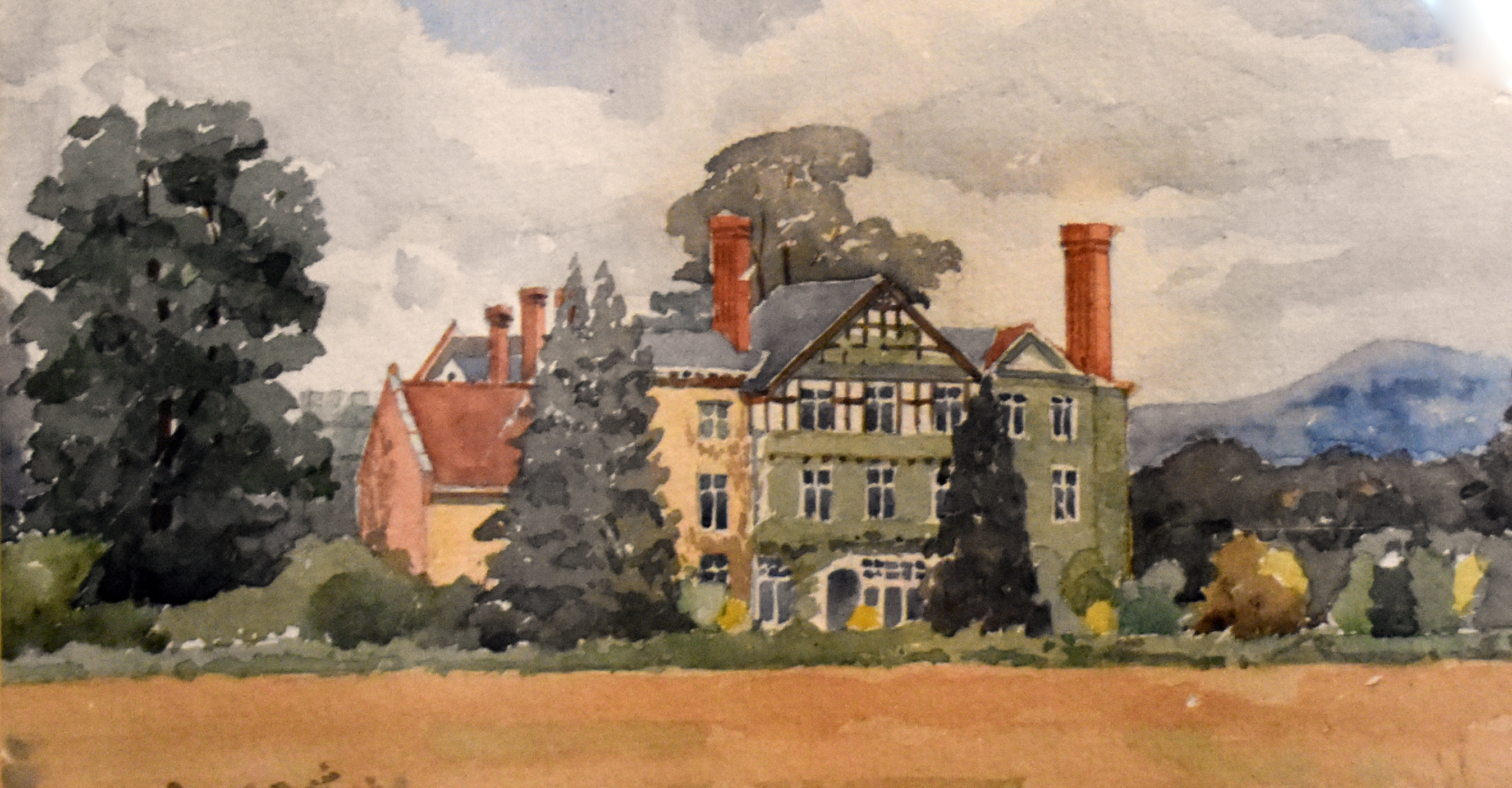
Farringdon House is the principal house of the parish of Farringdon, east of Exeter. The present building is essentially seventeenth‑century in origin, altered in the eighteenth and nineteenth centuries, and associated successively with the Cholwich family, later owners and tenants, and from 1919 with the Putnam family. In the twentieth century it was requisitioned during the Second World War and then used as an approved school for boys and later for girls. Its history can be followed in a continuous line from the late seventeenth century to the later twentieth century.
The documented association with the Cholwich family begins with John Cholwich (1634–1714). He moved to Exeter as a merchant and on 17 November 1674 married Ann Cooke, daughter of John Cooke of Kenbury, Exminster, at St Mary Major, Exeter. In 1675, through the acquaintance of Thomas Hunt of Hams Barton, he acquired a substantial dwelling in the parish of Farringdon, a few miles east of Exeter. His civic career advanced steadily: he became an alderman of Exeter, a deputy lieutenant for Devon in 1701 and a Justice of the Peace. He resided at Farringdon until his death on 3 October 1714. From this point the house remained in Cholwich hands for two further generations.
The line ended with his great‑grandson, John Burridge Cholwich (1752–1835). He was born on 19 September 1752 and baptised at Tiverton on 8 March 1753, the only son of John Cholwich (1718–1753) and Elizabeth Burridge, daughter of Samuel Burridge, a Tiverton woollen merchant. Educated at Tiverton and later at Exeter College, Oxford, he inherited the Oldstone Cholwich estates in the South Hams on the death of his uncle, the Revd Samuel Cholwich, in 1775. In 1776 he contested Exeter as a Whig in a by‑election but was defeated by John Baring (1730–1816) by 659 votes to 558. He served as Sheriff of Devon in 1781 and Mayor of Tiverton in 1800. On 8 February 1777 he married Frances Duntze, daughter of Sir John Duntze of Rockbeare; the marriage produced no heir. She died at Bath in January 1798, aged 39, and was interred at Farringdon. In 1800 he inherited Farringdon House on the death of his uncle William Cholwich (1722–1800) and lived there as a widower for nearly forty years. He died at Farringdon on 14 May 1835 without issue. His memorial tablet, and those of his wife and earlier members of the family, remain in the parish church and mark the end of the Cholwich line at Farringdon.
During the nineteenth century Farringdon House passed out of Cholwich ownership. By the later Victorian period it was associated with Bishop’s Court and occupied by tenants. A key visual record of the house at this stage is a watercolour painted c.1900 by Charles Lovett Gill (b.1880), third son of the Revd Alfred Gill, rector of Farringdon from 1889 to 1911. Gill later practised as an architect and was known as a violin maker and amateur watercolourist. His painting shows the house and its plantations at the turn of the century and is the principal image of Farringdon House before the changes brought by the First World War and the arrival of the Putnams.
The Putnam family background lies in Buckinghamshire. James Putman (later Putnam) was the youngest son of James senior (1832–1900) and Ann Reeves of Aylesbury, married in 1857. The family ran small village workshops making rope and furniture and operated the Rope Walk at Aston Clinton near Aylesbury. The business expanded into Putman Tent Contractors and later included Putman’s Hire and Gunter’s Catering. James was born in 1874 and by the 1891 census, aged 16, was described as a rope maker. In 1901 he appears as a “rope tent and flag manufacturer”. His first wife, Frances Watson, daughter of Alexander Watson, a North Country athletic outfitter, died in 1904, leaving him with a young daughter, Frances Annie (1904–1972).
In 1906 James married Violet Weeden (1878–1963) and they lived at Haydon Hill House, Aylesbury. They farmed and helped run the tenting business, and established Putnam House in Aylesbury as a home for unmarried mothers. James invested in engineering, including Bessemar and later the Cubitt Car Company, which attempted to manufacture motor cars at the former Great Southern Works in Aylesbury between 1919 and 1925. When Cubitt went into receivership in 1925 he lost a substantial sum. By the 1911 census he described himself as a “tent manufacturer and ball furnisher”.
On 6 June 1918 the freehold of Farringdon House, near Exeter, was offered for sale. In 1919 James purchased the estate and moved his family to Devon. The award‑winning Friesian herd from Haydon Hill was brought by train. At its peak the Farringdon estate comprised about 10,000 acres and eight farms. New gates were erected around the estate with white posts bearing the code “JP1919”. Farringdon House was run as a large country house and working farm. There were indoor staff, a nanny and governess, gardeners, chauffeurs, stable hands, farm workers and gamekeepers. The gardens and walled kitchen garden were maintained to a high standard, with neat squares of vegetables, gravel paths, cordon fruit and figs on the walls, and large quantities of soft fruit and asparagus supplying the house and staff.
The internal organisation of the house followed the standard pattern of a large early twentieth‑century country house. The kitchen, separated from the main rooms by green baize doors, was under the control of the cook, assisted by a scullery maid and other helpers. Meals were planned daily with Violet, and the head gardener was instructed what produce to send up from the garden. The pantry was the butler’s domain, with a sink, cupboards and a table for polishing glass and silver. He supervised the laying of the dining table with silver, glass and linen, and the storage of plate in a secure safe. Seating at lunch and dinner followed strict etiquette, with the host and hostess placed at opposite ends of the table and guests arranged by rank and seniority. Telephones, still a relative novelty, were routed through the local exchange, and long‑distance trunk calls were handled by operators who often knew the parties involved. Letter‑writing remained formal, with replies expected to invitations and hospitality.
Horses were central to the Putnams’ life at Farringdon. They bred and trained hunters and Hackneys, and their horses competed nationally. “Park Carnation”, a Hackney, won in Britain and the United States; “Punt Gun” and “Shell of Gold” ran in the Grand National; “Farringdon” was a champion hunter. The family hunted regularly and point‑to‑points were run. Meets were held at Farringdon House, where the butler would bring out a salver of violet buttonholes for the family. The ballroom contained what was said to be the largest sprung dance floor in any country house in Devon and was used for hunt balls and other events.
The house also had an artistic connection. Sir Alfred Munnings, later President of the Royal Academy, stayed at Farringdon to hunt and paint. He produced a miniature of James’s champion bull for Queen Mary’s Dolls’ House at Windsor Castle. James acquired about twenty of Munnings’ paintings of Canadian forestry and war work with heavy horses during the First World War; these were later purchased by Lord Beaverbrook for a Canadian collection commemorating the Canadian war effort.
The economic crash of 1929 forced the sale of many of the Farringdon farms, reducing the estate from its original extent. In 1932 James’s daughter Mary married at Farringdon church and moved abroad. In 1935 the family regularised the spelling of their name from Putman to Putnam to end confusion in business and legal documents. By the late 1930s James and his sons had interests in newspapers, including the Bournemouth Times and Poole and Dorset Herald, and in catering through Gunter’s in Curzon Street, London.
The approach of the Second World War altered the position of Farringdon House. During 1939–1945 the house was requisitioned by the Ministry of Home Security because of its proximity to Exeter Airport. The RAF and Polish Air Force took over the house and grounds. Some personnel arrived before the Putnams had fully vacated the property and initially lived in the stables. The estate was compulsorily purchased with only 90–100 acres and one home farm retained, for a reported £20,000. During the war the house was used for accommodation and operational purposes, and the surrounding land was used for training and encampments. Anti‑aircraft guns and other military installations were sited nearby as part of the wider defensive network around Exeter.
After the war Farringdon House entered a new phase as an approved school. It was first used for boys and later, from 1960, for girls when the Devon and Exeter Training School moved from Exeter and was renamed Farringdon House School. The buildings were adapted for classrooms, dormitories and staff accommodation. Former staff recalled a wall painting of two pilots and a Spitfire in the house, destroyed in a fire that damaged part of the interior. The school continued in use into the later twentieth century before the site was reorganised and the buildings altered again.

